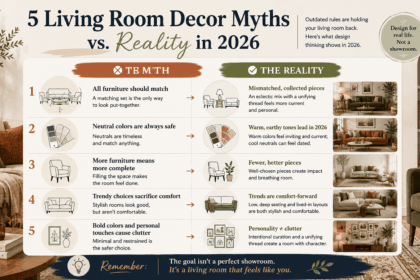


Ask ten people how to decorate a small space, and a lot of the answers trace back to assumptions that never got questioned — small rooms need small furniture, more storage is always the fix, everything should be white to feel bigger. Some of this advice sounds intuitive enough that it rarely gets challenged. In 2026, several of these assumptions are quietly working against the actual goal: a small space that feels calm, open, and genuinely livable rather than cramped or sterile.
- Myth 1: “Small rooms need small furniture to avoid feeling crowded”
- Myth 2: “More storage is always the fix for a small space feeling cluttered”
- Myth 3: “Everything should be white to make a small space feel bigger”
- Myth 4: “A big rug will make a small room feel even smaller by taking up too much floor space”
- Myth 5: “Multifunctional furniture is always the smartest choice in a small space”
- Myth vs. Reality: Quick Reference
- FAQ’s
- Conclusion
Here are five of the most common small-space decor myths, what current design thinking actually shows, and what to do instead.
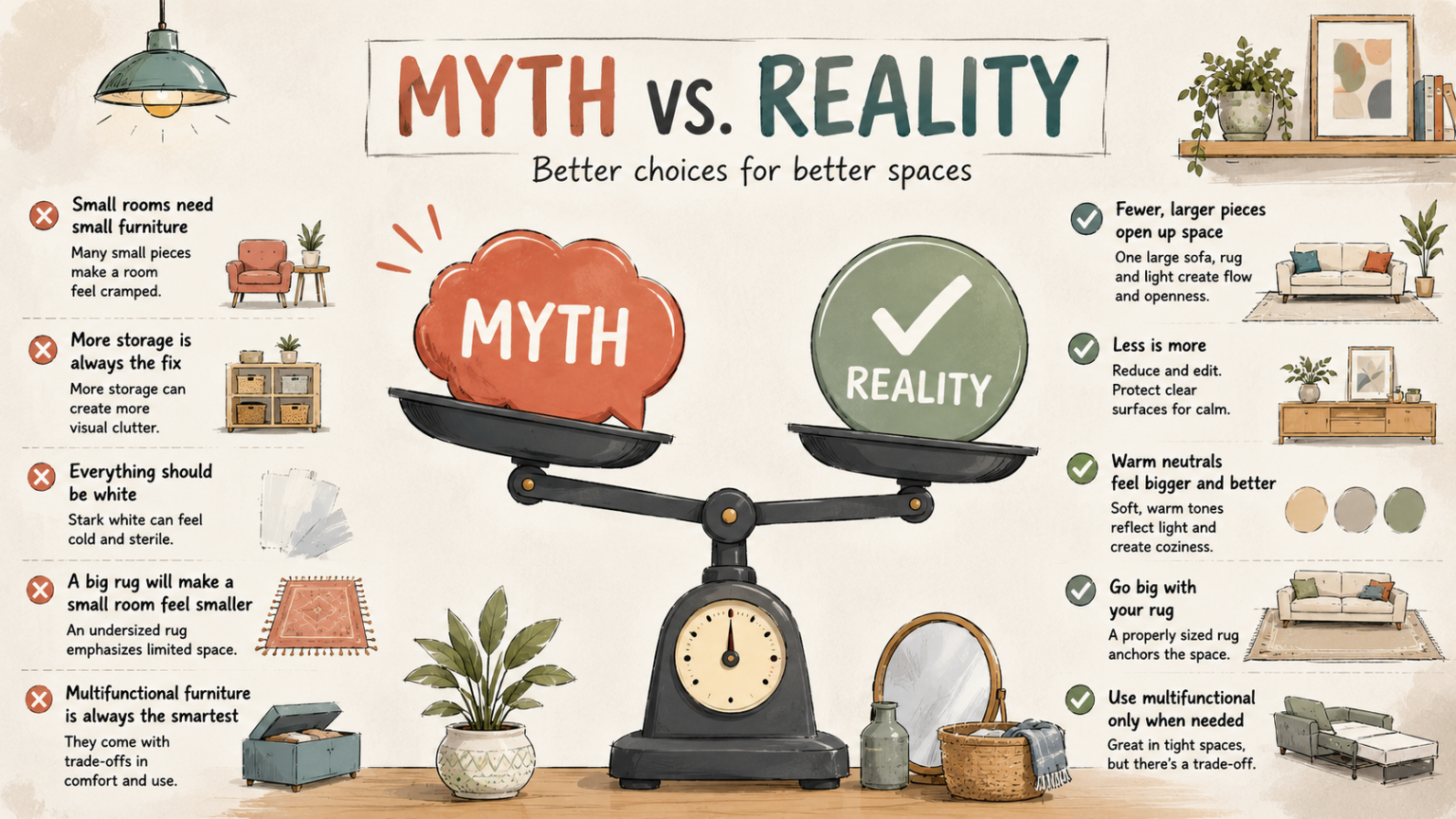
Myth 1: “Small rooms need small furniture to avoid feeling crowded”
The assumption: Filling a compact room with proportionally small furniture — a petite loveseat instead of a full sofa, small side tables instead of one larger piece — is the intuitive way to avoid overwhelming the space.
The reality: This is one of the more counterintuitive findings in small-space design: filling a small room with many smaller items often makes it feel more cramped, not less, because scattered small pieces visually fragment the space. A recent approach favors the opposite — one large sofa, one large rug, one large light fixture — using fewer, bigger pieces that work the walls and floor in a way that makes the whole room feel larger.
What to do instead: Choose an appropriately-scaled sofa, rug, and light fixture for your room’s actual dimensions rather than defaulting to the smallest available option in each category. Fewer, larger, well-chosen pieces generally outperform many small ones.
Myth 2: “More storage is always the fix for a small space feeling cluttered”
The assumption: If a small room feels cluttered or chaotic, the solution is adding more storage — more baskets, more shelving, more organizational systems to contain the stuff.
The reality: The number one small-space decorating mistake is specifically identified as adding more storage, more furniture, and more objects until every surface is occupied. Visual clutter is genuinely more tiring to live with than physical clutter, precisely because you can’t close a door on it — meaning more storage containers, if they’re visible and numerous, can actually add to the visual clutter problem rather than solving it.
What to do instead: Prioritize removing or relocating items over adding new storage solutions, and protect at least one surface as permanently clear. Negative space itself functions as a design element, not just empty room waiting to be filled with an organizational system.
Myth 3: “Everything should be white to make a small space feel bigger”
The assumption: Stark white walls, furniture, and decor are the go-to choice for maximizing the sense of space and light in a small room.
The reality: Light colors do genuinely help a small space feel more open by reflecting available light, but stark white specifically isn’t the only or necessarily the best option. Warm neutrals — a soft greige or warm white rather than cool gray or bright white — achieve the same light-reflecting, expansive benefit while creating a calmer, more inviting feeling than a starker, more clinical white can.
What to do instead: Choose a warm neutral tone over stark white or cool gray for your primary palette, getting the spaciousness benefit of a light color without the cold or sterile feeling that an all-white approach can create.
Myth 4: “A big rug will make a small room feel even smaller by taking up too much floor space”
The assumption: In a small room, a large area rug seems like it would overwhelm the limited floor space, so a smaller rug — or skipping a rug altogether — feels like the safer choice.
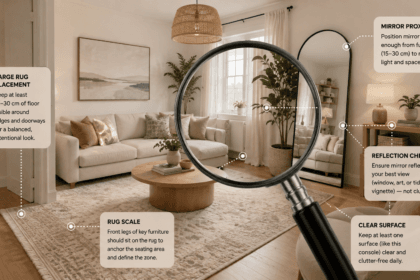
The reality: This runs opposite to how rug sizing actually affects a small room. An undersized rug floating awkwardly in the middle of a small space tends to emphasize how little floor area is available, while a properly sized, larger rug that extends toward the furniture creates a sense of a unified, intentional floor plan — one of the specific reasons designers recommend larger-format rugs (a general guideline being a minimum of roughly 200×300cm) even in compact rooms.
What to do instead: Size your rug to the room and furniture arrangement, not to a mistaken instinct that “smaller room means smaller rug.” An appropriately large rug typically makes a small room feel more finished and spacious, not less.
Myth 5: “Multifunctional furniture is always the smartest choice in a small space”
The assumption: Since multifunctional furniture is a headline recommendation for small spaces, it should always be prioritized over dedicated, single-purpose pieces whenever floor space is limited.
The reality: Multifunctional furniture genuinely reduces floor coverage, by a commonly cited 30–50% compared to single-purpose equivalents, and it’s a strong default in genuinely tight spaces. But it comes with a real trade-off: multifunctional pieces are often somewhat less optimized at each individual function than a dedicated piece would be — a sofa bed rarely matches the comfort of either a dedicated sofa or a dedicated bed. In a small space that isn’t at its absolute floor-space limit, this isn’t automatically the smartest choice if a specific function matters more to you than maximum space savings.
What to do instead: Reserve multifunctional furniture for genuinely space-constrained situations where the floor-space savings clearly outweigh the modest compromise in individual function, rather than defaulting to it universally just because it’s the headline small-space recommendation.
Myth vs. Reality: Quick Reference
| Myth | Reality |
|---|---|
| Small rooms need small furniture | Fewer, larger pieces often make a small room feel bigger than many small ones |
| More storage is always the clutter fix | Removing items and protecting clear surfaces beats adding more storage containers |
| Everything should be white | Warm neutrals achieve the same spaciousness with a calmer, less clinical feel |
| A big rug will overwhelm a small room | An undersized rug emphasizes limited space; a properly large rug unifies it |
| Multifunctional furniture is always smartest | Worth it in genuinely tight spaces; a real function trade-off in more flexible ones |
FAQ’s
If fewer, larger pieces work better, does that mean I should avoid buying any small decor items?
Not entirely — small textured accents (pillows, a pendant shade, woven baskets) still have a place for adding personality. The “go bigger” principle applies specifically to your key anchor pieces (sofa, rug, main light fixture), not every single item in the room.
How do I know if my current storage situation is adding to clutter rather than solving it?
If storage containers themselves are visible and numerous across multiple surfaces, they’re likely contributing to visual clutter. Consolidating into fewer, larger storage pieces (ideally with closed rather than open fronts) usually helps more than adding another basket or organizer.
Is a warm neutral palette a good choice for every small space, or are there exceptions?
It’s a strong general default, but a small space with excellent natural light and a specific design vision might successfully use a bolder palette on select accent elements. The warm-neutral recommendation applies most strongly to primary walls and larger furniture pieces.
How do I figure out the right rug size if my room is small?
As a general guideline, size the rug to extend under or near your key furniture pieces rather than floating in open floor space — a common minimum reference point for a living area is around 200×300cm, even in a compact room, though exact sizing depends on your specific furniture arrangement.
Conclusion
None of these five myths are unreasonable on their face — they’re mostly intuitive-sounding assumptions that don’t hold up once tested against how small spaces actually read and function. The pattern across all five: bigger, fewer, warmer, and more intentional consistently outperforms smaller, more numerous, starker, and more reflexive choices in a genuinely compact room. Test these assumptions against your own space before defaulting to what seems obvious, and you’ll likely find the counterintuitive choice is the one that actually makes the room feel bigger and calmer to live in.
Design trends, product availability, and pricing for home decor items change frequently. This article reflects general design guidance current at the time of publication; always assess your own space, budget, and personal style before making purchasing or renovation decisions.