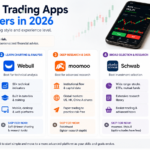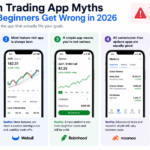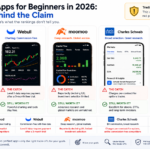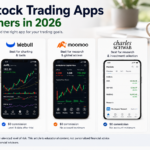


Most people don’t download a new trading app because they saw an ad — they download one because their current setup is creating a specific frustration. The interface feels overwhelming before they’ve even placed a trade. They want to actually understand charts, not just guess. Options fees are eating into small trades. Most app roundups skip straight to feature comparisons without asking the more useful question first:
- Problem 1: “Every trading app I’ve opened feels overwhelming before I’ve even placed a trade”
- Problem 2: “I actually want to understand charts and technical analysis, not just guess”
- Problem 3: “Options fees are eating into my smaller trades”
- Problem 4: “I want exposure to international markets, not just US stocks”
- Problem 5: “I want to trade on my own but still have someone to ask when I’m unsure”
- Matching Problems to Apps: Quick Reference
- A Word on Solving More Than One Problem at Once
- FAQ’s
- Conclusion
What’s actually the problem you’re trying to solve?
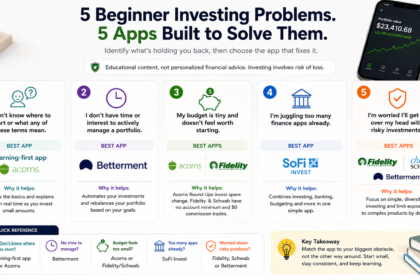
Here are five common beginner trading problems in 2026, and the specific apps built to solve each one.
Reminder: trading carries real, elevated risk, and this is educational content, not personalized financial advice.
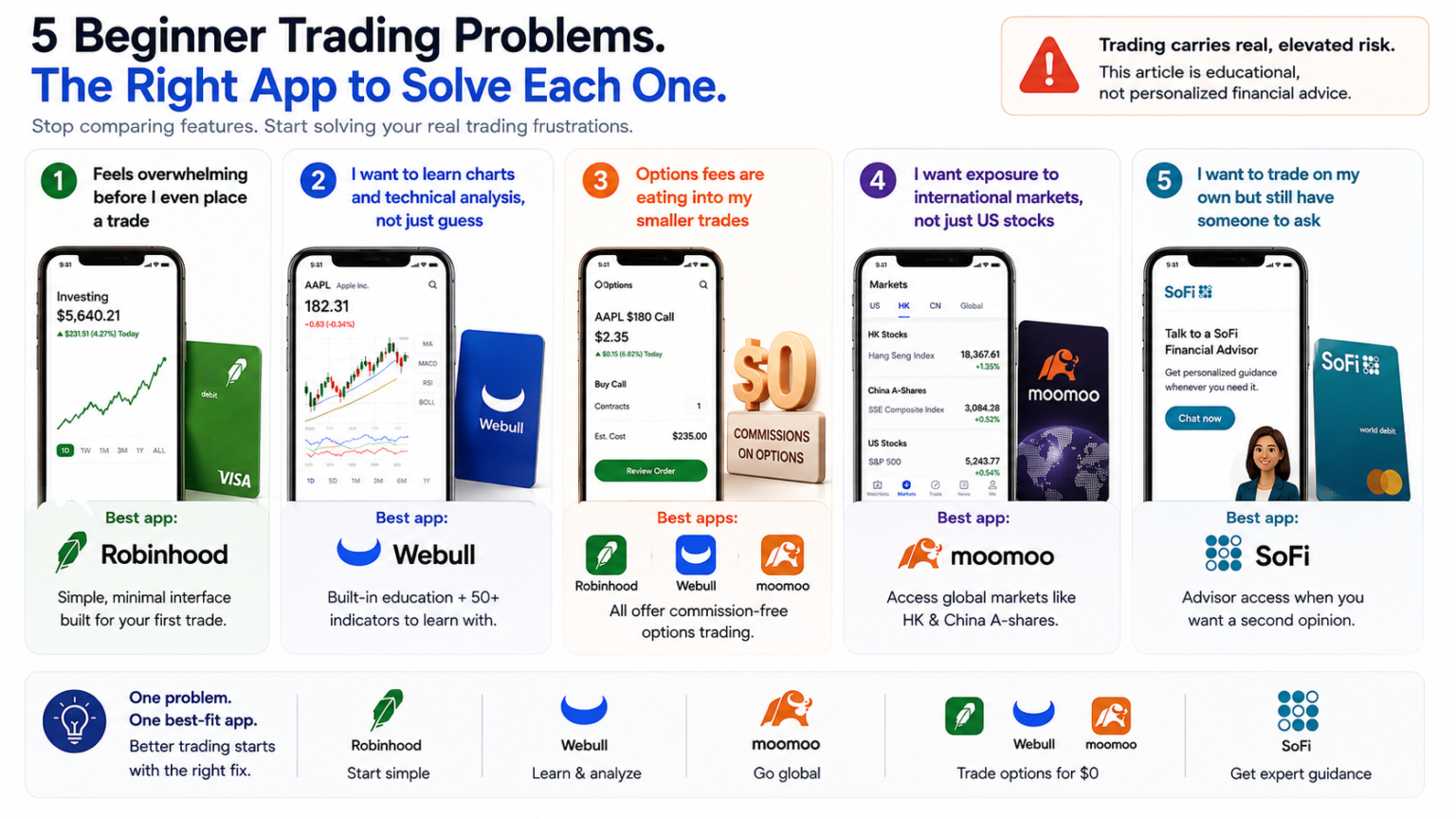
Problem 1: “Every trading app I’ve opened feels overwhelming before I’ve even placed a trade”
If dense charts, technical jargon, and cluttered dashboards are making you hesitate before you’ve even started, the fix is a platform specifically built around minimizing that friction for a genuine first trade.
The right app: Robinhood. Its straightforward, minimalist mobile interface is widely regarded as a strong fit specifically for brand-new traders getting involved for the first time, without the dense charting panels or research libraries that can make other platforms feel intimidating on day one.
Where it falls short: Once you’re past your first several trades and want to understand more about why a stock is moving, Robinhood’s market information isn’t as robust as more research-focused competitors — the simplicity that solves your initial overwhelm becomes a limitation once you’re ready for more depth.
Problem 2: “I actually want to understand charts and technical analysis, not just guess”
If you’re trading based on gut feeling or headlines alone and want to start reading price action and indicators properly, the fix is a platform with built-in education specifically designed to teach you as you go.
The right app: Webull. Its built-in training and educational content includes step-by-step tutorials for strategies like options trading, paired with 50+ technical indicators (moving averages, MACD, RSI, Bollinger Bands) that give you real tools to practice reading charts with actual guidance, not just a blank chart and hope.
Where it falls short: Webull’s free Level II market data — useful for traders who want to see deeper order-book detail — only lasts for an initial three-month trial before requiring a subscription, so factor that into your longer-term learning plan if you find yourself relying on it.
Problem 3: “Options fees are eating into my smaller trades”
If you’re trading options in modest sizes and a per-contract fee feels disproportionately expensive relative to your trade size, the fix is choosing a platform that doesn’t charge for options at all.
The right app: Robinhood, Webull, or moomoo. All three offer commission-free options trading, a genuine cost advantage over platforms that charge per contract — meaningful specifically for beginners trading smaller position sizes where a per-contract fee represents a larger percentage of the trade.
Where it falls short: Commission-free options trading doesn’t mean options trading itself is low-risk — options are inherently more complex and volatile than basic stock trading, and the absence of a commission fee shouldn’t be mistaken for the absence of real financial risk.
Problem 4: “I want exposure to international markets, not just US stocks”
If your interest extends beyond US-listed companies — say, into Hong Kong or China A-shares markets — a US-only platform simply won’t give you access, regardless of how good its other features are.
The right app: moomoo. It specifically offers access to global markets, including Hong Kong and China A-shares, from a single account, alongside instant currency exchange within the app — a genuinely distinctive feature among beginner-accessible US trading apps.
Where it falls short: That same global access and research depth can feel like more complexity than a true first-time trader needs, and at least one direct comparison notes a reportedly declining user experience — worth weighing against the specific value of the international access you’re seeking.
Problem 5: “I want to trade on my own but still have someone to ask when I’m unsure”
If fully self-directed trading feels isolating and you’d rather have occasional access to a human perspective without giving up control of your own decisions, the fix is a platform that builds that access directly in.
The right app: SoFi. Its financial advisor access is a genuinely distinctive perk among primarily self-directed trading apps, letting you make your own trades while having a professional resource available when you want a second opinion.
Where it falls short: SoFi’s self-directed toolset is comparatively thinner — it doesn’t offer basket trading and has a thinner research library than platforms like Schwab or moomoo — so the advisor access is offsetting some real gaps rather than adding to an equally deep self-directed experience.
Matching Problems to Apps: Quick Reference
| Your Problem | Best-Fit App | Not the Right Fit For |
|---|---|---|
| Feeling overwhelmed before a first trade | Robinhood | Anyone wanting deep research immediately |
| Wanting to learn charts and technical analysis | Webull | Anyone avoiding any future data subscription cost |
| Options fees eating into small trades | Robinhood, Webull, or moomoo | Anyone prioritizing Schwab’s broader research despite its options fee |
| Wanting international market access | moomoo | Anyone prioritizing the smoothest possible interface |
| Wanting self-directed trading + advisor access | SoFi | Anyone needing deep self-directed research tools too |
A Word on Solving More Than One Problem at Once
It’s tempting to look for one app that solves every beginner trading frustration simultaneously — simplicity, deep education, zero options fees, global access, and advisor guidance all at once. In practice, the apps above are strong specifically because they were built around a particular priority, and no single platform in this list combines all five strengths equally well. Identify which problem is genuinely the biggest obstacle in your current trading experience, and start there.
FAQ’s
What if I feel overwhelmed but also specifically want to trade international markets?
Consider starting with a simpler US-focused app like Robinhood to build basic comfort with trading mechanics, then evaluate moomoo once you’re ready to take on both the added complexity and the international access it offers.
Is commission-free options trading actually a meaningful cost savings for a beginner?
Yes, specifically for beginners trading smaller position sizes, where a flat per-contract fee (like Schwab charges) represents a larger percentage of the total trade compared to a larger, more experienced trader’s position size.
Can I get both deep research and advisor access on the same platform?
Not fully, based on current comparisons — SoFi offers advisor access but a thinner research library, while research-heavy platforms like Schwab and moomoo don’t offer the same built-in advisor access, so you may need to choose which priority matters more or use more than one resource.
Is moomoo worth the reportedly declining user experience for its international market access?
It depends on how much you specifically value that access — if Hong Kong or China A-shares exposure genuinely matters to your strategy, the trade-off may be worth it; if you’re only trading US stocks, a more consistently praised platform like Webull may serve you better.
Conclusion
The fastest way to end up frustrated with a trading app is choosing based on general reputation rather than the specific problem you’re actually trying to solve. Match the app to what’s genuinely bothering you — feeling overwhelmed, wanting to learn charts, options fees, lack of international access, or wanting occasional advisor guidance — and you’ll get a platform that actually fits your trading approach, not just one that topped a generic best-of list. And regardless of which app you choose, remember that trading carries real, elevated risk.
This article is for informational and educational purposes only and does not constitute financial, investment, or tax advice. The authors are not licensed financial advisors. Trading and investing involve risk, including the potential loss of principal, and past performance does not guarantee future results. Fees, features, and account terms change frequently and may have been updated since this article was published — always verify current details directly on each provider’s official website, and consider consulting a qualified financial professional before making trading or investment decisions.