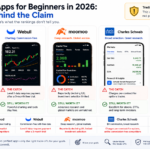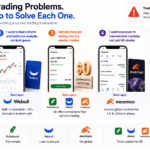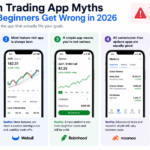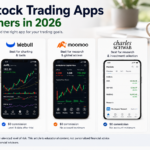


Most “best stock trading apps for beginners” lists rank every app as if all beginners want the same experience, as if someone placing their first-ever trade has the same needs as someone who’s read a few books on technical analysis and wants to start applying it. They don’t. Jumping straight into moomoo’s institutional-flow indicators on day one can feel overwhelming if you’ve never bought a share of stock; sticking with Robinhood’s bare-bones interface once you’re ready for real charting tools means you’ll outgrow it fast.
- If You’ve Genuinely Never Placed a Trade Before
- If You’re Ready to Learn Technical Analysis and Charting
- If You Want Deep Research and Institutional-Level Data
- If You Want the Broadest Investment Selection and Research Library
- If You Want Occasional Access to Human Guidance
- Trading Style Quick Reference
- A Note on Growing Into a New Platform
- FAQ’s
- Conclusion
This guide sorts 2026’s best beginner trading apps by trading style and readiness level, so you’re matching the platform to where you actually are.
Quick reminder: trading carries real, elevated risk, and this article is educational, not personalized financial advice.
If You’ve Genuinely Never Placed a Trade Before
If stocks, tickers, and order types are all completely new to you, the fix is a platform built around the absolute minimum friction to place a first trade, without a dense interface competing for your attention.
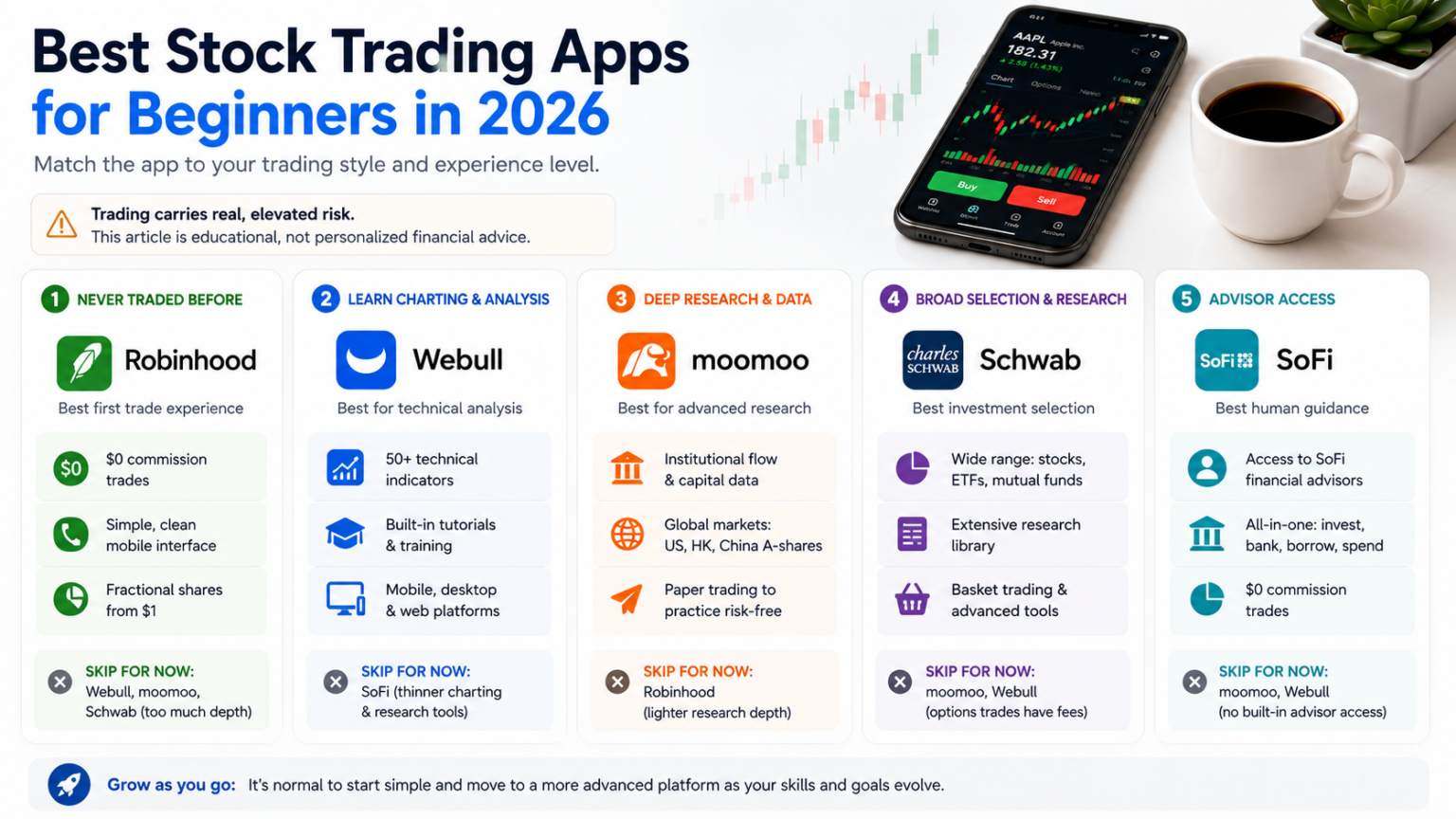
Robinhood is the strongest fit here. Its straightforward, minimalist mobile interface is widely regarded as a good fit for brand-new traders getting involved in trading for the first time, and its commission-free structure means your first trade doesn’t come with an added fee to worry about on top of the trade itself.
Skip for now: Webull, moomoo, and Charles Schwab. All three offer genuinely valuable depth, but that depth is exactly what can overwhelm a true first-timer — dense charting panels, research libraries, and institutional-flow indicators aren’t what you need for your very first trade.
If You’re Ready to Learn Technical Analysis and Charting
If you’ve made a few trades already and want to start understanding charts, indicators, and technical patterns rather than trading on gut feeling alone, a bare-bones interface will start to feel limiting.
Webull is specifically positioned for beginner and intermediate traders who want access to genuine technical analysis and charting tools, backed by built-in training and educational content, including step-by-step tutorials for strategies like options trading. Its 50+ technical indicators (moving averages, MACD, RSI, Bollinger Bands) give you real tools to practice with, without the steepest possible learning curve.
Skip for now: SoFi, if charting depth is your specific priority. It’s a reasonable platform overall, but reviewers note a comparatively thin research library, meaning it doesn’t offer the same charting and technical analysis depth Webull is specifically built around.
If You Want Deep Research and Institutional-Level Data
If you’re the type of trader who wants to understand not just price movement but what’s actually driving it — institutional buying patterns, detailed screening criteria, global market context — a beginner-simple app will feel thin.
moomoo stands out here specifically for its “capital flow” indicators showing institutional versus retail buying activity, alongside 80+ technical indicators and access to global markets (Hong Kong, China A-shares) from a single account — genuinely advanced tools that go beyond what most beginner-focused apps offer.
Skip for now: Robinhood, if research depth is genuinely your priority. Its market information isn’t as robust as moomoo’s or Webull’s, which matters if you specifically want to dig into the “why” behind price movement, not just execute trades quickly.
If You Want the Broadest Investment Selection and Research Library
If your priority is having access to the widest possible range of things to actually invest in — not just active trading tools — alongside a substantial library of third-party research to inform those choices, a narrower trading-focused app won’t cover that need as well.
Charles Schwab delivers a genuinely wide investment selection spanning stocks, ETFs, and mutual funds, alongside a large library of research and analysis tools and a useful basket-trading feature for managing groups of investments together — a strong pick for beginners who want to research thoroughly before committing.
Skip for now: moomoo and Webull, if per-contract options fees aren’t a concern and investment breadth matters more to you than commission-free options — though note Schwab does charge for options trades specifically, a real cost difference from its commission-free competitors.
If You Want Occasional Access to Human Guidance
If part of your hesitation about self-directed trading is not wanting to go completely alone, a purely app-based platform without any human touchpoint may not give you the reassurance you’re looking for.
SoFi stands out specifically for its financial advisor access, a genuinely distinctive perk among primarily self-directed trading apps, letting beginners combine their own trading decisions with occasional professional guidance.
Skip for now: moomoo and Webull, if advisor access is your top priority — both are excellent for self-directed research and technical analysis, but neither offers the built-in human advisor touchpoint SoFi provides.
Trading Style Quick Reference
| Your Style | Recommended App(s) | Skip For This Style |
|---|---|---|
| Never traded before | Robinhood | Webull, moomoo, Schwab (too much depth for a first trade) |
| Ready to learn charting/technical analysis | Webull | SoFi (thinner charting/research tools) |
| Wants deep research and institutional data | moomoo | Robinhood (lighter research depth) |
| Wants broadest investment selection + research | Charles Schwab | moomoo/Webull if avoiding options fees matters more |
| Wants occasional human advisor access | SoFi | moomoo, Webull (no built-in advisor access) |
A Note on Growing Into a New Platform
It’s genuinely common to start with Robinhood for your first few trades and then migrate to Webull or moomoo once you’re ready for charting and research depth — none of these apps require a lifelong commitment, and moving your trading style forward as your knowledge grows is a normal, expected progression rather than a sign you chose wrong the first time.
FAQ’s
Should I start with a simple app like Robinhood even if I eventually want to do technical analysis?
It’s a reasonable approach — starting simple lets you build comfort with the basics of placing trades before adding the complexity of charting and indicators, though you could also start directly with Webull if you’re already comfortable with the fundamentals and specifically want to learn charting from day one.
Is moomoo too advanced for a true beginner?
It can feel that way — one direct comparison notes that for a complete beginner who just wants a simple buy-and-hold portfolio, moomoo’s interface and tool depth can feel busier than necessary, so it may be better suited to beginners who are already comfortable with the basics and want to grow into deeper research.
Do I need a financial advisor if I’m using a self-directed trading app?
Not necessarily, but it’s a reasonable option if you want occasional professional input alongside your own decisions — SoFi is specifically noted for offering this as a distinctive perk among trading apps, though a licensed independent financial advisor is also always an option outside of any single platform.
Is it worth paying more for options trades on Charles Schwab if I want its broader research library?
It depends on how much you’ll actually trade options versus how much you value the research and investment selection — if options trading isn’t a major part of your plan, Schwab’s per-contract fee may matter less than its broader strengths.
Conclusion
The best beginner stock trading app isn’t a single universal answer — someone placing their first-ever trade, someone ready to learn charting, someone who wants deep research, someone prioritizing investment breadth, and someone who wants advisor access are all solving genuinely different problems, even though they’re all shopping in the same “beginner trading app” category. Match the app to where you actually are in your trading journey, and remember that trading carries real, elevated risk regardless of which platform you choose.
This article is for informational and educational purposes only and does not constitute financial, investment, or tax advice. The authors are not licensed financial advisors. Trading and investing involve risk, including the potential loss of principal, and past performance does not guarantee future results. Fees, features, and account terms change frequently and may have been updated since this article was published — always verify current details directly on each provider’s official website, and consider consulting a qualified financial professional before making trading or investment decisions.