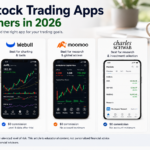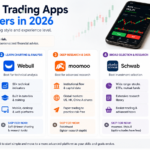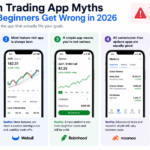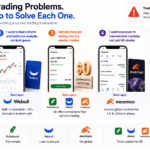


Every “best trading app for beginners” list leads with the same claim: commission-free trades. What most skip is the catch that shows up after the free trial ends, the specific product you want to trade turns out to cost extra, or the app’s user experience has quietly declined since the last time it topped a ranking.
- Robinhood: The Catch Is Thinner Research Behind the Simple Interface
- Webull: The Catch Is the Free Data Has an Expiration Date
- moomoo: The Catch Is a Reportedly Declining User Experience
- Charles Schwab: The Catch Is Options Trading Isn’t Actually Commission-Free
- SoFi: The Catch Is a Thinner Toolset Behind the Advisor Access
- Headline Claim vs. Real Cost or Trade-Off
- FAQ’s
- Conclusion
This guide flips the format. For each app, we lead with the catch, then explain whether it’s still worth using despite it.
As always: trading carries real, elevated risk, and this is educational content, not personalized financial advice.
Robinhood: The Catch Is Thinner Research Behind the Simple Interface
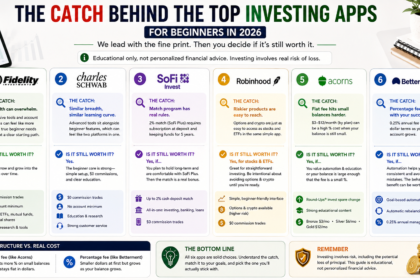
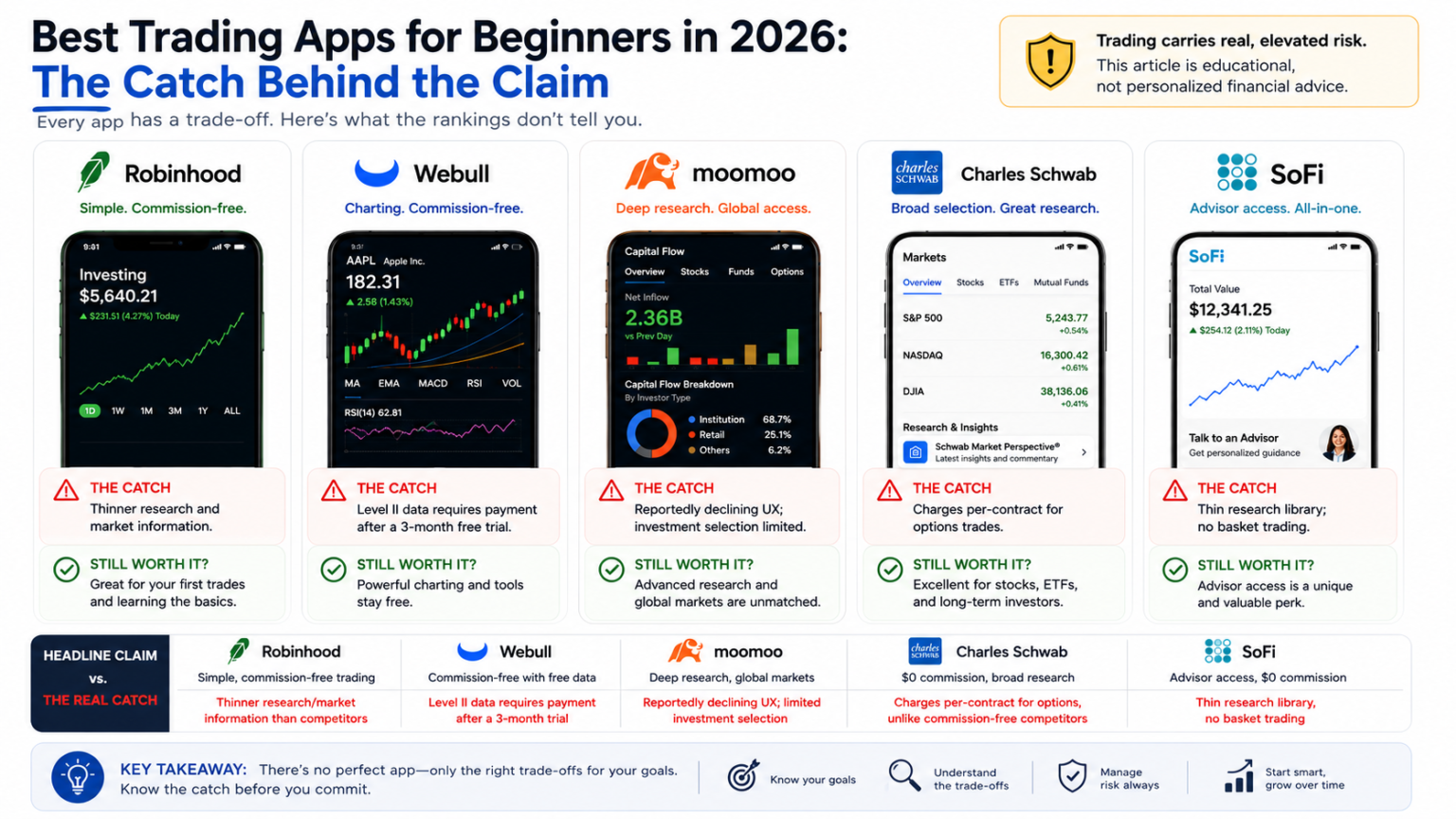
Robinhood’s straightforward, minimalist interface is genuinely one of the easiest ways for a brand-new trader to place a first trade, and its commission-free structure (plus low margin rates) makes it cost-competitive. The catch: that simplicity comes at the expense of research depth — market information available on Robinhood isn’t as robust as what moomoo or Webull offer, meaning you’re trading with less context on why a stock is moving the way it is.
Is it still worth it? Yes, for a genuine first trade or two while you’re building basic comfort with the mechanics of buying and selling. It’s worth planning to supplement with outside research or eventually migrating to a more research-rich platform once you’re ready to dig deeper than Robinhood’s interface supports.
Webull: The Catch Is the Free Data Has an Expiration Date
Webull’s built-in training content and 50+ technical indicators make it a genuinely strong choice for beginners ready to learn charting. The catch: Level II market data — detailed order-book information some traders rely on — is only free for an initial three-month trial, after which it requires a paid subscription, a cost that isn’t always obvious from headline “commission-free” marketing.
Is it still worth it? Yes, for the core charting and technical analysis tools, which remain free indefinitely. Just budget for the Level II data subscription if you find you genuinely rely on it after the trial period ends, rather than assuming all of Webull’s data features stay free forever.
moomoo: The Catch Is a Reportedly Declining User Experience
moomoo’s institutional-grade research tools — including its distinctive “capital flow” indicators — and global market access are genuinely advanced for a beginner-accessible app. The catch: at least one direct comparison notes that testers think the app’s user experience has gone downhill recently, and its investment selection is described as somewhat limited relative to some competitors, despite its research strengths.
Is it still worth it? Yes, if the research depth and global market access specifically matter to you and you’re willing to work through a reportedly less polished interface to get them. If ease of use is your top priority, this specific trade-off is worth weighing against Webull’s more consistently praised usability.
Charles Schwab: The Catch Is Options Trading Isn’t Actually Commission-Free
Charles Schwab’s wide investment selection and substantial research library are genuine strengths, especially for beginners who want to research thoroughly before trading. The catch: Schwab charges a per-contract fee for options trades, a real cost difference from Robinhood, Webull, and moomoo, all of which offer commission-free options trading — a detail easy to miss if you’re comparing platforms primarily on their headline “$0 commission” stock and ETF trading claims.
Is it still worth it? Yes, if your trading is primarily stocks and ETFs, where Schwab’s commission-free structure applies fully. If options trading is a significant part of your plan, factor the per-contract fee into your cost comparison rather than assuming Schwab matches its competitors’ commission-free options pricing.
SoFi: The Catch Is a Thinner Toolset Behind the Advisor Access
SoFi’s financial advisor access is a genuinely distinctive perk among self-directed trading apps. The catch: reviewers specifically note it doesn’t offer basket trading (a feature Schwab includes) and has a comparatively thin research library — meaning the advisor access is offsetting some real gaps in the self-directed toolset, not simply adding a bonus feature on top of an otherwise equally deep platform.
Is it still worth it? Yes, if advisor access is genuinely valuable to you and you don’t need extensive self-directed research tools or basket trading. If you want both strong self-directed research and advisor access, you may find the combination isn’t fully available on any single platform in this list.
Headline Claim vs. Real Cost or Trade-Off
| App | Headline Claim | The Catch |
|---|---|---|
| Robinhood | Simple, commission-free trading | Thinner research/market information than competitors |
| Webull | Commission-free with free data | Level II data requires payment after a 3-month trial |
| moomoo | Deep research, global markets | Reportedly declining user experience; limited investment selection |
| Charles Schwab | $0 commission, broad research | Charges per-contract for options, unlike commission-free competitors |
| SoFi | Advisor access, $0 commission | Thin research library, no basket trading |
FAQ’s
Will I definitely need to pay for Webull’s Level II data eventually?
Not necessarily — many casual and beginner traders find the free core charting tools sufficient without Level II data, which is more relevant for active traders closely watching order-book depth. Only budget for the subscription if you find you’re actively relying on it after the trial ends.
Is moomoo still worth using despite the reported decline in user experience?
It depends on how much you value its specific research strengths (capital flow indicators, global market access) relative to a smoother interface — if those research tools are genuinely important to your trading approach, the trade-off may be worth it; if ease of use matters more, Webull may be the more consistently praised alternative.
Why does Schwab charge for options when its competitors don’t?
Different platforms structure their fees differently based on their overall business model — Schwab’s broader research library and investment selection are strengths that come with a different fee structure specifically for options, which is worth weighing against how much you actually plan to trade options.
Is SoFi worth choosing just for the financial advisor access?
It’s worth considering specifically if human guidance matters to you and you’re comfortable with a thinner self-directed toolset otherwise — if deep research or basket trading are more important to your approach, a platform like Schwab or moomoo may serve you better despite lacking built-in advisor access.
Conclusion
None of these catches make the apps on this list bad choices — Robinhood, Webull, moomoo, Charles Schwab, and SoFi are all genuinely reasonable platforms for beginners, each with real strengths. The difference between a satisfying choice and a frustrating one usually comes down to understanding the specific trade-off behind each platform’s headline strength — thinner research, data subscription costs, declining usability, options fees, or a thinner toolset — before you commit, not after you’ve already started trading.
This article is for informational and educational purposes only and does not constitute financial, investment, or tax advice. The authors are not licensed financial advisors. Trading and investing involve risk, including the potential loss of principal, and past performance does not guarantee future results. Fees, features, and account terms change frequently and may have been updated since this article was published — always verify current details directly on each provider’s official website, and consider consulting a qualified financial professional before making trading or investment decisions.