

Trading stocks yourself, rather than handing the decisions off to a robo-advisor, means picking a platform built around executing trades quickly, understanding what you’re buying, and — ideally — not getting tempted into more complexity than you’re ready for. In 2026, the beginner trading app landscape splits fairly clearly between ultra-simple interfaces built for a first trade and more feature-dense platforms built for traders who want to grow into technical analysis and options.
- Direct Answer: The Best Stock Trading Apps for Beginners at a Glance
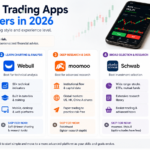
- Robinhood — Best for a Genuinely Simple First Trade
- Webull — Best Beginner-to-Intermediate Charting and Tools
- moomoo — Best for Research Depth and Global Market Access
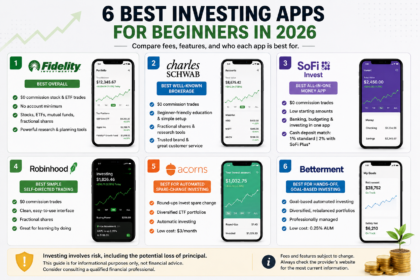
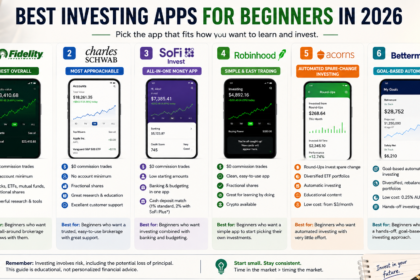
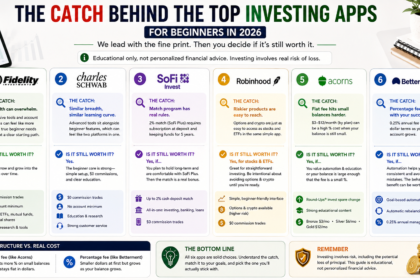
- Charles Schwab — Best Overall Investment Selection and Research Library
- SoFi — Best for Access to a Financial Advisor
- Comparison Table
- How to Choose the Right Trading App for You
- FAQ’s
- Conclusion
This guide compares five stock trading apps that consistently show up as strong 2026 picks for beginners, covering fees, features, and where each one starts to show its limits.
Before you continue: trading comes with an elevated level of risk, and this article is educational content, not personalized financial advice — the authors are not licensed financial advisors.
Direct Answer: The Best Stock Trading Apps for Beginners at a Glance
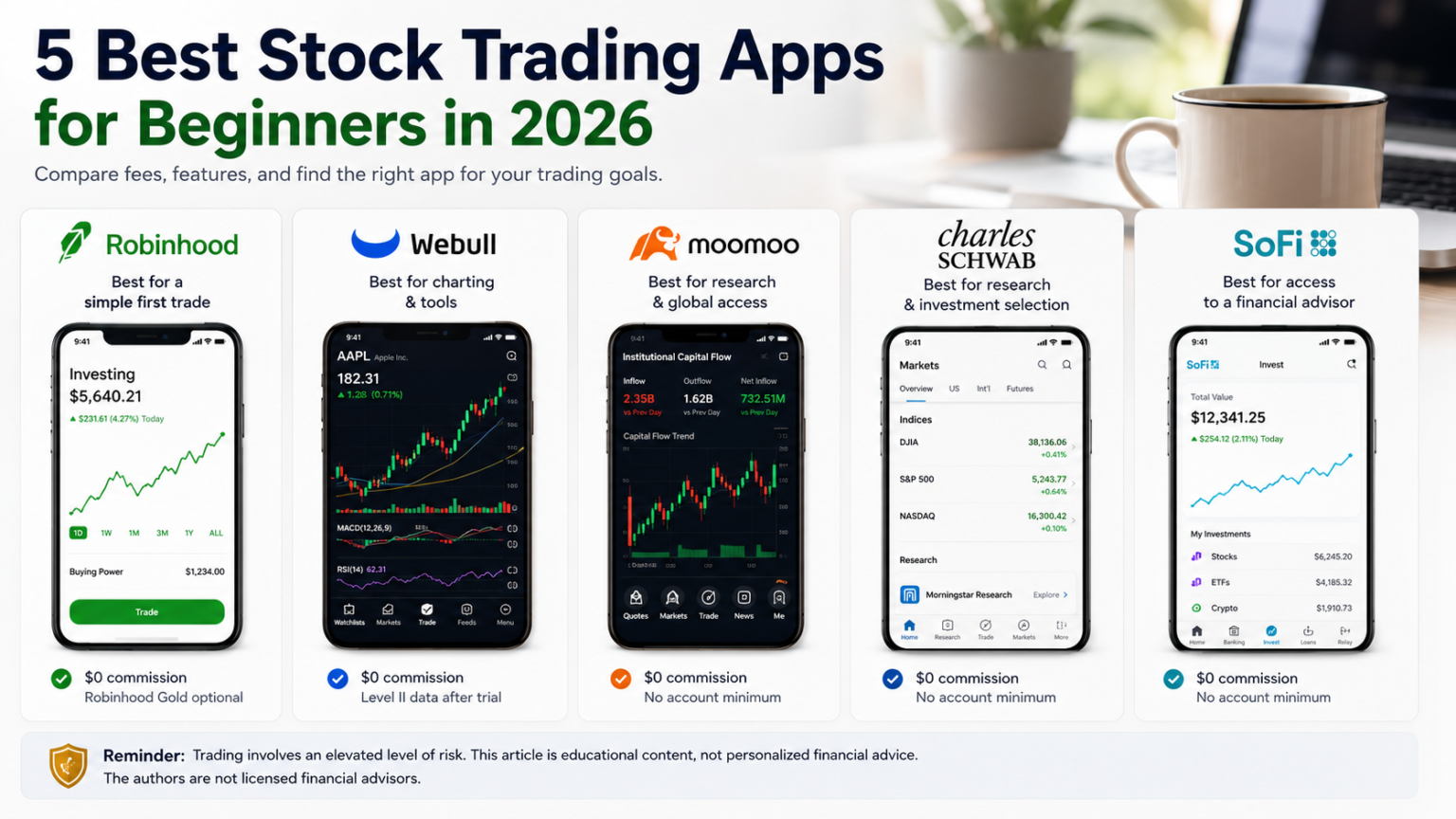
- Best for a genuinely simple first trade: Robinhood
- Best for beginner-to-intermediate charting and tools: Webull
- Best for research depth and global market access: moomoo
- Best overall investment selection and research library: Charles Schwab
- Best for access to a financial advisor: SoFi
Below, we break down what each app actually offers, real costs, and who should look elsewhere.
Robinhood — Best for a Genuinely Simple First Trade
Robinhood’s straightforward platform is widely considered a strong fit specifically for brand-new traders getting involved for the first time, built around a minimalist mobile interface that doesn’t overwhelm with technical indicators or dense research panels.
Key features:
- Commission-free trades on stocks, ETFs, options, and crypto
- Straightforward, uncluttered mobile trading interface
- Fractional share investing starting with small dollar amounts
- Lowest average margin rates among major platforms for the first half of 2026, according to one comparison
Costs: $0 commission on standard trades; Robinhood Gold is an optional paid subscription tier for additional features.
Pros:
- Genuinely one of the easiest entry points for someone placing their first trade ever
- Low margin rates make it a reasonable choice if you eventually explore margin trading
Cons:
- Market information and research depth aren’t as robust as more research-focused competitors like moomoo or Webull
- Its simplicity means easy access to options and crypto sits close to basic stock trading, without as much friction or guardrail for beginners tempted toward complexity early
Webull — Best Beginner-to-Intermediate Charting and Tools
Webull is specifically positioned for beginner and intermediate traders who want access to genuine technical analysis and charting tools without the steep learning curve of a fully professional platform — a strong next step once Robinhood’s simplicity starts to feel limiting.
Key features:
- Commission-free stocks, ETFs, and options trading
- Advanced charting with 50+ technical indicators (moving averages, MACD, RSI, Bollinger Bands, and more)
- Built-in training and educational content, including step-by-step tutorials for strategies like options trading
- Multiple platform options: mobile, desktop, and web
Costs: $0 commission on stocks, ETFs, and options trades; Level II market data requires a subscription after an initial three-month free trial.
Pros:
- Genuinely accessible for new users while still offering the charting depth more advanced traders want
- Free Level II Nasdaq TotalView data (during the trial period) can save $15–$25/month compared to other brokers
Cons:
- Limited OTC stock offering compared to some competitors
- Pays relatively little interest on smaller balances of uninvested cash sitting in the account
moomoo — Best for Research Depth and Global Market Access
For beginners who want to grow into more research-driven trading, moomoo positions itself as a professional-grade trading app with genuinely advanced data and real-time quotes, plus access to markets — including Hong Kong and China A-shares — that most US-focused competitors don’t offer.
Key features:
- Commission-free trading on US stocks, options, ADRs, and ETFs
- 80+ technical indicators, including unique “capital flow” indicators showing institutional versus retail buying activity
- Access to global markets (Hong Kong, China A-shares) from a single account
- Paper-trading feature to practice without using real money
Costs: Commission-free on core US stock, ETF, and options trades; no account minimum.
Pros:
- Genuinely deep research and screening tools, including institutional-flow data that’s uncommon on beginner-accessible platforms
- Paper trading lets true beginners practice strategies risk-free before committing real money
Cons:
- One direct comparison notes its investment selection is somewhat limited relative to some competitors, and its user experience has reportedly declined recently according to some testers
- For a complete beginner who just wants a simple buy-and-hold portfolio, the interface and tool depth can feel busier than necessary
Charles Schwab — Best Overall Investment Selection and Research Library
If you want a genuinely wide investment selection alongside a substantial research library — not just a lean trading interface — Charles Schwab combines a trusted, well-known brand with tools that scale from a beginner’s first trade to more advanced strategies later.
Key features:
- Wide investment selection spanning stocks, ETFs, mutual funds, and more
- Large library of research and analysis tools
- Useful basket-trading feature for managing groups of investments together
- $0 commission on standard stock and ETF trades
Costs: $0 commission on standard equity and ETF trades; charges a per-contract fee for options trades, unlike some commission-free-on-options competitors.
Pros:
- Genuinely broad enough to support a beginner’s growth into more sophisticated research and strategy over time
- Basket-trading feature is a useful, less common tool for managing multiple positions at once
Cons:
- Charges for options trades specifically, a real cost difference compared to Robinhood or Webull’s commission-free options
- Some reviewers note the Android version of its mobile app isn’t as well-regarded as its iOS counterpart
SoFi — Best for Access to a Financial Advisor
SoFi’s brokerage offering includes a genuinely distinctive perk among beginner trading apps: direct access to a financial advisor, a meaningful option for beginners who want occasional human guidance alongside their self-directed trades.
Key features:
- Decent investment selection covering stocks and ETFs
- Access to a financial advisor as part of the platform
- $0 commission on standard trades
- Combines trading with SoFi’s broader personal finance tools (banking, budgeting)
Costs: $0 commission on standard trades; specific terms around advisor access and any premium tiers should be confirmed directly on SoFi’s site.
Pros:
- The financial advisor access is a genuinely distinctive feature among primarily self-directed, app-based trading platforms
- Convenient for beginners who’d rather manage trading alongside everyday banking in one app
Cons:
- Doesn’t offer basket trading, a feature some competitors (like Schwab) include for managing grouped investments
- Reviewers note a comparatively thin research library relative to platforms like Schwab or moomoo
Comparison Table
| App | Best For | Options Trading Cost | Research Depth |
|---|---|---|---|
| Robinhood | Simple first trade | Commission-free | Lighter |
| Webull | Charting and technical analysis | Commission-free | Strong charting, moderate research |
| moomoo | Research depth, global markets | Commission-free | Deep (institutional-flow data) |
| Charles Schwab | Overall investment selection | Per-contract fee | Extensive |
| SoFi | Financial advisor access | Commission-free | Thinner |
How to Choose the Right Trading App for You
Before comparing feature lists line by line, get clear on a few practical priorities:
- Decide how much simplicity you actually want. If you’ve genuinely never traded before, Robinhood’s uncluttered interface removes friction; if you’re ready to start learning charting basics, Webull’s built-in tutorials offer a gentler technical on-ramp.
- Check whether you’ll trade options, and how. Charles Schwab charges per-contract for options, while Robinhood, Webull, and moomoo offer commission-free options trading — a meaningful cost difference if options are part of your plan.
- Consider whether you want occasional human guidance. SoFi’s financial advisor access is a distinctive feature among primarily self-directed apps, worth prioritizing if you don’t want to go fully alone.
- Weigh research depth against interface simplicity. moomoo and Schwab offer genuinely deep research tools, but that same depth can feel like more than a true beginner needs on day one — there’s a real trade-off between simplicity and depth.
FAQ’s
Is Robinhood still a good choice for a genuine beginner in 2026?
Yes, specifically for placing a first trade with minimal friction — its straightforward interface is widely regarded as a strong fit for brand-new traders, though its research tools are lighter than more data-dense competitors.
Do I need to pay for advanced charting tools as a beginner?
Not necessarily — Webull and moomoo both offer substantial charting and technical indicators for free (aside from optional data subscriptions like Webull’s Level II data after its trial period), so you can access real technical analysis tools without a premium platform.
Why does Charles Schwab charge for options trades when other apps don’t?
Pricing structures vary by platform and reflect different business models — Schwab’s per-contract options fee is a real cost difference worth factoring in specifically if options trading is part of your plan, even though its stock and ETF trades are commission-free.
Is it worth choosing an app based on access to a financial advisor?
It can be, if you specifically want occasional professional guidance alongside self-directed trading — SoFi’s advisor access is a distinctive perk not commonly offered by primarily self-directed trading apps like Robinhood or Webull.
Conclusion
There’s no single best stock trading app for every beginner — the right choice depends on how much simplicity you want on day one, whether you plan to trade options, how much research depth matters to you, and whether occasional financial advisor access is a priority. Robinhood remains the simplest genuine starting point, Webull is the strongest next step for learning charting and technical analysis, moomoo offers the deepest research and global market access, Charles Schwab delivers the broadest overall investment selection, and SoFi stands out specifically for its financial advisor access. Whichever you choose, remember that trading carries real, elevated risk, and it’s worth researching thoroughly — or consulting a licensed financial advisor — before committing money you can’t afford to lose.
This article is for informational and educational purposes only and does not constitute financial, investment, or tax advice. The authors are not licensed financial advisors. Trading and investing involve risk, including the potential loss of principal, and past performance does not guarantee future results. Fees, features, and account terms change frequently and may have been updated since this article was published — always verify current details directly on each provider’s official website, and consider consulting a qualified financial professional before making trading or investment decisions.