

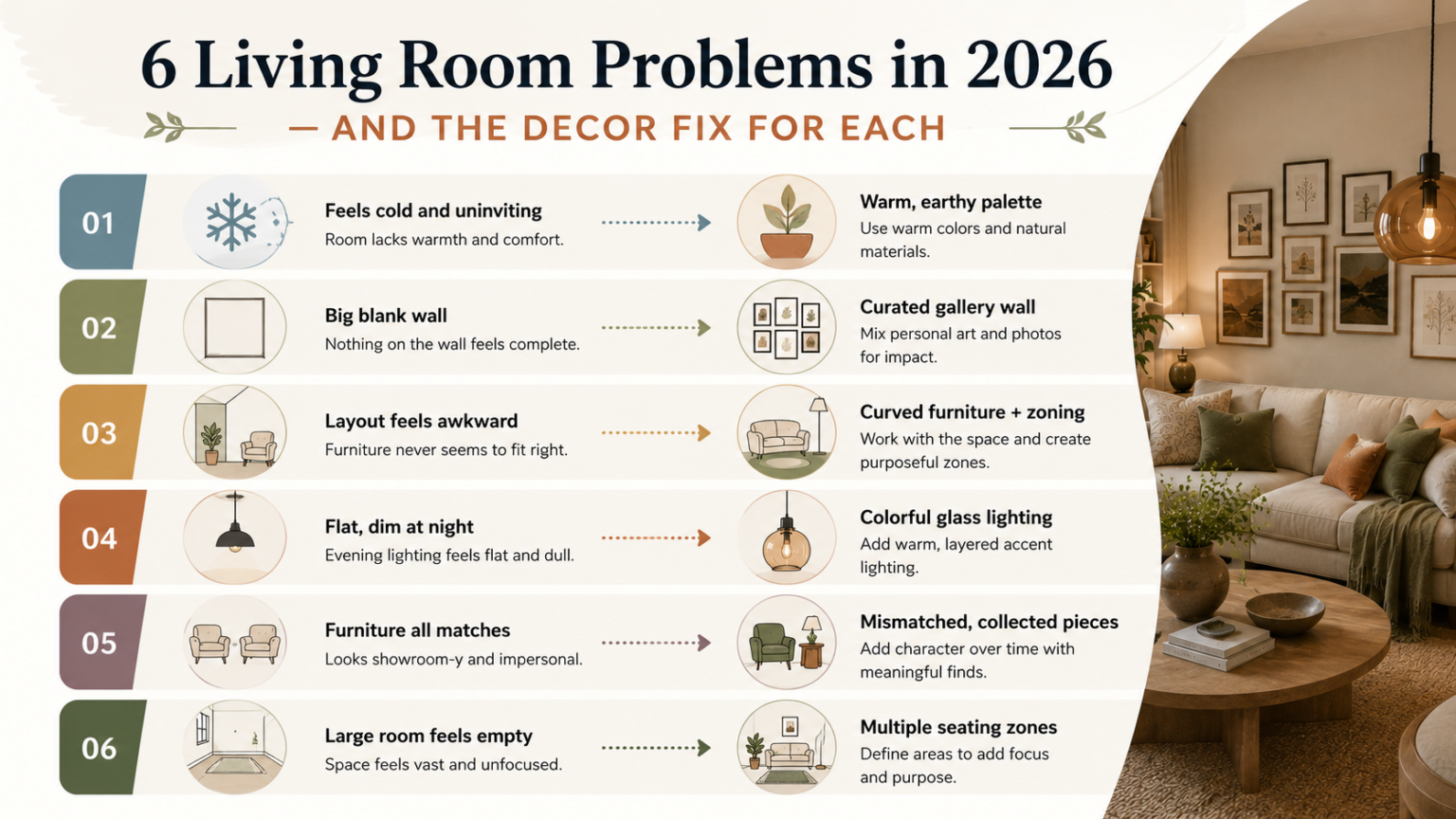
Most people don’t redecorate a living room because they saw a beautiful photo online — they do it because something specific about the room isn’t working. It feels cold and uninviting despite good furniture. A big blank wall has stared back at them for two years. The layout feels awkward no matter how the sofa gets rearranged. Most decor guides jump straight to inspiration photos without asking the more useful question first:
- Problem 1: “My living room feels cold and uninviting, even though the furniture is nice”
- Problem 2: “I have a big blank wall and no idea what to do with it”
- Problem 3: “My living room layout feels awkward no matter how I arrange the furniture”
- Problem 4: “The room looks fine in daylight but feels flat and dim in the evening”
- Problem 5: “My furniture all matches, but the room feels sterile and impersonal, like a showroom”
- Problem 6: “My large living room feels empty and unfocused despite having enough furniture”
- Matching Problems to Decor Fixes: Quick Reference
- A Word on Fixing More Than One Problem at Once
- FAQ’s
- Conclusion
what’s actually bothering you about the room right now?
Here are six common living room problems in 2026, and the specific design ideas built to solve each one.
Problem 1: “My living room feels cold and uninviting, even though the furniture is nice”
If a room technically has good furniture but still feels sterile or unwelcoming, the issue is usually the color palette and material choices working against warmth, rather than the furniture itself.
The right fix: Shift toward 2026’s warm, earthy palette. Soft browns, olive greens, terracotta, and clay tones create a calmer, more inviting feel than the cool grays that dominated the past decade, and pairing them with natural, tactile materials — matte linen, rattan, reclaimed wood — reinforces the warmth rather than undercutting it with glossy, high-shine finishes.
Where it falls short: A full room repaint is a bigger commitment than some people want for a first fix. Start with textiles and artwork in warmer tones before committing to wall color, and check that the effect actually solves the “cold” feeling before going further.
Problem 2: “I have a big blank wall and no idea what to do with it”
A large, unadorned wall is one of the most common living room complaints, and it often sits unaddressed for years because a single piece of art rarely feels like enough to fill the space meaningfully.
The right fix: Build a curated gallery wall. Rather than searching for one oversized piece of art, 2026’s gallery wall trend embraces a mix of personal photographs, smaller artworks, and a few three-dimensional objects, repeating one frame color or material to keep the eclectic mix feeling intentional rather than random.
Where it falls short: A gallery wall involves genuine wall damage from multiple hanging points, and it’s not an instant fix — it’s built gradually from pieces that actually matter to you, which takes longer than buying one large statement piece.
Problem 3: “My living room layout feels awkward no matter how I arrange the furniture”
If moving the sofa around hasn’t solved a nagging sense that the room doesn’t quite work, the actual problem may be an irregular architectural feature — an angled wall, an off-center window, an oddly placed doorway — that standard rectangular furniture arrangements simply don’t accommodate well.
The right fix: Work with the irregularity using curved furniture and deliberate zoning. A curved sofa or rounded coffee table can follow the flow of an angled wall in a way rectangular pieces can’t, and positioning a chair and floor lamp directly into an awkward alcove turns the irregular space into a functional reading nook rather than a permanent problem spot.
Where it falls short: This approach requires accepting that a “standard” furniture arrangement genuinely isn’t the answer for this room — some trial and error with furniture placement around the specific irregularity is usually necessary before landing on what works.
Problem 4: “The room looks fine in daylight but feels flat and dim in the evening”
A room that photographs and looks fine during the day but feels flat once the sun goes down usually has a lighting problem — specifically, relying on a single overhead source rather than layered, varied lighting.
The right fix: Layer in colorful glass accent lighting alongside your primary light source. Amber, cobalt, or emerald glass pendants and lamps cast warm, tinted, ambient light that shifts through the evening, adding genuine visual depth that a single flat overhead light can’t replicate.
Where it falls short: Colored glass fixtures alter color accuracy in the room, so they work best as a supplementary accent alongside neutral lighting, not as the sole light source, especially in areas where you need true-color visibility for tasks.
Problem 5: “My furniture all matches, but the room feels sterile and impersonal, like a showroom”
A perfectly matched furniture set can genuinely feel less inviting than an eclectic mix, precisely because it reads as purchased all at once rather than lived in and collected over time.
The right fix: Introduce mismatched, collected pieces gradually. Swap one piece of the matched set for something with more character — a vintage side table, a handmade lamp, a piece with personal history — and repeat a color or material across the mix to keep it cohesive rather than chaotic.
Where it falls short: This is a gradual process, not a weekend project. Rushing to mismatch everything at once without a unifying thread (a repeated color, material, or shape) risks landing on cluttered rather than curated.
Problem 6: “My large living room feels empty and unfocused despite having enough furniture”
A large room with adequate furniture can still feel cavernous and purposeless if everything is arranged as one undefined, sprawling zone rather than distinct functional areas.
The right fix: Divide the room into multiple deliberate seating zones. Use a rug to anchor a primary conversation area, a second rug or flooring transition to define a reading nook or secondary space, and furniture placement (like turning a sofa’s back toward an adjacent area) to create boundaries without adding walls.
Where it falls short: This fix requires more furniture, rugs, and lighting than a single unified arrangement, which adds real cost — it’s the right solution specifically for rooms large enough to genuinely need the definition, not a universal fix for every size room.
Matching Problems to Decor Fixes: Quick Reference
| Your Problem | Best-Fit Solution | Not the Right Fix For |
|---|---|---|
| Room feels cold despite good furniture | Warm, earthy palette + natural materials | Rooms that are already warm but feel cluttered |
| Big blank wall with no plan | Curated gallery wall | Renters wanting zero wall damage (use removable strips) |
| Layout feels awkward | Curved furniture + zoning around the irregularity | Perfectly rectangular, standard-shaped rooms |
| Flat, dim evening lighting | Colorful glass accent lighting | Rooms needing true-color task lighting as primary light |
| Matched furniture feels sterile | Gradual mismatched, collected pieces | Anyone wanting an instant, one-trip fix |
| Large room feels empty/unfocused | Multiple deliberate seating zones | Small or mid-size rooms without the square footage |
A Word on Fixing More Than One Problem at Once
It’s tempting to address every complaint about a room in a single weekend. In practice, the fixes above work best tackled one at a time, in order of what’s actually bothering you most. A room with both a cold color palette and an awkward layout doesn’t need both fixed simultaneously — start with whichever problem you notice most often day to day, solve it, live with the change for a few weeks, and then reassess whether the second problem still feels as pressing.
FAQ’s
What if my living room has more than one of these problems at once?
Prioritize by daily impact — a cold, uninviting feeling affects the room every single time you use it, while an awkward layout might only bother you occasionally. Fix the most constant irritation first.
Is a full repaint necessary to fix a “cold” feeling room?
Not always — start with textiles, artwork, and smaller accent pieces in warmer tones. If the room still feels cold after that lower-commitment change, a repaint becomes a more justified next step.
How long does it realistically take to build a gallery wall or mismatched furniture collection?
Both are intentionally gradual — designers frame these specifically as collected over time rather than purchased in one trip. Expect months, not a weekend, if you’re doing it in a way that stays personal and meaningful rather than just buying decor to fill space quickly.
Can I test whether colorful glass lighting will actually fix my evening lighting problem before committing?
Yes — start with a single affordable table lamp with a colored glass shade in the area that feels flattest in the evening, rather than committing to a full pendant installation, to see if the effect solves the problem before investing further.
Conclusion
The fastest way to end up frustrated with a living room redecoration is choosing ideas because they looked good in a photo, rather than because they solve the specific thing that’s actually bothering you about the room. Match the fix to the real problem — a cold palette, a blank wall, an awkward layout, flat lighting, a sterile matched look, or an unfocused large space — and you’ll get a room that genuinely feels better to live in, not just one that photographs well.
Design trends, product availability, and pricing for home decor items change frequently. This article reflects general design guidance current at the time of publication; always assess your own space, budget, and personal style before making purchasing or renovation decisions.