

Ask ten people what makes a “good” fitness smartwatch, and a lot of the answers trace back to assumptions nobody’s actually tested — the most expensive watch is always the most accurate, you need a Garmin to train seriously, battery life is the single most important spec. Some of this thinking made more sense a few years ago, before the category diversified so heavily by brand and use case. In 2026, several of these assumptions are quietly steering people toward overspending or picking a device that doesn’t match how they’ll actually train.
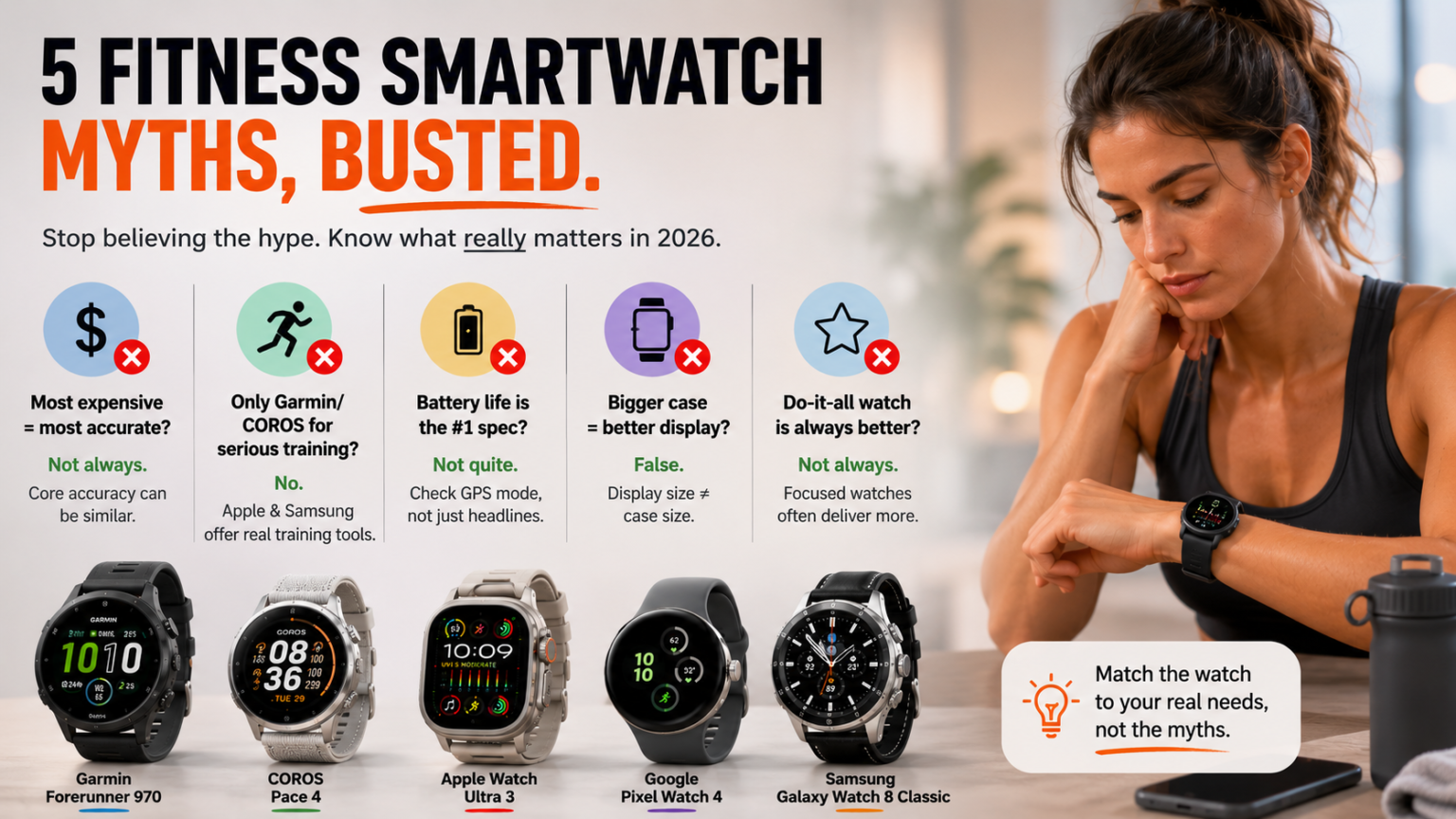
- Myth 1: “The most expensive watch is always the most accurate”
- Myth 2: “You need a dedicated Garmin or COROS watch to train seriously”
- Myth 3: “Battery life is the single most important spec to compare”
- Myth 4: “A bigger case size always means a better display and more features”
- Myth 5: “A do-it-all watch is always better than a specialized one”
- Myth vs. Reality: Quick Reference
- FAQ’s
- Conclusion
Here are five of the most common fitness smartwatch myths, what current reviews actually show, and what to do instead.
Myth 1: “The most expensive watch is always the most accurate”
The assumption: Since the Garmin Forerunner 970 costs $749 and the COROS Pace 4 costs $249, the pricier watch must deliver meaningfully more accurate GPS and heart rate data across the board.
The reality: Direct head-to-head testing during real races found both watches performed well for GPS, heart rate, and race prediction accuracy — the Forerunner 970 offers more in terms of training features, offline maps, and a more robust design, but reviewers specifically rate the Pace 4 as the best value option precisely because its core accuracy holds up against a watch three times its price.
What to do instead: Separate “more accurate” from “more feature-rich” when comparing price tiers. A cheaper watch can deliver comparable core accuracy while a pricier one adds depth in secondary features like mapping and battery life, not necessarily raw precision.
Myth 2: “You need a dedicated Garmin or COROS watch to train seriously”
The assumption: Since Garmin and COROS dominate the “serious training” conversation, a general smartwatch like an Apple Watch or Galaxy Watch can’t genuinely support structured training.
The reality: The Apple Watch Ultra 3 is specifically noted as offering the strongest balance between fitness tracking and smartwatch features for iPhone users, and the Samsung Galaxy Watch 8 Classic includes genuine training tools like Samsung’s Running Coach, described as comprehensive and encouraging for beginners and the marathon-curious alike. Serious training support isn’t exclusive to sports-first brands anymore.
What to do instead: Evaluate general smartwatches on their actual training feature set rather than dismissing them by brand category — the gap between “smartwatch” and “sports watch” has narrowed considerably, even if dedicated sports watches still lead on battery life and endurance-specific depth.
Myth 3: “Battery life is the single most important spec to compare”
The assumption: Since battery life numbers are prominently advertised and easy to compare, the watch with the highest battery life rating is the best overall choice for fitness use.
The reality: Battery life numbers can be misleading without context — the Apple Watch Ultra 3’s roughly 35-hour battery life in smartwatch mode drops to about 12 hours in GPS tracking mode, a dramatically different number that matters more for actual workout use. Meanwhile, a watch with lower headline battery life but better-suited features (like the Garmin Venu 4’s Training Readiness score or the Galaxy Watch 8 Classic’s comprehensive health metrics) may serve your actual training needs better than raw hours alone would suggest.
What to do instead: Check battery life specifically in the mode you’ll actually use most (GPS tracking versus general smartwatch mode) rather than comparing headline numbers that may reflect a mode you rarely use.
Myth 4: “A bigger case size always means a better display and more features”
The assumption: Since the Samsung Galaxy Watch 8 Classic’s 46mm case is larger than the Google Pixel Watch 4’s size options, it must offer a correspondingly bigger or better display.
The reality: This is directly contradicted by a side-by-side comparison: the Galaxy Watch 8 Classic’s larger 46mm case actually has a smaller display (1.34 inches) than the Pixel Watch 4’s 45mm option, because the Classic’s rotating bezel and squircle chassis consume more of the case’s surface area. A bigger watch body doesn’t automatically translate to a bigger or better screen.
What to do instead: Compare actual display specifications (screen size, resolution, brightness) directly rather than assuming a larger case size correlates with a larger or superior display.
Myth 5: “A do-it-all watch is always better than a specialized one”
The assumption: A watch that combines fitness tracking, smart features, payments, and apps into one device is inherently a smarter purchase than a more narrowly focused sports watch.
The reality: The COROS Pace 4 is explicitly not a do-it-all device, yet it’s specifically praised as delivering exactly what matters for runners without making them pay for features they won’t use — its narrow focus is precisely why it offers such strong value. A broader feature set isn’t automatically better if a meaningful share of those features go unused; it just means a higher price for capability that may not translate into practical benefit for your specific training.
What to do instead: Evaluate whether a watch’s broader functionality actually matches your real needs, rather than assuming more built-in features is inherently the smarter purchase. A focused, specialized device that nails your core use case can outperform a broader one in practical, everyday value.
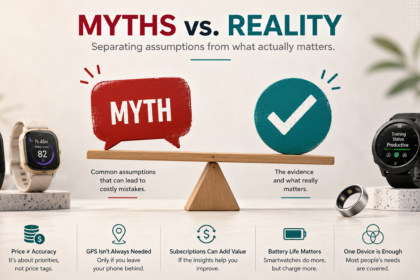
Myth vs. Reality: Quick Reference
| Myth | Reality |
|---|---|
| The most expensive watch is always the most accurate | Core accuracy can be comparable across price tiers; price often buys secondary features |
| Only Garmin/COROS can support serious training | General smartwatches like Apple Watch Ultra 3 and Galaxy Watch 8 Classic now offer real training tools |
| Battery life is the single most important spec | Check battery life specifically in the mode you’ll actually use (GPS vs. smartwatch mode) |
| A bigger case always means a better display | Case size and screen size don’t always correlate — check display specs directly |
| A do-it-all watch is always better than a focused one | A narrowly focused watch can deliver more practical value if you won’t use the extra features |
FAQ’s
How do I know if I actually need a Garmin/COROS-level sports watch, or if a general smartwatch is enough?
Check whether you need long-duration GPS battery life (multi-day hikes, ultramarathons) or highly detailed performance analytics (training load, VO2 max trends) — if not, a well-reviewed general smartwatch with solid fitness features may cover your actual needs.
Should I always check battery life in GPS mode specifically, even for a watch I won’t use for long runs?
It’s still worth checking, since GPS mode battery life is generally a good proxy for how the watch performs during any tracked activity, not just long runs — a large gap between smartwatch-mode and GPS-mode battery life is a useful signal regardless of your typical workout length.
Is it worth paying more for a bigger watch case if I want a bigger screen?
Not necessarily — as the Galaxy Watch 8 Classic and Pixel Watch 4 comparison shows, a larger case doesn’t guarantee a larger display, since design elements like a rotating bezel can reduce the actual screen area within a bigger case.
How do I figure out if I actually need all the features of a premium do-it-all smartwatch?
Review your typical week of activity honestly — if you rarely use apps, payments, or extensive notifications during workouts, a focused sports watch may deliver better value than a broader smartwatch, even if the smartwatch has more total features on paper.
Conclusion
None of these five myths are unreasonable on their face — they’re mostly assumptions that made more sense before the fitness smartwatch category diversified into distinct brands, price tiers, and specialized use cases. The pattern across all five: the right smartwatch decision comes down to your specific training needs and how you’ll actually use the device, not a general rule about price, brand, battery life headlines, case size, or feature breadth. Test these assumptions against your own training habits before defaulting to whichever watch seems most impressive on paper.
Pricing, specifications, and availability for smartwatches change frequently and may have been updated since this article was published. Always verify current pricing and specs directly on the manufacturer’s or retailer’s official website before purchasing. This article is for informational purposes and does not constitute medical advice; consult a healthcare provider for health-related concerns.