

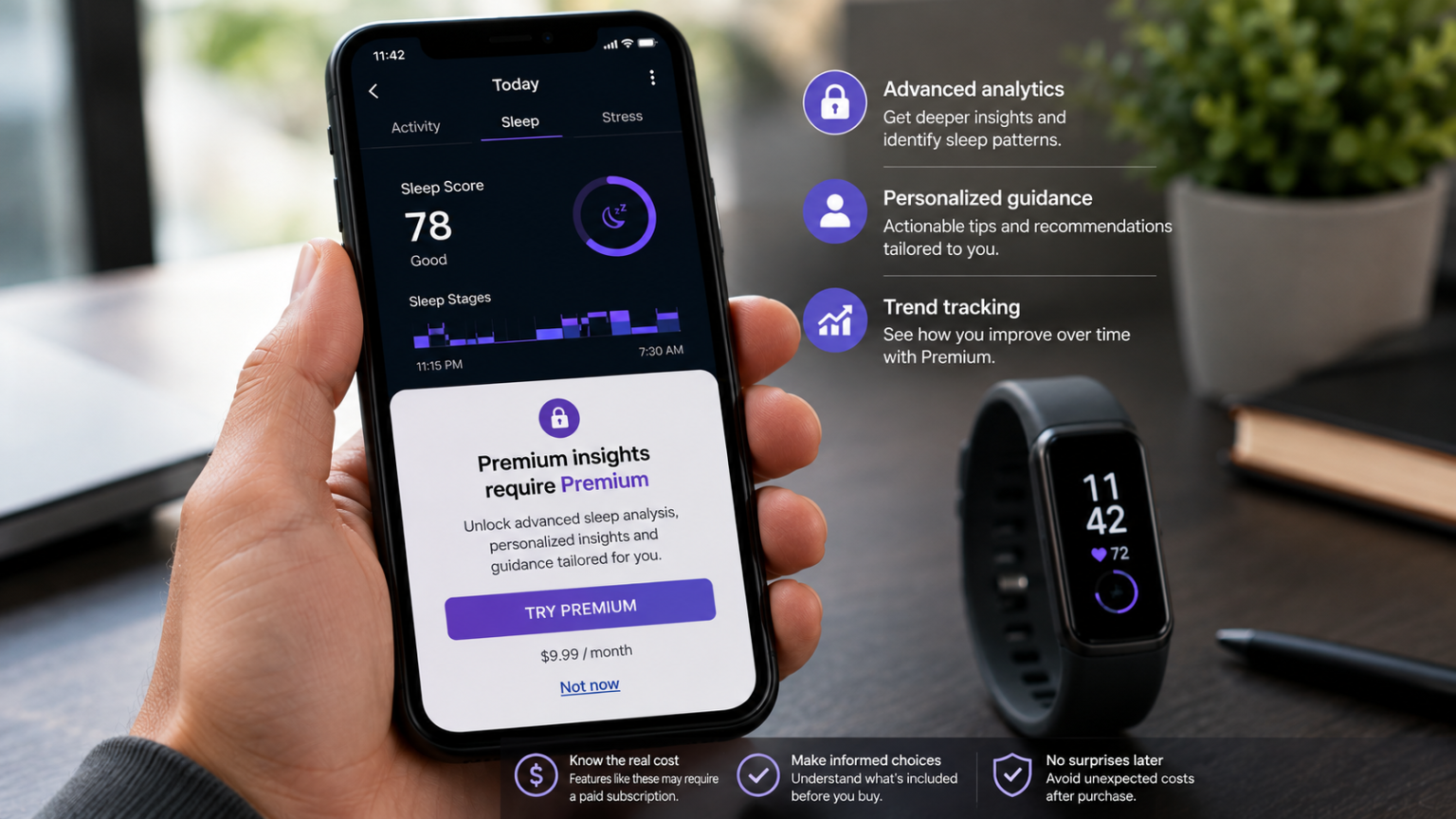
Every “best fitness tracker” list leads with the same headline numbers: battery life, sensor count, starting price. What most skip is the catch that shows up after you’ve already bought the device — a required subscription, a feature paywalled behind a premium tier, or a limitation that only becomes obvious once you’re actually wearing it daily.
- Fitbit Charge 6: The Catch Is the Best Insights Sit Behind a Subscription
- Garmin Vivoactive 6: The Catch Is a Previous-Generation Sensor Despite the Premium Price
- Google Fitbit Air: The Catch Is Phone Dependency for GPS
- Oura Ring 5: The Catch Is a Mandatory Subscription, Not an Optional Add-On
- Apple Watch SE 3: The Catch Is Battery Life That Doesn’t Match Dedicated Trackers
- WHOOP 5.0: The Catch Is There’s No Way to Own the Device Outright
- Headline Price vs. Real Cost of Ownership
- FAQ’s
- Conclusion
This guide flips the format. For each tracker, we lead with the catch, then explain whether it’s still worth the purchase despite it.
Fitbit Charge 6: The Catch Is the Best Insights Sit Behind a Subscription
The Fitbit Charge 6’s headline price — around $159, sometimes discounted to $99 — makes it look like a straightforward one-time purchase, and for basic step counts, heart rate, and sleep stages, it genuinely is. The catch: some of the deeper wellness insights and personalized guidance live behind a paid Fitbit Premium subscription, which isn’t always obvious from the device’s headline pricing alone.
Is it still worth it? Yes, for most everyday users — the core, non-paywalled tracking (steps, basic sleep stages, heart rate, ECG) is genuinely solid on its own. Just don’t assume the full feature set is included with the hardware price if you’re expecting Fitbit’s most detailed insights.
Garmin Vivoactive 6: The Catch Is a Previous-Generation Sensor Despite the Premium Price
At $299–$300, the Garmin Vivoactive 6 is a meaningful step up in price from a basic band, and its long battery life and full activity suite genuinely deliver. The catch: it uses a previous-generation heart rate sensor and lacks dual-band GPS — limitations that matter more in difficult GPS environments (dense cities, tree cover) and for performance-focused runners than for walking, gym sessions, or general daily exercise.
Is it still worth it? Yes, for its actual target audience — people who want a real GPS watch and value long-term subscription-free cost predictability over having Garmin’s absolute latest hardware. If you’re a competitive or performance-focused runner specifically, this is worth knowing before buying, since Garmin does offer more advanced running-specific watches at a higher price point.
Google Fitbit Air: The Catch Is Phone Dependency for GPS
At around $100, the Google Fitbit Air is one of the more affordable trackers on this list, and its screenless simplicity is a genuine selling point for anyone who doesn’t want another display competing for attention. The catch: its screenless design means it relies on your phone for GPS tracking during outdoor activity — a real limitation if you regularly walk, run, or cycle without carrying your phone.
Is it still worth it? Yes, if you typically have your phone with you during activity anyway — which describes most casual walkers and everyday users. If you specifically want to leave your phone at home during workouts and still get route and pace data, this is the wrong tracker for that use case.
Oura Ring 5: The Catch Is a Mandatory Subscription, Not an Optional Add-On
The Oura Ring 5’s $399 upfront price already positions it as a premium purchase, and its comfort for overnight wear is a genuine strength. The catch, stated plainly by reviewers: the $6/month or $70/year membership is non-negotiable if you want to actually use your data — without it, the ring is largely decorative. This isn’t an optional premium tier the way Fitbit Premium is; it’s required for the device to function meaningfully at all.
Is it still worth it? Yes, if sleep and recovery insight is genuinely your priority and you’ve budgeted for the ongoing cost from the start. It’s a poor purchase if you’re expecting a one-time cost the way most other trackers on this list are, since the true cost of ownership is meaningfully higher than the sticker price suggests.
Apple Watch SE 3: The Catch Is Battery Life That Doesn’t Match Dedicated Trackers
The Apple Watch SE 3 offers a genuinely broad smartwatch experience — notifications, apps, payments, fall detection — well beyond what dedicated fitness bands provide. The catch: at roughly 18 hours of battery life, it requires daily charging, a real departure from the multi-day (or multi-week) battery life offered by the Fitbit Charge 6, Garmin Vivoactive 6, or Oura Ring 5.
Is it still worth it? Yes, if the broader smartwatch functionality genuinely matters to you and daily charging is a manageable habit (charging overnight works for many people, though it can conflict with using the watch for sleep tracking). If multi-day battery life without a charging routine is a priority, a dedicated fitness band will serve that specific need better.
WHOOP 5.0: The Catch Is There’s No Way to Own the Device Outright
WHOOP 5.0’s recovery and readiness coaching is genuinely well-regarded for anyone managing structured training load. The catch: WHOOP is subscription-based rather than a single upfront purchase — there’s no option to simply buy the hardware once and use it indefinitely without ongoing payment, a meaningfully different cost structure than every other device on this list.
Is it still worth it? Yes, specifically for people who want ongoing, updated recovery coaching and view the subscription as paying for a service rather than a device. It’s the wrong choice if you’re looking for a one-time purchase you can use for years without further cost, since that option genuinely doesn’t exist with WHOOP’s current model.
Headline Price vs. Real Cost of Ownership
| Tracker | Headline Price | The Catch |
|---|---|---|
| Fitbit Charge 6 | ~$159 (sometimes ~$99) | Deepest insights require a Fitbit Premium subscription |
| Garmin Vivoactive 6 | ~$299–$300 | Previous-gen heart rate sensor, no dual-band GPS |
| Google Fitbit Air | ~$100 | Phone-dependent GPS; can’t track routes without your phone |
| Oura Ring 5 | ~$399 | Mandatory ~$6/mo or $70/yr membership — ring is decorative without it |
| Apple Watch SE 3 | Below Ultra 3’s $799 | Only ~18-hour battery life; daily charging required |
| WHOOP 5.0 | Subscription-only | No one-time purchase option exists at all |
FAQ’s
Which fitness tracker has the lowest true total cost of ownership?
The Garmin Vivoactive 6 and Fitbit Charge 6 (using only its non-Premium features) generally have the lowest long-term cost, since neither requires an ongoing subscription to remain useful — you pay once and keep the core functionality indefinitely.
Is Fitbit Premium worth paying for on top of the Charge 6?
It depends on how deeply you want to engage with your data — the core tracking (steps, heart rate, basic sleep) works without it, so Premium is worth it only if you specifically want more detailed insights and guidance beyond the raw numbers.
Why does Oura require a subscription when other trackers don’t?
Oura’s business model is built around the ongoing membership as the primary way it delivers value — the ring hardware itself is designed to be paired with continuously updated software insights, which is why the company frames the membership as essential rather than optional.
Is it worth buying Apple Watch SE 3 for fitness tracking specifically, given the battery life trade-off?
Only if the broader smartwatch features (notifications, apps, payments) matter enough to offset the daily charging requirement — if fitness tracking alone is your priority, a dedicated tracker with multi-day battery life will likely serve that specific need more conveniently.
Conclusion
None of these catches make the trackers on this list bad purchases — the Fitbit Charge 6, Garmin Vivoactive 6, Google Fitbit Air, Oura Ring 5, Apple Watch SE 3, and WHOOP 5.0 are all genuinely well-reviewed devices. The difference between a satisfying purchase and a frustrating one usually comes down to understanding the real cost of ownership — subscription or otherwise — before buying, not discovering it after the first bill or the first dead battery mid-day.
Pricing, specifications, and availability for fitness trackers change frequently and may have been updated since this article was published. Always verify current pricing and specs directly on the manufacturer’s or retailer’s official website before purchasing. This article is for informational purposes and does not constitute medical advice; consult a healthcare provider for health-related concerns.