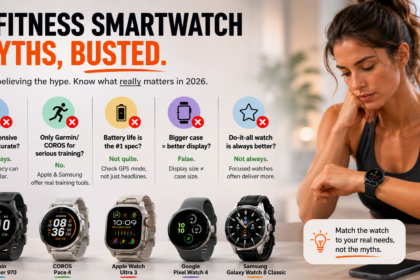


Most people don’t buy a new fitness smartwatch because they saw an ad — they buy one because something specific about their current training setup isn’t working. The watch dies mid-long-run. The premium model feels like overkill for what they actually do. The case is too big for a smaller wrist. Most smartwatch roundups skip straight to spec comparisons without asking the more useful question first:
- Problem 1: “My watch dies in the middle of a long run or hike”
- Problem 2: “I’m overpaying for features I don’t actually use”
- Problem 3: “The watch I want looks and feels too big on my wrist”
- Problem 4: “I need real training data, but I’m not ready to give up my iPhone’s smartwatch features”
- Problem 5: “I want serious training features but I’m on Android, not iPhone”
- Matching Problems to Smartwatches: Quick Reference
- A Word on Solving More Than One Problem at Once
- FAQ’s
- Conclusion
What’s actually the problem you’re trying to solve?
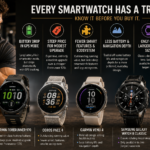
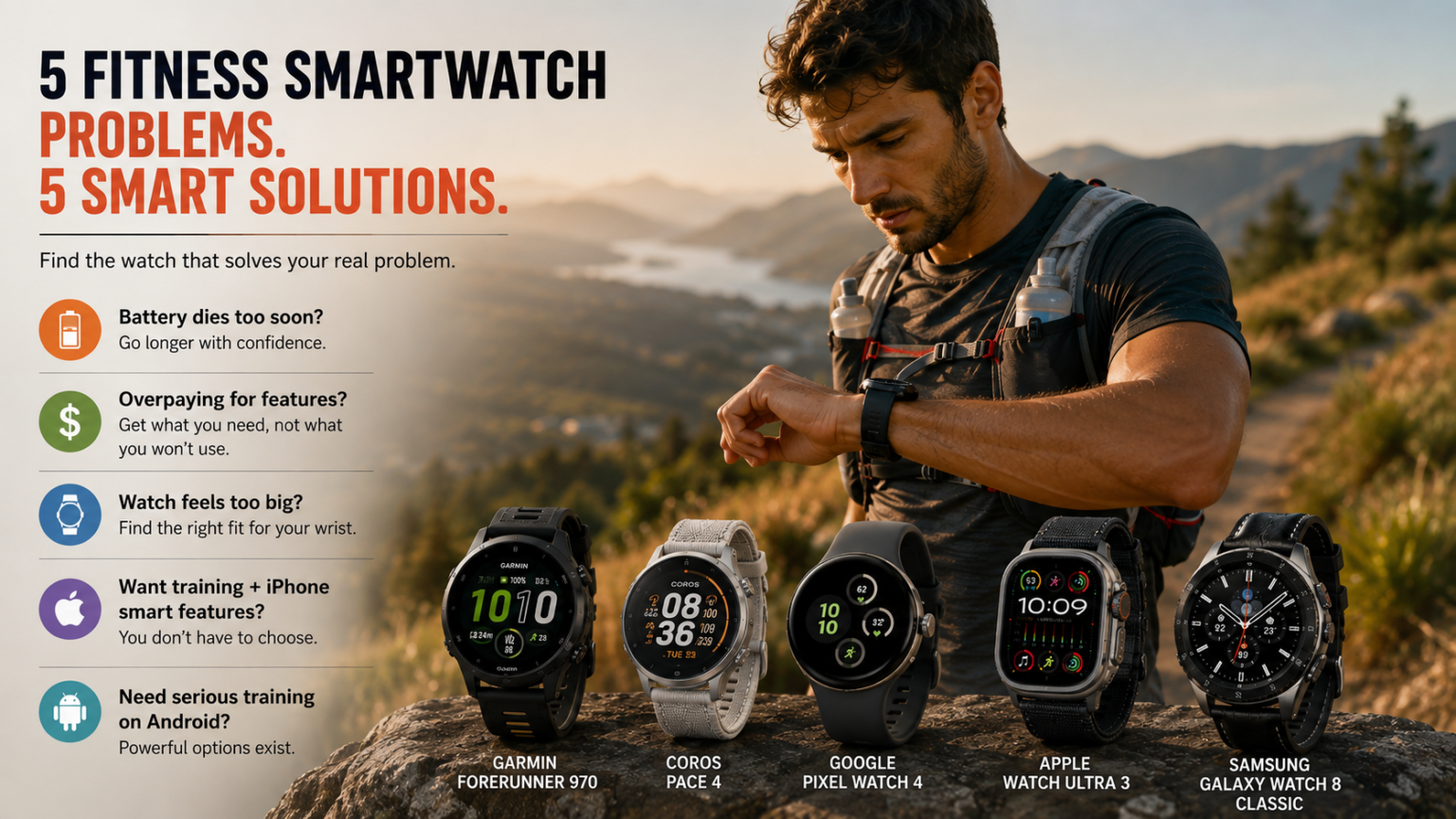
Here are five common fitness smartwatch problems in 2026, and the specific devices built to solve each one.
Problem 1: “My watch dies in the middle of a long run or hike”
If you’ve had a watch’s battery drop out mid-activity, the fix is a device specifically built around long-duration GPS battery life, not just a headline smartwatch-mode number that doesn’t reflect real workout use.
The right watch: Garmin Forerunner 970. Its 41 hours (42mm) or 65 hours (46mm) of GPS tracking battery life comfortably covers ultra-long training runs, multi-day hikes, or even full ultramarathons without needing a mid-activity charge — a genuinely different tier of endurance than smartwatch-first devices offer.
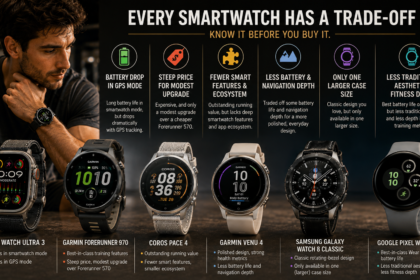
Where it falls short: This level of battery life comes at a real financial premium ($749, sometimes $649 on sale), and reviewers note it’s not a huge leap over the cheaper Forerunner 570 for shorter, more casual workouts where battery life was never actually the bottleneck.
Problem 2: “I’m overpaying for features I don’t actually use”
If you suspect your current or prospective watch has more capability than your actual training demands, the fix is choosing a device specifically scoped to deliver core value without premium extras.
The right watch: COROS Pace 4. At $249, it delivers accurate GPS tracking and detailed running dynamics — the metrics that actually matter for most runners — without charging for the deeper mapping, multi-band GPS, or extensive smart features that a $749 watch includes but many runners never fully use.
Where it falls short: It’s explicitly not a do-it-all device — if you do eventually want deeper smartwatch functionality (extensive apps, voice assistant, broader ecosystem), you may outgrow it and need to upgrade to a pricier alternative.
Problem 3: “The watch I want looks and feels too big on my wrist”
If a specific watch’s premium design appeals to you but its case size doesn’t fit comfortably, the fix is checking for size flexibility before committing to a single-size model.
The right watch: Google Pixel Watch 4. Available in both 41mm and 45mm case sizes, it offers meaningfully more flexibility for smaller wrists than a single-size competitor, while still delivering strong battery life (60+ hours in the 45mm model) and solid fitness tracking.
Where it falls short: If you specifically wanted the Samsung Galaxy Watch 8 Classic’s rotating bezel and stainless steel aesthetic, the Pixel Watch 4 doesn’t replicate that traditional-watch design — it solves the sizing problem but not if a specific look was the actual draw.
Problem 4: “I need real training data, but I’m not ready to give up my iPhone’s smartwatch features”
If you don’t want to choose between structured training metrics and the broader Apple ecosystem (apps, notifications, payments), the fix is a device specifically built to deliver both without a major compromise on either.
The right watch: Apple Watch Ultra 3. It’s specifically positioned as the strongest balance between fitness tracking and smartwatch features for iPhone users, delivering genuine training data alongside full app support, notifications, and payments in one device.
Where it falls short: Its GPS battery life drops to about 12 hours during active tracking, a real limitation for very long endurance training compared to dedicated sports watches — this solves the ecosystem-versus-training tension but not the endurance-battery-life problem for genuinely long events.
Problem 5: “I want serious training features but I’m on Android, not iPhone”
If the Apple Watch Ultra 3’s training-and-smartwatch balance appeals to you but you’re not an iPhone user, the fix is one of the strongest Android-compatible alternatives rather than assuming Android users have no comparable option.
The right watch: Samsung Galaxy Watch 8 Classic, particularly for its comprehensive health metrics (ECG, sleep coaching, Running Coach, body composition) and Wear OS smart features, or the Garmin Forerunner 970 for Android users who want to prioritize training depth over smartwatch breadth entirely.
Where it falls short: Neither fully replicates the Apple Watch Ultra 3’s specific ecosystem integration — Samsung’s smart features work best with a Samsung phone specifically, and the Forerunner 970 trades smartwatch breadth for training depth rather than balancing both equally.
Matching Problems to Smartwatches: Quick Reference
| Your Problem | Best-Fit Smartwatch | Not the Right Fit For |
|---|---|---|
| Battery dies mid-long-run | Garmin Forerunner 970 | Casual, shorter workouts where battery was never the issue |
| Overpaying for unused features | COROS Pace 4 | Anyone needing deep smartwatch/app functionality |
| Watch feels too big on wrist | Google Pixel Watch 4 (two sizes) | Anyone specifically wanting a rotating-bezel design |
| Want training data + iPhone ecosystem | Apple Watch Ultra 3 | Ultra-long endurance events (GPS battery limit) |
| Want serious training on Android | Galaxy Watch 8 Classic or Garmin Forerunner 970 | Anyone expecting Apple-specific ecosystem features |
A Word on Solving More Than One Problem at Once
It’s tempting to look for one watch that solves every training frustration simultaneously — endless battery life, minimal cost, perfect fit, and full smartwatch functionality all at once. In practice, the watches above are strong specifically because they were built around a particular priority. Identify which problem is genuinely costing you the most in your current training setup, and solve that one specifically, rather than searching for a single device that claims to do it all.
FAQ’s
What if my long runs are occasionally interrupted by a dead battery, but I also want smartwatch features?
Prioritize whichever problem happens more often. If battery death during long activities is a frequent, real issue, a dedicated sports watch like the Forerunner 970 solves that more reliably than a smartwatch ever will, even a good one like the Apple Watch Ultra 3.
Is the COROS Pace 4 a bad choice if I might want more advanced features later?
Not necessarily a bad choice — it’s a reasonable, low-cost way to build a training habit and confirm you’ll actually use more advanced features before investing in a pricier watch. If your needs do grow, you can upgrade later without having overpaid initially.
Can I fix a too-big watch problem by just choosing a different band?
No — case size (the watch body itself) is different from band size, and a smaller band doesn’t reduce how large the watch face and case feel on your wrist. If size is the issue, you need a model offered in a smaller case size, not just a different strap.
Is there an Android watch that matches the Apple Watch Ultra 3’s exact balance of training and smart features?
Not an exact match, since ecosystem integration differs meaningfully between platforms, but the Samsung Galaxy Watch 8 Classic comes closest for Android users who want strong health metrics alongside genuine smartwatch functionality.
Conclusion
The fastest way to end up frustrated with a fitness smartwatch purchase is choosing based on overall reputation rather than the specific problem you’re actually trying to solve. Match the watch to what’s genuinely bothering you — dead batteries mid-activity, overpaying for unused features, a poor wrist fit, ecosystem trade-offs, or a lack of Android options — and you’ll get a device that actually earns its place on your wrist, not just one that topped a generic best-of list.
Pricing, specifications, and availability for smartwatches change frequently and may have been updated since this article was published. Always verify current pricing and specs directly on the manufacturer’s or retailer’s official website before purchasing. This article is for informational purposes and does not constitute medical advice; consult a healthcare provider for health-related concerns.