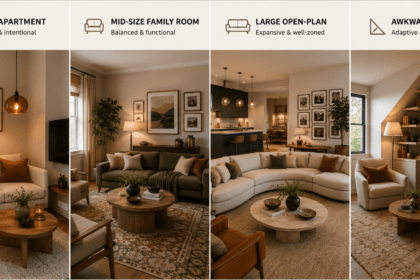


Most “small space decor ideas” lists show the same handful of tricks regardless of what your actual space looks like — a studio apartment, a narrow rowhouse living room, and a single small room doubling as an office all get the same generic advice. But a studio’s biggest challenge (zoning one open room into several functions) is genuinely different from a narrow room’s biggest challenge (working around an awkward length-to-width ratio), and a renter’s constraints (no permanent changes) are different from both.
This guide sorts small-space decor ideas by the specific layout challenge they solve, so you’re applying the right fix to your actual room.
If You Live in an Open Studio Apartment
The core challenge in a studio isn’t a lack of square footage exactly — it’s that one open room needs to function as living room, bedroom, and often a home office all at once, without feeling like an undivided single-purpose space.
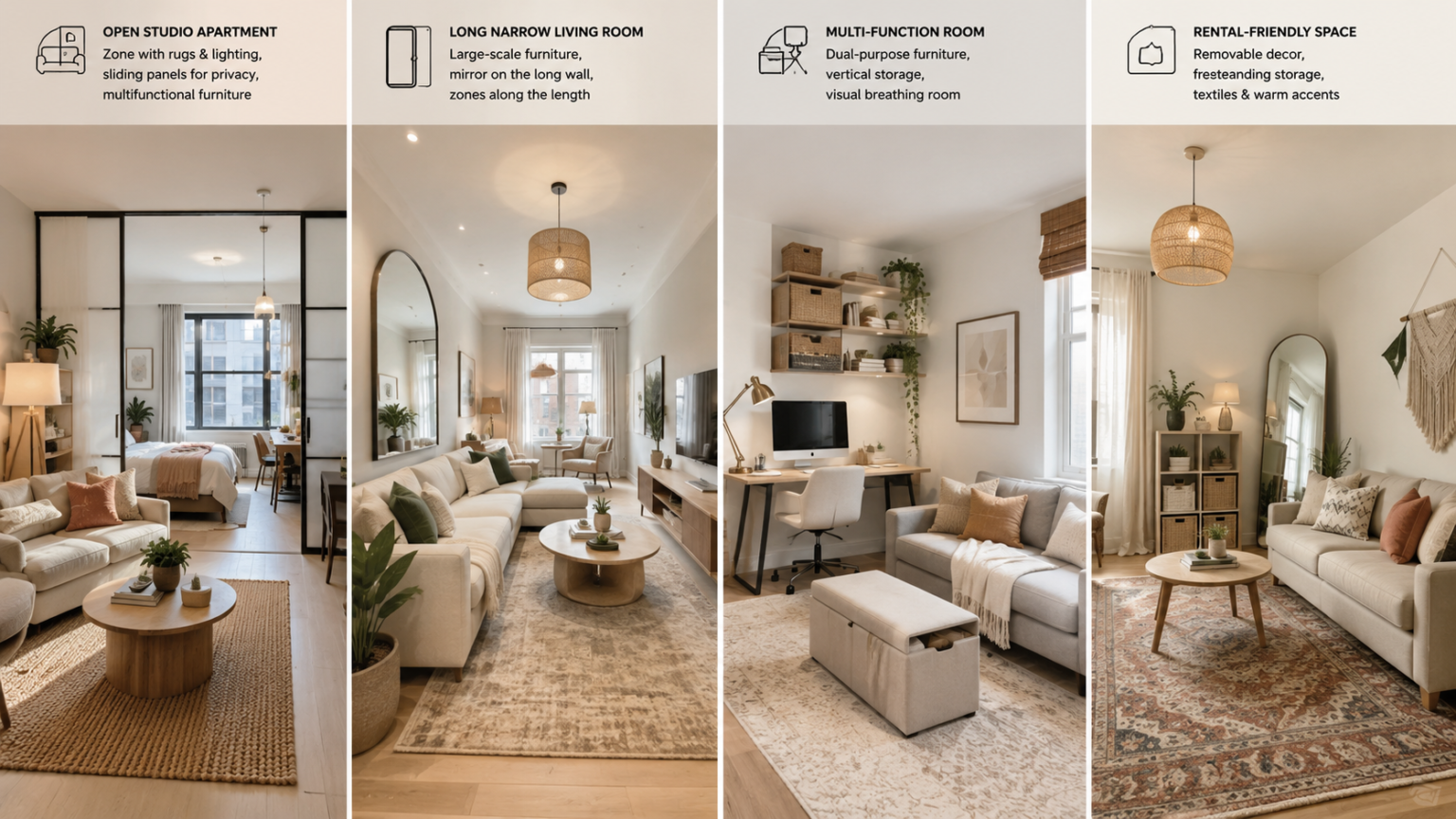
Zone with rugs and lighting rather than walls. A large rug (a general guideline is a minimum of roughly 200×300 cm) anchoring your living area, paired with a distinct lighting source for each zone, defines separate functional areas without the cost or permanence of adding actual walls — critical in a studio where physical dividers would eat into already-limited square footage.
Use sliding panels or curtains to add privacy where it matters most. A sliding panel that quietly hides a sleeping area behind the living space can turn one compact room into something that feels layered and private, without permanently sacrificing the open, flexible feel a studio depends on.
Prioritize multifunctional furniture above almost everything else. A studio benefits more than any other layout type from furniture that reduces floor coverage by doing double duty — a storage ottoman as both seating and hidden storage, a sofa bed for occasional guests, foldable or extendable pieces that shrink when not in use.
If You Have a Narrow or Long, Skinny Living Room
A narrow room’s challenge is specifically proportional — furniture and layouts designed for a roughly square room often feel wrong in a long, skinny one, creating an awkward bowling-alley effect if not addressed directly.
Go big rather than small with your key pieces. Counterintuitively, filling a narrow room with smaller furniture often emphasizes the awkward proportions rather than softening them. A large sofa, one large light fixture, and one large rug that work the walls and floor use the narrow space in a way smaller, scattered pieces can’t.
Use a large mirror to counteract the narrow proportions specifically. Positioned on a long wall (rather than the short end), a substantial mirror can visually widen the room’s felt proportions in a way that’s especially valuable in a narrow layout, beyond the general small-space benefit of reflecting light.
Break the room into distinct zones along its length rather than treating it as one long undivided space — a seating area at one end and a reading nook or secondary function at the other, connected by a consistent color palette, keeps a narrow room from feeling like a single monotonous corridor.
If You Have a Small Room Serving Multiple Functions
(Living Room + Office, or Living Room + Guest Space)
The challenge here isn’t primarily about square footage — it’s that a single small room needs to genuinely support two different activities without either one feeling like an afterthought crammed into leftover space.
Apply the visual breathing room principle strictly, since a multi-function room accumulates clutter fastest. Keep at least one surface completely clear at all times, and be more disciplined than usual about removing an item before adding a new one — a room serving two functions is more vulnerable to feeling chaotic than a single-purpose space.
Choose furniture that explicitly serves both functions rather than furniture for each function separately. A console table that works as both a display surface and an occasional desk, or a storage ottoman that becomes extra seating when guests are over, avoids doubling the furniture footprint that two entirely separate furniture sets would require.
Use vertical storage aggressively, since wall space above roughly 170cm is typically underused, and a dual-function room needs more storage capacity (for both living-room and office/guest items) without more floor space to hold it.
If You’re Renting and Can’t Make Permanent Changes
The core constraint here isn’t the room’s size or shape — it’s that walls, built-ins, and anything requiring holes or paint are often off-limits, or at least risky to invest time and money into.
Lean on removable, non-permanent versions of every small-space trick. A large freestanding or leaning mirror delivers the same light-reflecting, space-expanding benefit as a wall-mounted one, without drilling. Removable, repositionable rugs handle zoning without any installation at all.
Prioritize furniture over structural changes for zoning and storage. Since built-in shelving and walls typically aren’t an option, freestanding tall shelving units and multifunctional furniture carry more of the functional weight in a rental than they would in a space where structural changes are possible.
Add warmth and personality through textiles and small decor rather than paint. Macramé pillows, a rattan pendant lamp (swapped in over an existing fixture, then swapped back at move-out), and woven throws deliver 2026’s warm, textured small-space aesthetic without requiring landlord approval or a repaint.
Layout Type Quick Reference
| Your Layout | Primary Challenge | Top Priority Fix |
|---|---|---|
| Open studio | One room, multiple functions | Zone with rugs/lighting; sliding panels for privacy |
| Narrow/long living room | Awkward proportions | Large-scale furniture; mirror on the long wall |
| Small multi-function room | Two functions, one small footprint | Dual-purpose furniture; strict visual breathing room |
| Rental with restrictions | No permanent changes allowed | Freestanding/removable versions of every trick |
A Note on Combining Layout Challenges
Plenty of small spaces face more than one of these challenges at once — a narrow studio apartment you’re renting, for instance, combines all three constraints. In that case, prioritize whichever constraint is least flexible. Rental restrictions are usually non-negotiable, so start there and layer in narrow-room and studio-zoning strategies using only removable, freestanding solutions, rather than trying to apply every fix at full strength simultaneously.
FAQ’s
Can zoning with rugs actually work in a studio, or does it need real walls to be effective?
It genuinely works without walls — a rug anchoring one area, paired with distinct lighting for each zone, creates a visual boundary that’s often enough to make a studio feel organized into separate functions, without the cost or commitment of construction.
Is a large mirror worth it in a narrow room specifically, beyond the general small-space benefit?
Yes — beyond reflecting light, a mirror placed on a long wall in a narrow room can specifically counteract the room’s skewed proportions in a way that’s less relevant in a more evenly-proportioned small room.
What’s the single highest-impact change for a rental with no permanent-change options?
A large freestanding mirror and a substantial rug are both high-impact, fully removable changes that address two of the biggest small-space challenges (light/visual expansion and zoning) without any installation.
How do I keep a multi-function room from feeling like two crammed rooms in one?
Choose furniture that explicitly serves both functions rather than doubling up on furniture for each activity, and apply the visual breathing room principle more strictly than you would in a single-purpose room, since clutter compounds faster when two functions share one space.
Conclusion
The best small-space decor ideas aren’t one-size-fits-all — a studio’s zoning challenge, a narrow room’s proportional challenge, a multi-function room’s dual-purpose challenge, and a rental’s permanence restrictions each call for a different starting priority, even though they draw from the same broader toolkit of light palettes, mirrors, and multifunctional furniture. Identify which specific challenge your space actually presents, and start there rather than applying every small-space trick evenly across the board.
Design trends, product availability, and pricing for home decor items change frequently. This article reflects general design guidance current at the time of publication; always assess your own space, budget, lease terms, and personal style before making purchasing or renovation decisions.