

Most people shopping for a fitness tracker in 2026 aren’t training for a marathon — they want something simple that counts steps, tracks sleep, and gives a gentle nudge to move more, without a confusing setup or a steep learning curve. The good news: the category has matured well beyond basic step counts, and there’s a genuinely strong option here whether your priority is battery life, subscription-free simplicity, or deeper health insights.
- Direct Answer: The Best Fitness Trackers for Everyday Use at a Glance
- Fitbit Charge 6 — Best Overall for Most People
- Garmin Vivoactive 6 — Best for GPS and Serious Daily Exercise
- Google Fitbit Air — Best Budget, Screenless Option
- Oura Ring 5 — Best for Sleep-Focused Tracking
- Apple Watch SE 3 — Best for iPhone Users
- WHOOP 5.0 — Best for Recovery and Readiness Insights
- Comparison Table
- How to Choose the Right Tracker for You
- FAQ’s
This guide covers six fitness trackers that consistently show up as 2026 favorites for everyday, non-athlete use, with real pricing and where each one falls short.
Direct Answer: The Best Fitness Trackers for Everyday Use at a Glance
- Best overall for most people: Fitbit Charge 6
- Best for GPS and serious daily exercise: Garmin Vivoactive 6
- Best budget, screenless option: Google Fitbit Air
- Best for sleep-focused tracking: Oura Ring 5
- Best for iPhone users: Apple Watch SE 3
- Best for recovery and readiness insights: WHOOP 5.0
Below, we break down what each tracker actually does well, current pricing, and who should look elsewhere.
Fitbit Charge 6 — Best Overall for Most People
The Fitbit Charge 6 remains the benchmark for a simple, reliable everyday tracker, and it’s earned that reputation with detailed sleep reports, an accurate heart rate sensor, and a bright touchscreen that’s easy to read even outdoors.
Key features:
- Built-in GPS plus GLONASS for tracking walks and runs without a phone
- ECG sensor and EDA stress-scanning capability
- Google Maps, YouTube Music, and Google Wallet support
- Connects with third-party equipment like Peloton, NordicTrack, and Tonal
Pricing: Officially listed around $159, though it has been seen discounted as low as $99 during sales — worth checking current pricing before buying at full price.
Pros:
- Comprehensive daily tracking in a lightweight, discreet band rather than a bulky watch
- Genuinely accurate heart rate monitoring and detailed sleep insights, even at this price point
Cons:
- Small display compared to a full smartwatch, and the charger has been noted as slightly loose in testing
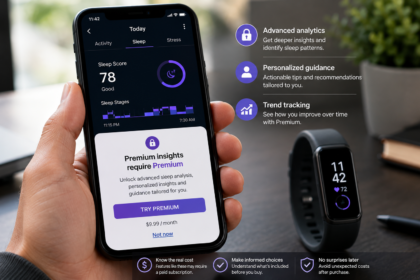
- Some of the deeper wellness insights sit behind a paid Fitbit Premium subscription
Garmin Vivoactive 6 — Best for GPS and Serious Daily Exercise
For anyone who takes daily walks, runs, or gym sessions seriously and wants a real GPS smartwatch rather than a slim band, the Garmin Vivoactive 6 is the clear step up — and it does this without requiring an ongoing subscription to access its core features.
Key features:
- Onboard GPS with roughly 21 hours of GPS battery life
- 11-day battery life in smartwatch mode
- 8GB of onboard storage for offline music
- Full suite of activity and health tracking, including smart wake-up alarms
Pricing: Listed at $299–$300, with sales bringing it down to around $249 at times.
Pros:
- No subscription required to access core training and health features, making long-term cost predictable
- Genuinely long battery life, both in smartwatch mode and during GPS-tracked activity
Cons:
- Uses a previous-generation heart rate sensor and lacks dual-band GPS, which matters more for performance-focused runners than casual daily use
- Bulkier watch-style design compared to a slim fitness band, which may not suit everyone’s daily wear preference
Google Fitbit Air — Best Budget, Screenless Option
For anyone who wants tracking without another screen competing for their attention, the Google Fitbit Air strips things down to the essentials — lightweight, simple, and aimed specifically at people who don’t want to think too hard about their fitness tech.
Key features:
- Screenless design relying on a paired smartphone for GPS and data display
- Lightweight, beginner-friendly build
- Core activity and sleep tracking
Pricing: Listed around $100, making it one of the more accessible entries in this list.
Pros:
- Genuinely low-effort daily wear — no screen, no notifications competing for attention
- Strong value for anyone who just wants basic activity and sleep tracking without extra complexity
Cons:
- Requires your phone nearby for GPS tracking during outdoor activity, unlike watch-style options with onboard GPS
- Lacks the deeper health metrics and display feedback that pricier trackers offer
Oura Ring 5 — Best for Sleep-Focused Tracking
If sleep quality is your primary concern rather than workout metrics, the Oura Ring 5 remains a standout — its ring form factor is discreet enough to wear to bed comfortably, which a bulkier wrist-worn tracker often isn’t.
Key features:
- Sleep staging, recovery, and readiness scoring
- Discreet ring form factor, worn 24/7 including overnight
- Long battery life relative to its small size
Pricing: Listed around $399 for the ring itself, plus a required membership of about $6/month or $70/year to access full data and insights — without the membership, the ring is largely decorative.
Pros:
- Genuinely comfortable for continuous overnight wear in a way most watches and bands aren’t
- Strong, detailed sleep and recovery insights that are a specific strength of the ring form factor
Cons:
- The membership fee is mandatory for meaningful use, adding an ongoing cost on top of the upfront price
- Not suited for weightlifting or barbell-based strength training, where the ring’s pressure and grip exposure risk damaging both the ring and your finger
Apple Watch SE 3 — Best for iPhone Users
For iPhone users who want a genuine smartwatch alongside fitness tracking — not just a dedicated band — the Apple Watch SE 3 is Apple’s most accessible current option, offering the broader Apple Watch experience without the premium Ultra 3 price tag.
Key features:
- Built-in GPS, heart rate, and activity tracking
- Full smartwatch functionality: notifications, apps, contactless payments
- 5ATM water resistance
Pricing: Apple’s current Ultra 3 model starts at $799, positioning the SE 3 as the significantly more affordable entry point into the Apple Watch lineup, aimed at people who don’t need the most premium adventure-focused hardware.
Pros:
- Seamless iPhone integration and an intuitive, mature operating system
- Genuinely useful beyond fitness — notifications, maps, payments, and safety features like fall detection
Cons:
- Only around 18 hours of battery life, requiring more frequent charging than most dedicated fitness trackers
- iOS-only compatibility, so it’s not an option for Android users regardless of how strong the fitness features are
WHOOP 5.0 — Best for Recovery and Readiness Insights
For anyone specifically interested in recovery coaching rather than just step counts, WHOOP 5.0 takes a different approach entirely — a screenless band built around continuous physiological monitoring and a subscription-based coaching model.
Key features:
- Continuous heart rate variability, sleep, and strain monitoring
- No on-device screen — all data lives in the companion app
- Recovery and readiness scoring designed to guide daily training decisions
Pricing: WHOOP is subscription-based rather than a single upfront purchase; a higher-tier WHOOP MG option exists with additional features limited to that specific tier.
Pros:
- Genuinely strong recovery and readiness coaching, useful for anyone actively managing training load
- Screenless design means no notifications or display to manage — data lives entirely in the app
Cons:
- Ongoing subscription cost is required indefinitely to use the device at all, unlike a one-time-purchase tracker
- No onboard GPS or display, which makes it a poor fit for anyone who wants real-time stats during a walk or run
Comparison Table
| Tracker | Best For | Starting Price | Subscription Required? |
|---|---|---|---|
| Fitbit Charge 6 | Overall daily tracking | ~$159 (seen as low as $99) | No (some features paywalled) |
| Garmin Vivoactive 6 | GPS and serious exercise | ~$299–$300 | No |
| Google Fitbit Air | Budget, screenless simplicity | ~$100 | No |
| Oura Ring 5 | Sleep-focused tracking | ~$399 | Yes (~$6/mo or $70/yr) |
| Apple Watch SE 3 | iPhone smartwatch + fitness | Below Ultra 3’s $799 | No |
| WHOOP 5.0 | Recovery/readiness coaching | Subscription-based | Yes |
How to Choose the Right Tracker for You
Before comparing feature lists line by line, get clear on a few practical priorities:
- Decide if you’re willing to pay an ongoing subscription. The Oura Ring 5 and WHOOP 5.0 both require recurring payments to be meaningfully useful, while the Fitbit Charge 6, Garmin Vivoactive 6, Google Fitbit Air, and Apple Watch SE 3 don’t require one for core functionality.
- Check your phone’s operating system first. The Apple Watch SE 3 only works with iPhones, which immediately rules it out for Android users regardless of how appealing its other features are.
- Decide if you want a screen at all. The Google Fitbit Air and WHOOP 5.0 are both screenless by design, relying entirely on a companion app — a genuine plus for some, a dealbreaker for others who want at-a-glance stats on their wrist.
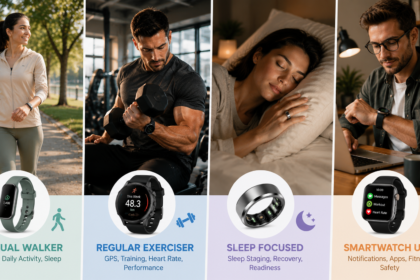
- Match the form factor to your daily habits. If you sleep with your tracker on, the Oura Ring 5’s ring form factor is meaningfully more comfortable overnight than a bulkier watch. If you lift weights regularly, avoid wearing a ring during barbell work specifically.
FAQ’s
Do I need a subscription to use a fitness tracker in 2026?
Not necessarily — the Fitbit Charge 6, Garmin Vivoactive 6, Google Fitbit Air, and Apple Watch SE 3 all provide core tracking without a required subscription, though some deeper Fitbit insights sit behind Fitbit Premium. The Oura Ring 5 and WHOOP 5.0 both require an ongoing membership to be genuinely useful.
Is a smart ring or a wrist-worn tracker better for everyday use?
It depends on your priority — a ring like the Oura Ring 5 is generally more comfortable for continuous overnight wear and sleep tracking, while a wrist-worn device typically offers a screen for at-a-glance stats and is a better fit for anyone doing regular strength training.
What’s the best fitness tracker if I don’t want to spend much?
The Google Fitbit Air, at around $100, and the Fitbit Charge 6, which has been seen discounted to around $99, are both strong budget-friendly options that cover the core basics — steps, heart rate, and sleep tracking — without a premium price tag.
Do I need onboard GPS, or is phone-based GPS good enough?
If you regularly walk, run, or cycle without carrying your phone, onboard GPS (available on the Fitbit Charge 6, Garmin Vivoactive 6, and Apple Watch SE 3) records route, distance, and pace independently. If you always have your phone with you, phone-based GPS on a screenless device like the Google Fitbit Air is a reasonable trade-off for the lower price.
Conclusion
There’s no single best fitness tracker for everyday use — the right pick depends on how much you’re willing to spend upfront, whether you’re comfortable with an ongoing subscription, and what you actually want tracked most closely. The Fitbit Charge 6 remains the strongest all-around choice for most people, the Garmin Vivoactive 6 is worth the step up for serious daily exercise without a subscription, the Google Fitbit Air covers the basics on a tight budget, the Oura Ring 5 excels specifically at sleep tracking, the Apple Watch SE 3 makes sense for iPhone users who want a full smartwatch, and WHOOP 5.0 is the pick for anyone who wants dedicated recovery coaching and doesn’t mind the subscription cost.
Pricing, specifications, and availability for fitness trackers change frequently and may have been updated since this article was published. Always verify current pricing and specs directly on the manufacturer’s or retailer’s official website before purchasing. This article is for informational purposes and does not constitute medical advice; consult a healthcare provider for health-related concerns.