

Most “best fitness trackers” lists rank devices as if everyone wants the same thing from a tracker — as if someone who just wants a gentle nudge to walk more has the same needs as a person doing structured strength training five days a week. They don’t. Buying a subscription-dependent recovery tool like WHOOP when you just want step counts is unnecessary complexity and cost; buying a basic screenless band when you’re seriously training for a race means you’ll outgrow it within weeks.
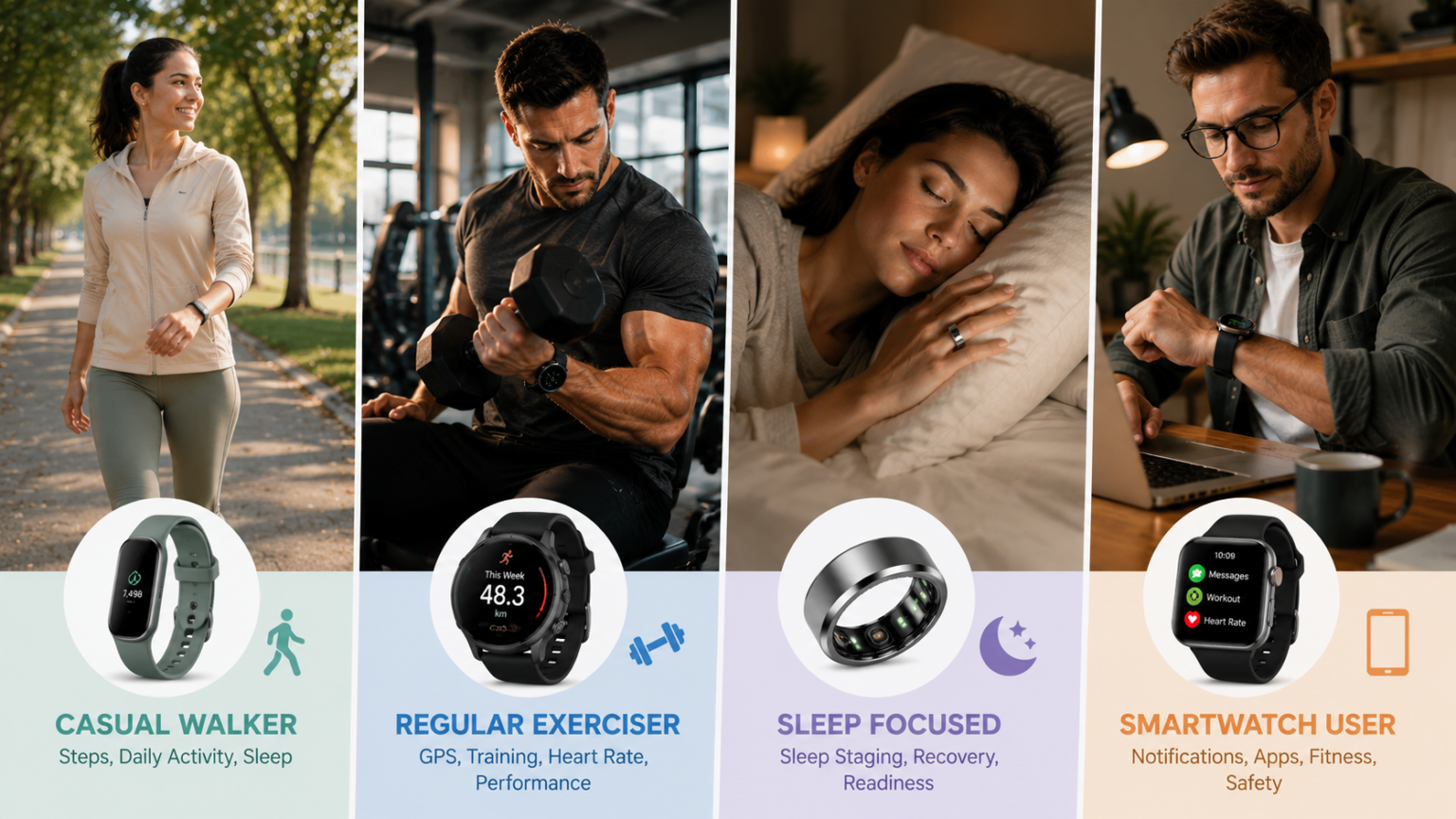
- If You Just Want to Walk More and Sleep Better
- If You Exercise Regularly and Want Real Training Data
- If Sleep Quality Is Your Main Concern, Not Workouts
- If You Want Deep Recovery Insight and Don’t Mind a Subscription
- If You Want a Full Smartwatch, Not Just a Fitness Tracker
- Lifestyle Quick Reference
- A Note on Mixed Priorities
- FAQ’s
- Conclusion
This guide sorts 2026’s best fitness trackers by the lifestyle they’re actually built for, so you’re matching the device to your actual daily habits.
If You Just Want to Walk More and Sleep Better
If your goals are genuinely simple — more steps, better sleep, a gentle nudge toward moving more — you don’t need a device built for athletes, and paying for one wastes both money and mental overhead on features you won’t touch.
The Google Fitbit Air is the strongest fit here. Priced around $100, it’s specifically aimed at people who want tracking without another screen competing for their attention — lightweight, simple, and beginner-friendly, covering core activity and sleep tracking without unnecessary complexity.
The Fitbit Charge 6, at around $159 (sometimes discounted to $99), is the natural step up if you want a display for at-a-glance stats — its detailed sleep reports and accurate heart rate sensor genuinely deliver for this exact use case, without requiring the deeper training features a Garmin or WHOOP would push on you.
Skip for now: The Garmin Vivoactive 6 and WHOOP 5.0. Both are built around structured training and recovery optimization — genuinely excellent at that, but overkill and unnecessarily complex if your goals are simply “walk more, sleep better.”
If You Exercise Regularly and Want Real Training Data
If your week includes structured runs, gym sessions, or cycling, and you want a device that captures accurate pace, distance, and heart rate zones during that activity, a basic screenless band will frustrate you quickly.
The Garmin Vivoactive 6 is purpose-built for this. Its onboard GPS delivers roughly 21 hours of GPS battery life, and its full suite of activity tracking covers running, cycling, and gym-based training without requiring a subscription to access core features — a real advantage for long-term cost predictability. At $299–$300 (sometimes seen for $249), it’s a bigger investment than a basic band, but it’s built to keep up with regular training rather than just casual movement.
The Apple Watch SE 3 is the strong alternative specifically for iPhone users who want the broader smartwatch ecosystem — notifications, apps, payments — alongside solid activity tracking, though its roughly 18-hour battery life means more frequent charging than the Garmin.
Skip for now: The Google Fitbit Air and Oura Ring 5. The Fitbit Air’s phone-dependent GPS is a real limitation if you regularly train without your phone, and the Oura Ring’s form factor isn’t built to capture the same real-time exercise metrics a watch delivers.
If Sleep Quality Is Your Main Concern, Not Workouts
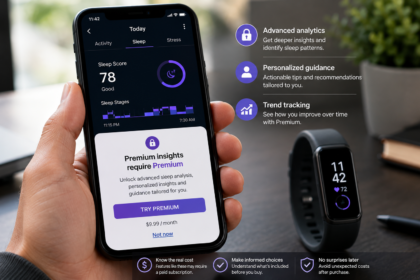
If your actual goal is understanding and improving your sleep — not tracking workouts — a wrist-worn device built around daytime activity may not be the best tool, since comfort during overnight wear matters more than screen size or GPS accuracy.
The Oura Ring 5 is specifically built for this. Its ring form factor is genuinely more comfortable for continuous 24/7 wear, including overnight, than a bulkier watch or band, and its sleep staging, recovery, and readiness scoring are a specific strength of the category. Priced around $399, plus a required membership of about $6/month or $70/year to access full insights.
Skip for now: The Garmin Vivoactive 6, if your main use case is genuinely sleep-focused rather than exercise-focused — its bulkier watch design is a less comfortable choice for overnight wear compared to a ring, even though it can technically track sleep.
A note on cost: The Oura membership isn’t optional if you want to actually use your data — without it, the ring is largely decorative, so budget for the ongoing cost alongside the upfront purchase.
If You Want Deep Recovery Insight and Don’t Mind a Subscription
If you’re actively managing training load — balancing hard workout days against rest days based on how your body is actually recovering — a basic step-counter won’t give you the insight you’re looking for.
WHOOP 5.0 is built specifically around this use case. Its continuous heart rate variability, sleep, and strain monitoring feed into recovery and readiness scores designed to guide daily training decisions, and its screenless design keeps the focus on the app-based coaching rather than on-wrist notifications.
Skip for now: The Google Fitbit Air and Fitbit Charge 6. Both offer basic activity and sleep tracking, but neither is built around the same depth of recovery coaching WHOOP specifically prioritizes — you’d be paying for WHOOP’s subscription without getting its core value if your goals are simpler.
A note on ongoing cost: WHOOP’s subscription is required indefinitely to use the device meaningfully — there’s no one-time purchase option — so this is a genuinely different cost structure than every other tracker on this list, and worth confirming you’re comfortable with before committing.
If You Want a Full Smartwatch, Not Just a Fitness Tracker
If notifications, apps, contactless payments, and general smartphone-adjacent functionality matter as much to you as fitness tracking itself, a dedicated fitness band is going to feel limited regardless of how good its health metrics are.
The Apple Watch SE 3 is the clear pick for iPhone users here — genuinely useful beyond fitness, with seamless iPhone integration, an intuitive interface, and safety features like fall detection, positioned as Apple’s accessible entry point below the premium Ultra 3’s $799 price tag.
Skip for now: Everything else on this list if you’re an iPhone user prioritizing the smartwatch experience — dedicated fitness bands like the Fitbit Charge 6 or Google Fitbit Air simply don’t offer the same breadth of non-fitness functionality.
A note for Android users: The Apple Watch SE 3 is iOS-only, so this specific recommendation doesn’t apply if you’re on Android — the Garmin Vivoactive 6 is the closest equivalent in terms of a fuller smartwatch-style experience with strong fitness tracking built in.
Lifestyle Quick Reference
| Your Lifestyle | Recommended Tracker(s) | Typical Cost |
|---|---|---|
| Casual walker, simple goals | Google Fitbit Air or Fitbit Charge 6 | ~$100–$159 |
| Regular exerciser wanting real training data | Garmin Vivoactive 6 or Apple Watch SE 3 | ~$300 or below $799 |
| Sleep-focused, not workout-focused | Oura Ring 5 | ~$399 + ~$6/mo membership |
| Wants recovery/readiness coaching | WHOOP 5.0 | Subscription-based |
| Wants a full smartwatch (iPhone) | Apple Watch SE 3 | Below $799 |
A Note on Mixed Priorities
Plenty of people don’t fit neatly into one category — someone who exercises regularly but also cares deeply about sleep quality, for instance. In that case, prioritize whichever goal is currently the bigger gap in your routine. If you’re already sleeping fine but want better workout data, the Garmin Vivoactive 6 is the better first purchase; if workouts are going fine but sleep is the actual problem, the Oura Ring 5 addresses that more directly, even though neither device does both equally well.
FAQ’s
Can I get accurate workout tracking and sleep tracking from the same device?
To some degree, yes — most trackers on this list handle both to varying degrees. But a device optimized for one (the Oura Ring 5 for sleep, the Garmin Vivoactive 6 for exercise) will generally outperform a device that’s simply adequate at both.
Is it worth paying for WHOOP or Oura if I’m not a serious athlete?
It depends on what specifically interests you — if detailed recovery coaching or sleep staging genuinely appeals to you regardless of athletic ambition, the subscription can be worth it. If you mainly want basic activity and sleep tracking, a non-subscription tracker like the Fitbit Charge 6 covers that more affordably.
What’s the easiest fitness tracker to start with if I’ve never used one before?
The Google Fitbit Air is a reasonable starting point specifically because it’s designed to be simple and beginner-friendly, without the complexity of training zones, recovery scores, or a subscription commitment.
Should Android users avoid the Apple Watch entirely?
Yes — the Apple Watch SE 3 is iOS-only, so Android users should look at the Garmin Vivoactive 6 or Fitbit Charge 6 instead, both of which offer broad Android compatibility alongside strong fitness tracking.
Conclusion
The best fitness tracker for everyday use isn’t a single universal answer — it’s a function of what you actually want out of the data. A casual walker, a regular exerciser, someone sleep-focused, someone recovery-focused, and someone who wants a full smartwatch are all solving different problems, even though they’re all shopping in the same “fitness tracker” category. Match the device to your actual daily habits and goals, and you’ll get far more genuine value than picking whatever tops a generic best-of list.
Pricing, specifications, and availability for fitness trackers change frequently and may have been updated since this article was published. Always verify current pricing and specs directly on the manufacturer’s or retailer’s official website before purchasing. This article is for informational purposes and does not constitute medical advice; consult a healthcare provider for health-related concerns.