

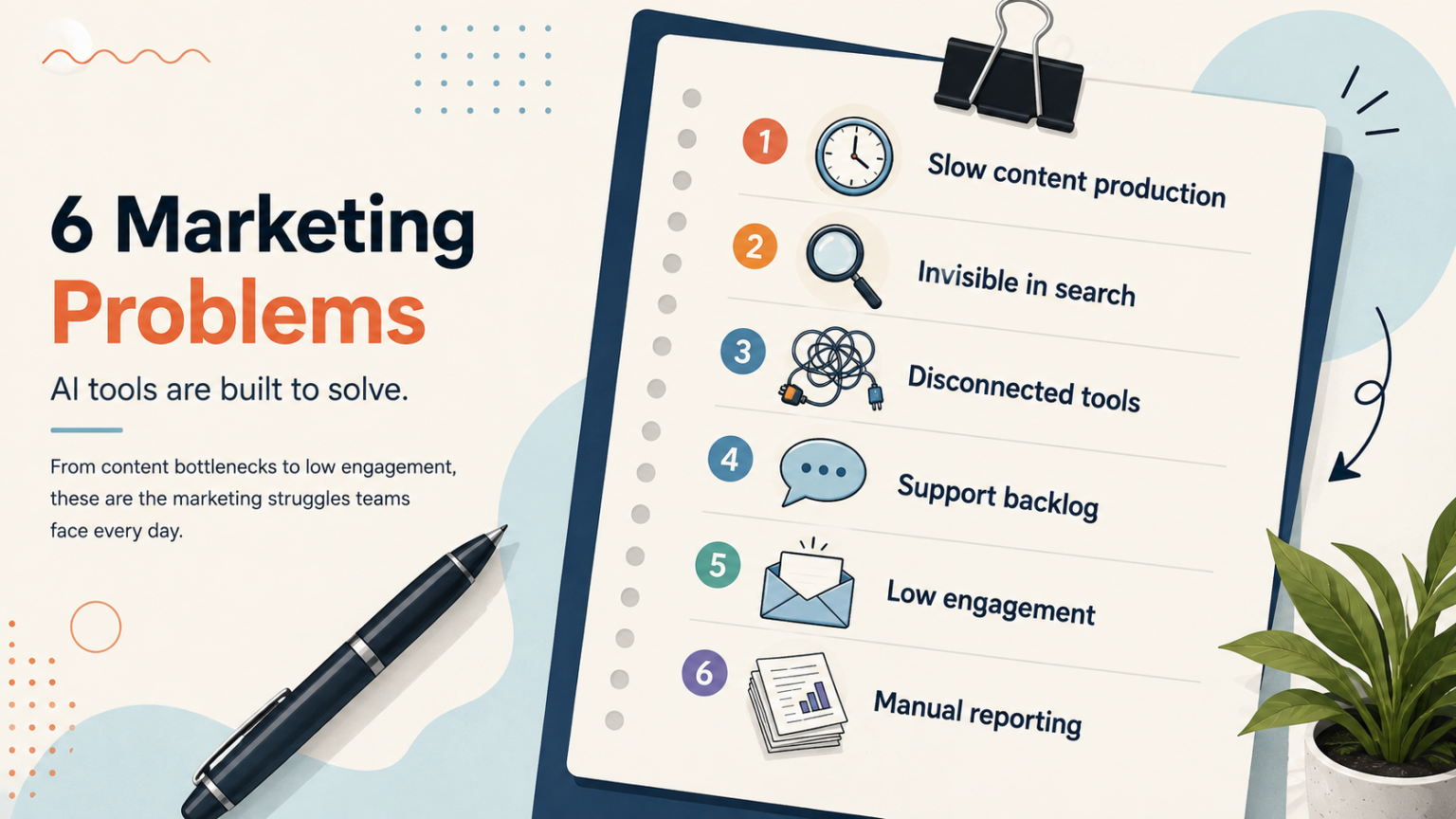
Marketing teams don’t buy software because it has AI in the name — they buy it because something specific is broken. Content takes too long to produce. Rankings are stagnant. The team is drowning in manual reporting. Most buying guides skip straight to feature lists without asking the more useful question:
- Problem 1: “We can’t produce content fast enough”
- Problem 2: “We’re writing content but it’s not ranking”
- Problem 3: “We don’t know how we’re showing up in AI search results”
- Problem 4: “Marketing, sales, and support all use different customer data”
- Problem 5: “Our social engagement is high but we can’t keep up with replies and sentiment”
- Problem 6: “Email campaigns feel generic and engagement is dropping”
- Matching Problems to Tools: Quick Reference
- A Word on Stacking Multiple Tools
- FAQ’s
- Conclusion
what problem are you actually trying to fix?
Here are six common marketing problems in 2026, and the AI tools genuinely built to solve each one — along with tools people often reach for that aren’t actually the right fit.
Problem 1: “We can’t produce content fast enough”
If your bottleneck is raw output — blog posts, ad copy, product descriptions, landing pages — the fix is an AI writing platform with a trained brand voice, not a general-purpose chatbot you’re prompting from scratch every time.
The right tool: Jasper. Its Brand Voice feature means you train the tool once on your company’s tone and it applies that consistently across every piece of content a team member generates, which matters once more than one person is writing. The Canvas editor and marketing-specific templates (ads, product pages, campaign copy) are built for output volume, not one-off writing tasks.
Where it falls short: Jasper produces drafts, not finished, fact-checked pieces — especially for content involving statistics, pricing, or technical claims, which still need human verification before publishing. It also doesn’t optimize for search on its own; pair it with a dedicated SEO tool for that.
Problem 2: “We’re writing content but it’s not ranking”
This is a different problem than Problem 1, and it needs a different tool. Writing volume isn’t your issue — competitiveness is. You need to know what top-ranking pages are doing that yours isn’t.
The right tool: Surfer SEO. Its Content Editor scores your draft against real top-ranking competitors for a target keyword in real time, flagging missing subtopics, thin sections, and structural gaps — the kind of feedback that’s hard to generate manually without spending hours studying SERPs by hand.
Where it falls short: Surfer optimizes existing content; it doesn’t tell you which keywords are worth targeting in the first place or track how you’re doing over time at a strategic level. That’s a job for a broader SEO platform.
Problem 3: “We don’t know how we’re showing up in AI search results”
Traditional rank tracking tells you where you sit in Google’s blue links. It says nothing about whether your brand is being mentioned — or ignored — in AI Overviews, ChatGPT answers, or other AI-generated search responses, which are increasingly where some searches end.
The right tool: Semrush’s AI Visibility toolkit. As of 2026, Semrush folded AI-answer monitoring directly into its core plans, tracking prompts and reporting on AI-answer sentiment alongside traditional SEO metrics — giving you one dashboard instead of stitching together separate tools for “old search” and “new search.”
Where it falls short: AI visibility tracking is still a young category industry-wide, and Semrush’s own plan structure around it has changed more than once in the past year. Treat the data as directional rather than a precise, stable benchmark, and expect the tooling (and pricing around it) to keep evolving.
Problem 4: “Marketing, sales, and support all use different customer data”
If your marketing team’s view of a customer doesn’t match what sales or support sees, personalization breaks down and campaigns fire at the wrong moments — like a win-back email going out the same week support just resolved a complaint.
The right tool: HubSpot’s Breeze AI, specifically because it’s not a marketing-only tool — it operates on a shared customer record across HubSpot’s marketing, sales, and service hubs. Breeze Intelligence enriches that shared record automatically, and agents like the Customer Agent and Data Agent act on the same unified data rather than a marketing-only silo.
Where it falls short: This only pays off if your team is actually consolidated on HubSpot across functions. If sales or support uses a completely different platform, you’re paying for a “unified” feature that has nothing to unify.
Problem 5: “Our social engagement is high but we can’t keep up with replies and sentiment”
Once a brand’s social presence grows past a certain size, manually reading every comment and DM for tone and urgency stops being realistic — and negative sentiment that goes unnoticed for too long becomes a bigger problem than it needed to be.
The right tool: Sprout Social, specifically its Advanced-tier sentiment analysis and AI-assisted reply suggestions inside the Smart Inbox. It flags tone automatically and surfaces messages that need urgent attention instead of leaving them buried in a chronological feed.
Where it falls short: These specific features are gated behind Sprout’s highest published tier (roughly $399/seat/month), so teams evaluating Sprout for this exact problem need to budget for Advanced from the start — the entry Standard plan won’t solve this problem even though it’s the same platform.
Problem 6: “Email campaigns feel generic and engagement is dropping”
Blast-everyone email campaigns increasingly underperform compared to segmented, behavior-triggered messaging — but manually building and maintaining dozens of audience segments isn’t sustainable for most teams.
The right tool: Klaviyo. Its AI-generated segments build audiences based on actual purchase and engagement behavior rather than static rules you have to maintain by hand, and its Marketing Agent can draft full campaigns and automated flows from a plain-language brief.
Where it falls short: Klaviyo is built around e-commerce customer data specifically (orders, browsing, purchase history). B2B teams or service businesses without transactional data to feed it will get far less value from its AI segmentation than an online store will.
Matching Problems to Tools: Quick Reference
| Your Problem | Best-Fit Tool | Not the Right Fit |
|---|---|---|
| Content production is too slow | Jasper | Semrush, Sprout Social |
| Content isn’t ranking | Surfer SEO | Jasper alone |
| Invisible in AI search results | Semrush (AI Visibility) | Surfer SEO alone |
| Fragmented customer data across teams | HubSpot (Breeze AI) | Standalone content/SEO tools |
| Social sentiment/reply backlog | Sprout Social (Advanced tier) | Sprout Social Standard tier |
| Generic, underperforming email | Klaviyo | HubSpot for non-e-commerce use |
A Word on Stacking Multiple Tools
It’s tempting to buy a tool for every row in that table at once. Don’t. Each of these problems is worth solving individually, but the tools above were evaluated for depth in one area, not for playing nicely together out of the box. Before adding a second or third tool, check what native integrations already exist (Surfer SEO connects to Google Docs and WordPress; Sprout Social integrates with HubSpot and Zendesk) so you’re not manually copying data between platforms — which just recreates the manual-work problem you were trying to solve with AI in the first place.
FAQ’s
What if I have more than one of these problems at once?
Prioritize by revenue impact, not by how many problems exist. A ranking problem (Problem 2) usually has a slower, more indirect payoff than a conversion or retention problem (Problem 6) — start with whichever fix moves a number your business tracks most closely.
Can one tool solve more than one of these problems?
Occasionally, but rarely well. Semrush touches both SEO ranking and AI visibility, and HubSpot touches both content and unified customer data, but in both cases the platform is stronger at one function than the other — check reviews for the specific feature you need, not just the platform’s overall reputation.
Should I solve the cheapest problem first to build momentum?
Not necessarily. It’s more useful to solve the problem with the clearest, fastest-to-measure outcome — for example, email segmentation improvements (Problem 6) tend to show results in weeks, while SEO ranking improvements (Problem 2) can take months, even with the right tool.
How do I know when a tool has actually solved the problem versus just added a feature I don’t use?
Set a specific, measurable target before you buy — publish velocity, ranking position, AI-answer mention rate, response time, or email revenue per send — and check it against a baseline 60–90 days after adoption. If the number hasn’t moved, the tool likely isn’t being used for its intended purpose yet.
Conclusion
The fastest way to waste an AI marketing budget is buying tools in the order they appear on “best of” lists instead of the order your actual problems are costing you money. Match the tool to the specific bottleneck — content speed, search visibility, AI-answer presence, fragmented customer data, social response time, or email relevance — and you’ll get more value from one well-matched tool than from five tools chosen because they were popular.
Pricing, plan structures, and feature availability for software products change frequently and may have been updated since publication. Always confirm current pricing and features directly on each provider’s official website before purchasing. This article is for informational purposes only and does not constitute professional business or financial advice.