

Ask five marketers what makes an AI marketing tool “good,” and you’ll often get answers based on assumptions nobody’s actually tested — bigger platforms are always better, more expensive means more capable, one tool should do everything. Some of these assumptions were closer to true a couple of years ago. In 2026’s market, several of them are now actively steering people toward the wrong purchase.
- Myth 1: “The all-in-one platform is always the smarter buy”
- Myth 2: “A higher price always means a more capable tool”
- Myth 3: “AI-generated content is basically ready to publish”
- Myth 4: “AI visibility tracking is a nice-to-have, not urgent yet”
- Myth 5: “Usage-based AI pricing is riskier than flat monthly fees”
- Myth vs. Reality: Quick Reference
- FAQ’s
- Conclusion
Here are five of the most common myths about AI marketing tools, what the evidence actually shows, and what to do instead.
Myth 1: “The all-in-one platform is always the smarter buy”
The assumption: Consolidating everything into one platform — like HubSpot or Semrush — is more efficient than juggling several specialized tools, so it’s worth the higher price tag.
The reality: All-in-one platforms are genuinely efficient only if you’re actually using enough of the platform to justify it. HubSpot’s AI agents require at minimum a Professional-tier subscription (roughly $800/month and up) before you even touch usage-based agent fees. If your team only needs email and a CRM, that’s a lot of unused surface area — Content Remix, Prospecting Agent, Data Agent — sitting idle while you pay the platform tax.
Semrush shows the same pattern from a different angle: it now bundles more than a dozen optional toolkits (Local SEO, Social, Advertising, AI Visibility, Traffic & Market Trends), and it’s genuinely easy to end up paying for several you never open.
What to do instead: Consolidate once you can name at least three distinct functions you’ll actively use every week. Below that threshold, a couple of specialized tools (say, Surfer SEO plus Klaviyo) usually costs less and does each job better than a platform bought for its “potential.”
Myth 2: “A higher price always means a more capable tool”
The assumption: Sprout Social costs more than most social scheduling tools, so it must do more, across the board, at every tier.
The reality: Price often reflects the ceiling of a platform, not what you get at your specific tier. Sprout Social’s entry Standard plan (roughly $199/seat/month) is, feature-for-feature, a solid but fairly basic scheduling and inbox tool. The things that actually justify the “premium AI platform” reputation — sentiment analysis, AI reply enhancement, automation workflows — are locked behind the Advanced tier at roughly $399/seat/month. A team paying Standard pricing is paying premium-adjacent rates for a non-premium feature set.
What to do instead: Compare tiers, not brands. The feature set at Jasper’s $59 Pro tier and the feature set at Jasper’s custom Business tier are different products wearing the same name — evaluate the specific plan you’ll actually buy, not the platform’s overall reputation.
Myth 3: “AI-generated content is basically ready to publish”
The assumption: Tools like Jasper have gotten good enough that AI drafts need only a light polish before going live.
The reality: Modern AI writing tools are genuinely strong at structure, tone matching, and first-draft speed. They’re still unreliable specifically on the details that carry the most risk if wrong: prices, statistics, technical specifications, and claims attributed to real sources. This isn’t a Jasper-specific limitation — it’s a known characteristic of how large language models generate text, and it applies across every AI writing platform on the market, including the tools recommended in this article.
What to do instead: Treat AI writing tools as a speed multiplier for structure and drafting, not a fact-checking replacement. Any number, statistic, price, or specific claim in AI-generated content needs independent verification before publishing — no exceptions, regardless of how confident the output sounds.
Myth 4: “AI visibility tracking is a nice-to-have, not urgent yet”
The assumption: Traditional SEO rank tracking still covers the important part of search visibility; monitoring how you show up in AI Overviews and chatbot answers can wait.
The reality: This is moving faster than most marketing teams’ budgets have caught up to. Semrush restructured its entire core plan lineup in 2026 specifically to bundle AI-visibility monitoring into every paid tier by default, rather than as a niche add-on — a strong signal from a major SEO vendor that this is now considered baseline, not experimental. Waiting means losing the historical baseline data that makes future AI-visibility reporting meaningful; you can’t retroactively measure how you were showing up in AI answers six months ago if you weren’t tracking it then.
What to do instead: Start monitoring AI-search visibility now, even at a basic level, specifically to build the historical baseline — the earlier you start, the more useful the trend data becomes later, regardless of which specific tool you use.
Myth 5: “Usage-based AI pricing is riskier than flat monthly fees”
The assumption: A flat subscription (like Sprout Social’s per-seat pricing) is more predictable and therefore safer than usage-based pricing (like HubSpot’s per-resolved-conversation Breeze agents).
The reality: It depends entirely on what you’re actually optimizing for. HubSpot’s move to outcome-based pricing for its Customer Agent in April 2026 — from a flat $1.00 per conversation to $0.50 per resolved conversation — means you only pay when the AI actually delivers the outcome. That’s arguably lower-risk than a flat seat fee, which you pay whether or not the tool gets meaningfully used that month. The real risk with usage-based pricing isn’t unpredictability — it’s forecasting: teams that don’t estimate their expected volume in advance can be surprised by the total, even though each individual charge is fair.
What to do instead: Before adopting a usage-based tool, run a rough volume estimate (conversations per month, leads per month, articles per month) and calculate the resulting cost range. Usage-based pricing isn’t inherently riskier than flat fees — it’s just a different kind of homework.
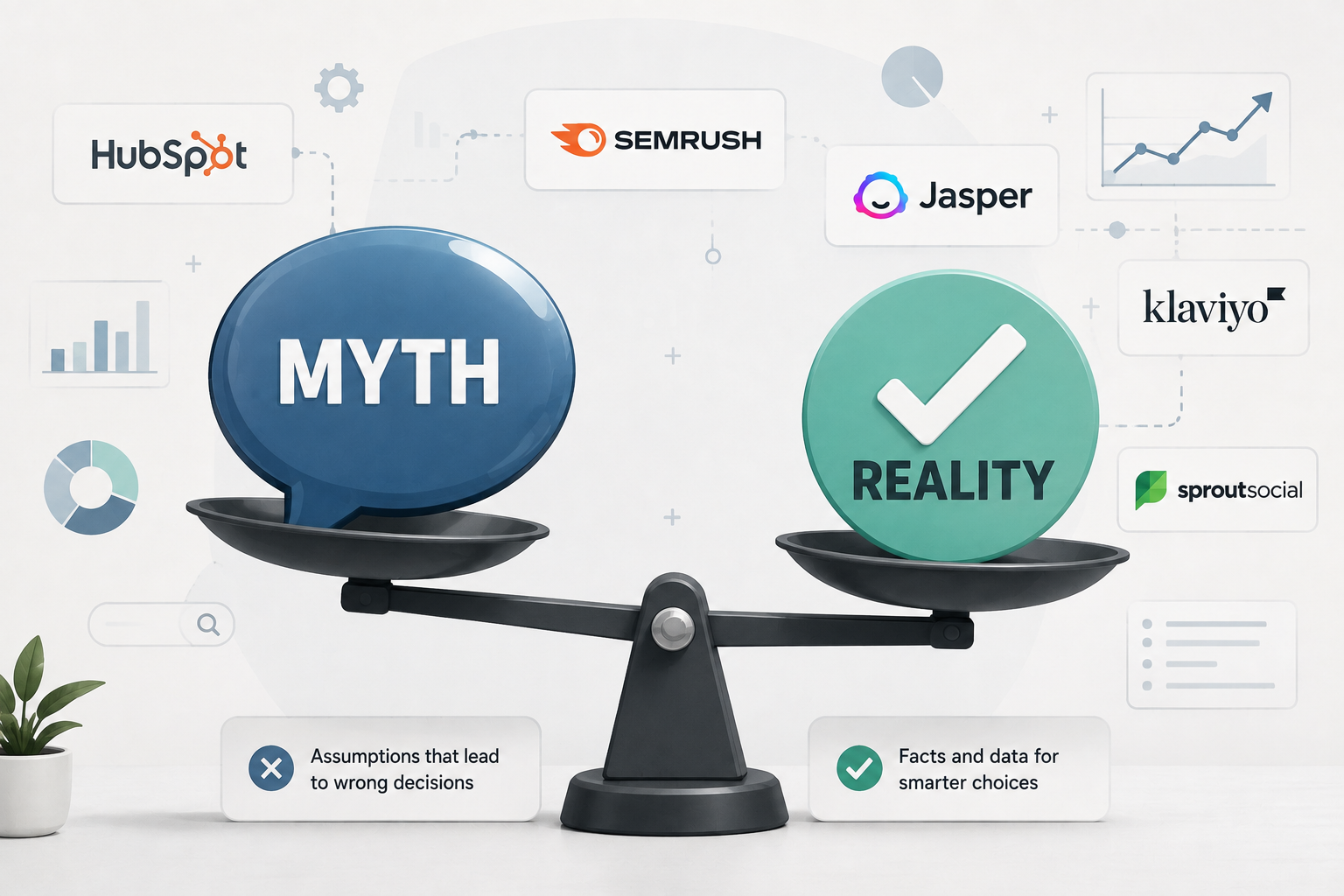
Myth vs. Reality: Quick Reference
| Myth | Reality |
|---|---|
| All-in-one platforms are always smarter | Only if you’ll use 3+ core functions weekly |
| Higher price = more capable at every tier | Feature sets vary drastically by tier within one brand |
| AI content is ready to publish as-is | Facts, prices, and stats still need human verification |
| AI-search visibility tracking can wait | Waiting loses the historical baseline you’ll need later |
| Usage-based pricing is riskier than flat fees | Riskier without a volume forecast; not riskier by nature |
FAQ’s
If all-in-one platforms aren’t always better, when should I actually consolidate?
Once you’re paying for three or more specialized tools that overlap in function, or once your team is spending noticeable time manually moving data between disconnected platforms — at that point, the consolidation overhead usually pays for itself.
How much should I budget for fact-checking AI-generated marketing content?
Plan for a human review pass on every piece before publishing, particularly for any content containing prices, statistics, or specific claims — this is an ongoing editorial cost, not a one-time setup step, regardless of which AI writing tool you use.
Is it too late to start tracking AI search visibility if I haven’t already?
No — but earlier is meaningfully better, since trend data (are we gaining or losing visibility in AI answers over time) is more useful than a single snapshot. Starting now still beats starting later.
How do I estimate usage volume before committing to a usage-based pricing tool?
Use your current manual process as a baseline — for example, count how many support conversations, leads, or content pieces you handle monthly today, then apply the tool’s per-unit pricing to that number to get a realistic monthly range before signing up.
Conclusion
None of these myths are unreasonable assumptions — they’re mostly outdated advice that made sense a year or two ago and hasn’t been updated as the market shifted. The common thread across all five: the right decision almost always comes down to your specific usage pattern, not a general rule about platforms, pricing models, or AI capability. Test that assumption against your own numbers before you buy, not after.
Pricing, plan structures, and feature availability for software products change frequently and may have been updated since publication. Always confirm current pricing and features directly on each provider’s official website before purchasing. This article is for informational purposes only and does not constitute professional business or financial advice.