

Most “best AI tools for affiliate marketing” lists rank everything at once, as if a solo blogger publishing their first ten reviews needs the same stack as an agency running six-figure paid traffic campaigns. They don’t. Buying Voluum before you have paid traffic to track, or Ahrefs’ Advanced tier before you have ten articles published, is money spent solving a problem you don’t have yet.
This guide is organized by stage instead: what to use when you’re starting out, what to add once you’re scaling organic content, and what becomes worth it once paid traffic enters the picture.
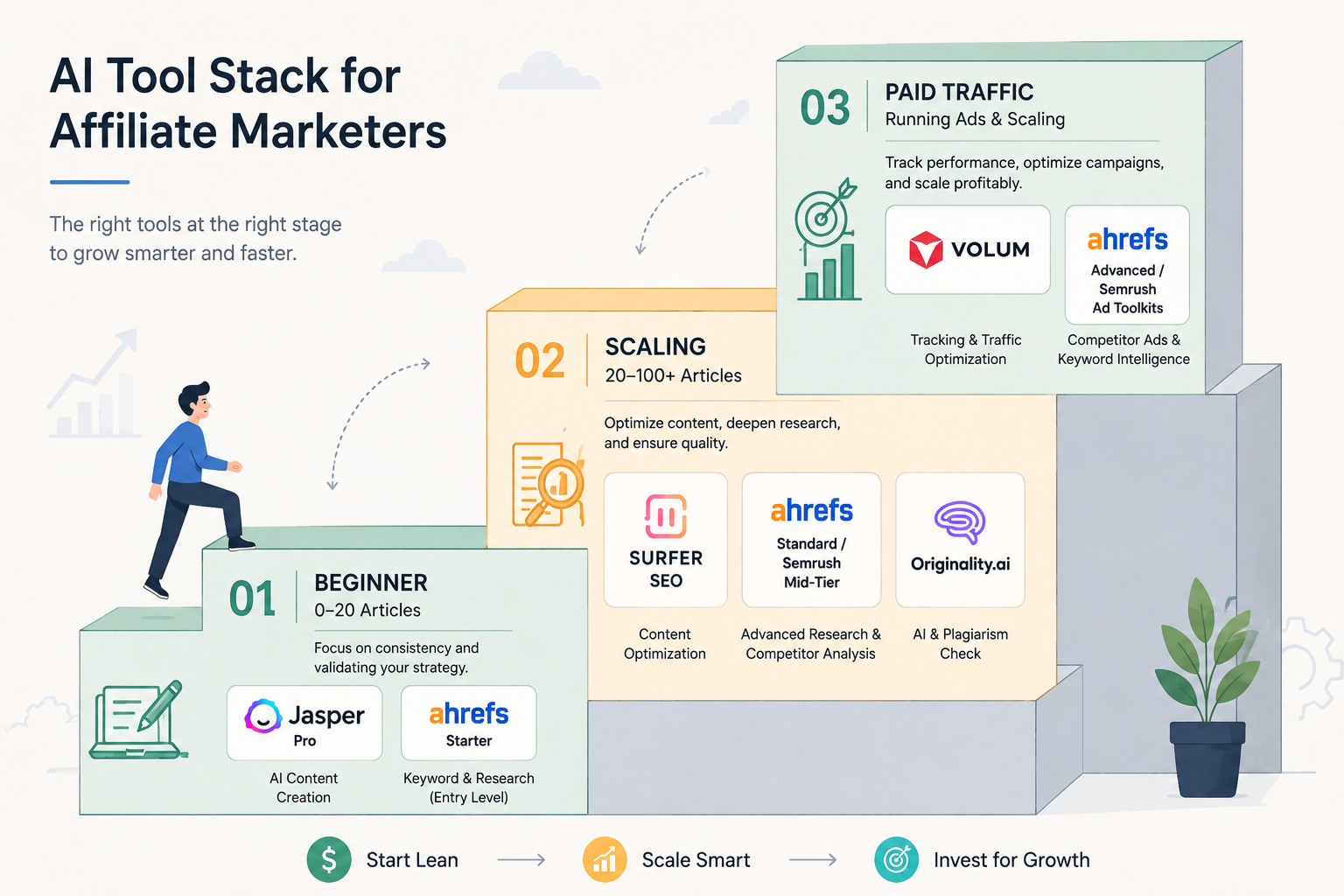
Stage 1: Just Starting Out (0–20 Articles Published)
At this stage, the priority is proving the model works — publishing consistently and seeing whether any content ranks or converts — without overspending on tools built for a scale you’re not at yet.
Jasper (Pro plan), at roughly $49–$69/month, is the right content tool here. It gets you consistent, on-brand drafts at the volume needed to hit 15–30 posts a month without a full writing team, using built-in AIDA and PAS copy frameworks that are genuinely useful for affiliate hooks and calls to action.
Ahrefs Starter, at $29/month, is the right research entry point rather than jumping straight to a $130+/month Semrush or Ahrefs Standard plan. It’s credit-limited and doesn’t include Content Explorer, but for validating whether a handful of target keywords are realistically winnable, it’s enough to get started.
Skip for now: Voluum, Semrush’s higher tiers, and Originality.ai’s team features. None of these solve a problem you have yet at 0–20 articles — you don’t have paid traffic to track, you don’t need AI-visibility monitoring on content that isn’t ranking yet, and you’re likely the only person touching your content, so quality-control workflows for multiple contributors aren’t necessary.
Realistic monthly budget at this stage: roughly $80–$100/month for one content tool and one lightweight research tool.
Stage 2: Scaling Organic Content (20–100+ Articles, Consistent Publishing)
Once you’re publishing consistently and have some ranking data to work with, the priority shifts from “produce content” to “produce content that competes” — and from guessing at quality to actively checking it.
Surfer SEO becomes worth adding here, generally starting around $49/month at the entry tier. The value isn’t writing content anymore — it’s scoring your drafts against what’s actually ranking for a given keyword, which matters much more once you’re competing against established review sites rather than just trying to get indexed.
Ahrefs Standard (roughly $249/month) or Semrush’s mid-tier plans (roughly $130–$300/month) become worth the upgrade at this stage specifically because Content Explorer and deeper competitive analysis — locked out of entry tiers — start paying for themselves once you’re chasing more competitive keywords and need to find content and link gaps competitors haven’t covered.
Originality.ai (starting around $14.95/month) is worth adding the moment more than one person — a freelancer, a VA, or even just heavier reliance on AI drafting tools — touches your content. At this volume, manually reviewing every draft for AI-detection risk or accidental plagiarism stops being realistic.
Realistic monthly budget at this stage: roughly $300–$550/month across content, optimization, research, and quality control.
Stage 3: Running Paid Traffic Alongside Organic
This is where the calculation changes most. Once you’re spending real money to drive clicks — rather than relying only on organic search — tracking which offers, landing pages, and traffic sources actually convert becomes the highest-leverage thing you can invest in.
Voluum, starting around $149/month, is specifically built for this. Its AI-powered traffic distribution automatically routes clicks toward better-performing offers and landing pages, and its anti-fraud detection filters out bot traffic before it skews your numbers — both of which matter far more once real ad spend is on the line. Voluum’s own positioning makes this explicit: it’s generally not worth the cost until you’re spending somewhere around $3,000+/month on traffic. Below that, the optimization gains don’t outweigh the subscription.
Semrush’s advertising-related toolkits and Ahrefs’ Advanced tier (roughly $449/month and up) become more justifiable here too, since paid campaigns benefit from the deeper competitor ad intelligence and keyword data these tiers unlock — data that’s overkill for a purely organic operation but genuinely useful once you’re bidding against competitors directly.
Realistic monthly budget at this stage: roughly $700–$1,200+/month, scaling with ad spend — this is the stage where tool costs should be evaluated as a percentage of traffic budget, not as a flat expense.
Stage-by-Stage Quick Reference
| Stage | Add This | Skip This | Typical Monthly Tool Cost |
|---|---|---|---|
| Starting Out (0–20 articles) | Jasper Pro, Ahrefs Starter | Voluum, Originality.ai, Semrush higher tiers | ~$80–$100 |
| Scaling Organic (20–100+ articles) | Surfer SEO, Ahrefs Standard/Semrush mid-tier, Originality.ai | Voluum (unless running paid traffic) | ~$300–$550 |
| Paid Traffic | Voluum, Ahrefs Advanced/Semrush ad toolkits | — | ~$700–$1,200+ |
The Mistake Most Affiliates Make
The most common budget mistake isn’t picking bad tools — it’s buying Stage 3 tools during Stage 1. A new affiliate site with a handful of published articles doesn’t need Voluum’s traffic-routing AI or Ahrefs’ Advanced tier competitive intelligence; it needs consistent content and validated keyword targets. Every dollar spent on a tool solving a problem you don’t have yet is a dollar not spent on the content or research that would actually move you to the next stage.
The reverse mistake also happens: staying on Stage 1 tools too long once you’re clearly in Stage 2 or 3. If you’re publishing 50+ articles and still relying on Ahrefs Starter’s limited credits, or running meaningful paid traffic through platform-native dashboards instead of a real tracker, you’re likely leaving performance on the table that would more than cover the upgrade cost.
FAQ’s
How do I know when I’ve moved from one stage to the next?
Use output and spend as the signal, not calendar time. Roughly 20+ consistently published articles signals a move to Stage 2; meaningful paid ad spend (generally cited around $3,000+/month) signals Stage 3 — not a fixed number of months since you started.
Should I upgrade research tools (Ahrefs/Semrush) before or after adding Surfer SEO?
Generally after. Research tools help you pick winnable keywords; Surfer SEO helps you compete once you’ve picked them. Upgrading optimization tools before you have a validated pipeline of target keywords usually isn’t the highest-leverage next step.
Is it ever worth skipping straight to a higher-tier tool if I’m starting with more budget?
It can be, but budget alone doesn’t create the need — a well-funded beginner still doesn’t have ranking data, published content, or traffic to optimize yet. Consider starting lean and reinvesting saved tool budget into content volume instead.
Do quality-control tools like Originality.ai matter for solo affiliates who write everything themselves?
Less critically, but they’re not useless — even solo writers using AI drafting tools benefit from a quality check before publishing, since AI-detection risk exists regardless of team size.
Conclusion
The best AI tool stack for affiliate marketing isn’t a fixed list — it’s a moving target tied to how much content you’re publishing and how much traffic you’re driving. Start lean with content and research tools, add optimization and quality control once you’re publishing consistently, and only add tracking tools like Voluum once paid traffic makes the investment pay for itself. Matching the tool to the stage is what keeps the stack profitable instead of just expensive.
Pricing, features, and plan names for software products change frequently and may have been updated since this article was published. Always verify current pricing and feature availability directly on each provider’s official website before making a purchasing decision. This article is for informational purposes and does not constitute professional business or financial advice.