
Every “best AI marketing tools” list makes the same mistake: it ranks tools as if every reader has the same problem. A solo freelancer juggling five clients has almost nothing in common with an enterprise marketing department managing a multi-hub CRM. Recommending the same platform to both is how people end up either overpaying for features they’ll never touch, or under-buying a tool that collapses the moment they try to scale it.
So instead of one ranked list, this guide is organized around a more useful question:
what does your team actually look like, and which AI marketing tools match that reality?
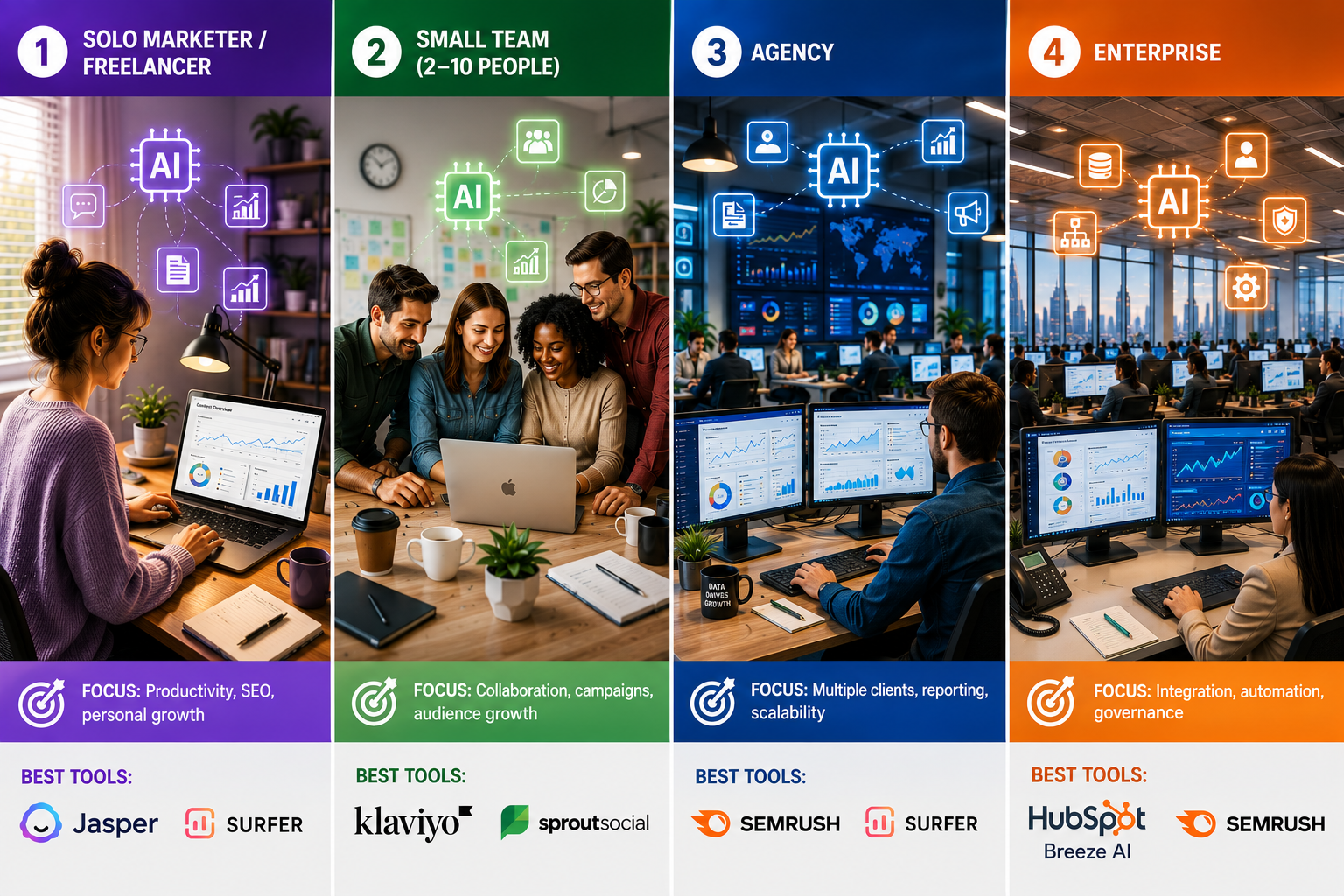
We’ll walk through four situations — solo operator, small team, agency, and enterprise — and name the tools that make sense at each stage, along with what they cost and where they start to strain.
If You’re a Solo Marketer or Freelancer
At this stage, budget and time are the two constraints that matter most. You need tools that work well without a learning curve eating your billable hours, and you need to avoid multi-seat pricing that assumes you’ll never be the only person using the software.
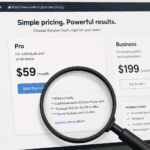
Jasper (Pro plan) is the strongest fit here for content production. At roughly $59–$69/month, it gives a single user a trained Brand Voice, a full content editor, and marketing-specific templates — without forcing you into the custom-quote Business tier that Jasper reserves for teams. The catch: if you ever add a second user, you’re negotiating enterprise pricing, so treat Jasper Pro as a single-seat tool by design, not a starter tier you’ll grow within.
Surfer SEO’s entry plan pairs well with Jasper for solo bloggers and affiliate marketers publishing 10–20 articles a month. Pricing has shifted around over the past year (expect somewhere in the $49–$99/month range depending on the current tier names), but the core value — a live SEO score as you write — doesn’t change. For a solo operator, this is often more useful than a full SEO suite like Semrush, which is built for competitive research most solo marketers don’t have time to act on anyway.
Skip for now: HubSpot Professional, Sprout Social, and Semrush’s higher tiers. These are built around team collaboration and multi-channel campaign management that a solo marketer typically doesn’t need yet — you’d be paying for seats and workflows you’re not using.
If You’re a Small Marketing Team (2–10 People)
This is where pricing models start to matter more than raw features. A tool that’s cheap for one person can become the most expensive line item on your budget once you multiply by headcount.
Klaviyo tends to make more sense than seat-based tools for small e-commerce teams, because its pricing scales with your contact list rather than your team size — the whole team can use the same account without extra per-seat charges. Entry pricing starts around $20/month for small lists, with every tier including the same AI segmentation and campaign-generation features, so you’re not paying more just to unlock functionality as your team grows.
Sprout Social’s Standard plan (around $199/seat/month on annual billing) is worth it once a small team needs a shared social inbox and can’t keep managing multiple platform logins individually. The AI reply suggestions and basic reporting cover most small-team needs; sentiment analysis and automation stay locked until the Advanced tier, which is usually overkill until you’re managing higher engagement volume.
Where teams get burned: Sprout Social and similar seat-based tools require annual prepayment with no simple month-to-month option, so a 5-person team on the Standard plan is committing to roughly $12,000/year upfront — budget for that before demoing the tool, not after.
If You’re Running an Agency
Agencies have a different problem entirely: the tools need to work across multiple client accounts without the pricing multiplying out of control, and reporting needs to be client-presentable, not just internally useful.
Semrush earns its place here because of breadth. A single Guru or Pro+ tier subscription covers keyword research, competitor tracking, content briefs, and — as of 2026 — AI visibility monitoring for how clients show up in AI Overviews and chatbot answers, all under one login your whole team can use. Pricing sits roughly in the $200–$300/month range for the mid tier, which is steep for a solo marketer but reasonable when it’s replacing three or four narrower tools across a client roster.
Surfer SEO’s Scale-tier plans (roughly $175–$220/month with annual billing) fit agencies producing higher content volume across multiple clients, since the content-editor credit limits scale with plan tier rather than being a hard per-account cap.
The agency-specific risk: almost every tool in this category prices “team seats” and “brand workspaces” as separate line items. Before signing an annual contract, map out exactly how many client brands and team members you’ll need supported — agencies routinely get surprised by add-on costs for things like extra workspaces or white-label reporting that weren’t obvious on the pricing page.
If You’re an Enterprise Marketing Department
At enterprise scale, the calculation changes again: you’re not choosing a tool, you’re choosing a system that other departments (sales, support) will also touch.
HubSpot’s Breeze AI, bundled into Marketing Hub Professional and above, is built for exactly this. Base subscriptions start around $800/month and multi-hub bundles run $1,300/month and up, but the real value at enterprise scale is that AI agents (Customer Agent, Prospecting Agent, Data Agent) work across marketing, sales, and service from one shared customer record. Since April 2026, agent pricing has moved to an outcome basis — for example, roughly $0.50 per resolved customer conversation — which is a meaningfully different cost model than a flat monthly fee and needs its own usage forecast before you turn agents on at scale.
Semrush’s Business tier (roughly $500+/month) becomes worth it here mainly for the API access, which lets enterprise teams pipe SEO and AI-visibility data directly into internal dashboards rather than working inside Semrush’s own UI.
The enterprise trap: it’s tempting to buy the top tier of everything “to be safe.” Resist it. Both HubSpot and Semrush charge meaningfully more for capabilities (API access, agent automation, advanced reporting) that sit unused for months while teams are still learning the core platform. Roll out in phases.
Quick Reference: Tool by Team Size
| Team Type | Recommended Tool(s) | Typical Monthly Cost |
|---|---|---|
| Solo / Freelancer | Jasper (Pro) + Surfer SEO (entry tier) | ~$110–$170 |
| Small Team (2–10) | Klaviyo + Sprout Social (Standard) | ~$220+ (varies by list size) |
| Agency | Semrush (mid tier) + Surfer SEO (Scale) | ~$375–$520 |
| Enterprise | HubSpot (Breeze AI) + Semrush (Business) | ~$1,300–$1,800+ base, plus usage |
A Note on Automation Across Any Team Size
Regardless of team size, one category worth layering in separately is no-code automation — tools like Gumloop, which let you connect AI models to your existing marketing stack without engineering resources. A solo marketer might use it to automate report pulls; an agency might use it to route client content approvals. It’s usage-priced with a free tier for testing, so it’s low-risk to try alongside whichever core platform you land on above.
FAQ’s
Should I choose based on price or features first?
Neither — choose based on your pricing model fit first. A seat-based tool (Sprout Social) and a usage-based tool (HubSpot agents) can list similar headline prices but produce very different bills once you factor in how your business actually grows.
Can I switch tools later without losing my work?
Usually yes for content tools (you own the drafts), but be careful with CRM and email platforms like HubSpot and Klaviyo — customer data, automation flows, and segmentation logic don’t always migrate cleanly between platforms, so switching later has real setup costs.
Is it worth paying for AI visibility tracking (like Semrush’s AI Visibility toolkit) yet?
If a meaningful share of your traffic already comes from search, it’s worth monitoring now rather than waiting — AI-generated answers are increasingly replacing some traditional search clicks, and it’s easier to track the shift from the start than to reconstruct historical data later.
Do agencies need different tools than in-house marketing teams?
Not fundamentally different tools, but different plan tiers — agencies almost always need the multi-workspace or multi-brand features that sit in the mid-to-upper pricing tiers of tools like Semrush and Surfer SEO, which in-house teams managing a single brand can usually skip.
Conclusion
The “best” AI marketing tool isn’t a fixed answer — it’s a function of team size, pricing model fit, and how much complexity you can actually manage right now. A solo marketer overpaying for HubSpot’s enterprise stack is just as much of a mismatch as an agency trying to run five client brands through a single-seat Jasper Pro account. Match the tool to where your team actually is today, not where you hope to be in two years — you can always upgrade once the current tier’s limits start showing.