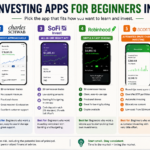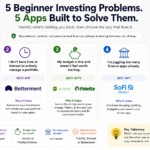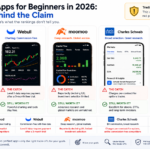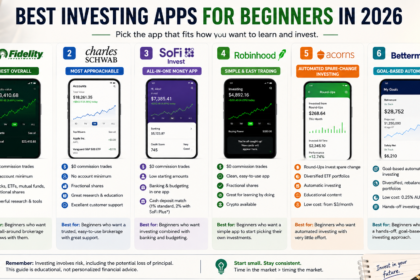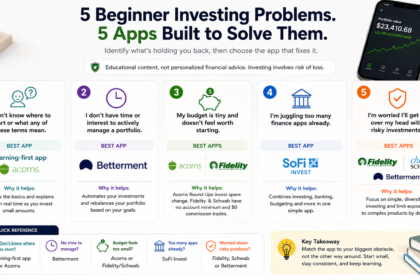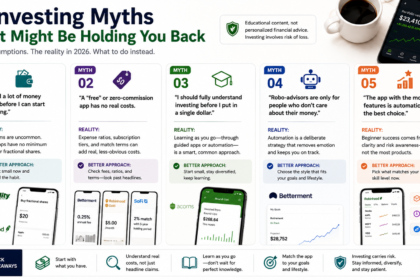

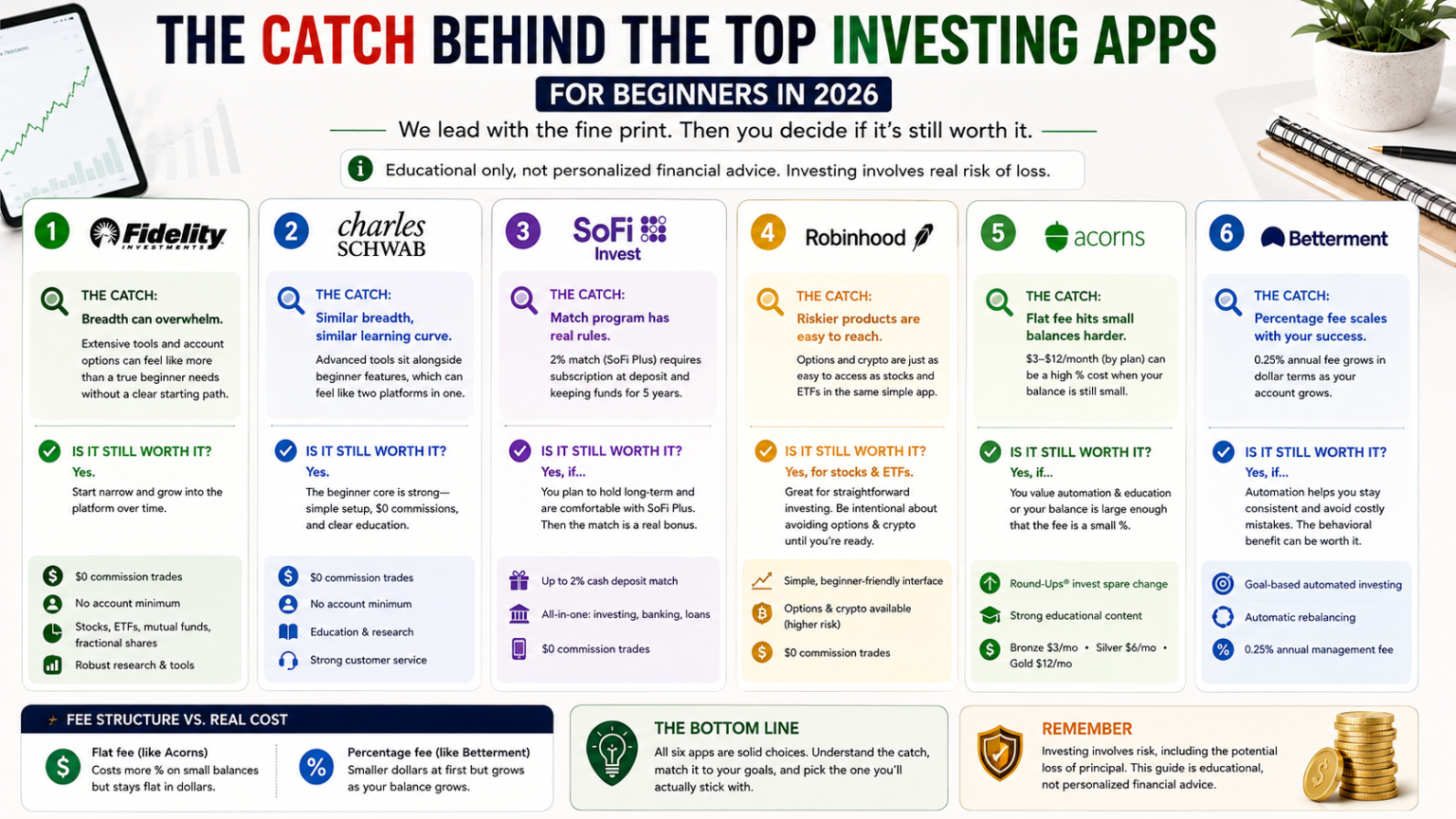
Every “best investing app for beginners” list leads with the same headline claim: zero commission, no account minimum, start with just a dollar. What most skip is the fine print that shows up after you’ve already opened the account — a flat fee that costs more than it looks like on a small balance, a match program with a multi-year holding requirement, or a percentage-based fee that scales differently than a flat one.
- Fidelity: The Catch Is Its Breadth Can Overwhelm a True Beginner
- Charles Schwab: The Catch Is Similar Breadth, Similar Learning Curve
- SoFi Invest: The Catch Is the Match Program’s Real Requirements
- Robinhood: The Catch Is Easy Access to Riskier Products Alongside Basic Investing
- Acorns: The Catch Is the Flat Fee’s Real Cost on a Small Balance
- Betterment: The Catch Is a Percentage Fee That Scales With Your Success
- Fee Structure vs. Real Cost Quick Reference
- FAQ’s
- Conclusion
This guide flips the format. For each app, we lead with the catch, then explain whether it’s still worth using despite it.
As a reminder: this article is educational only, not personalized financial advice, and investing carries real risk of loss.
Fidelity: The Catch Is Its Breadth Can Overwhelm a True Beginner
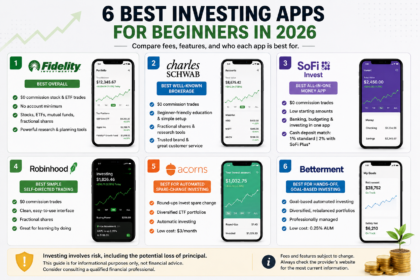
Fidelity’s $0 commission trades and lack of an account minimum make it genuinely accessible, and it’s repeatedly cited as the default recommendation for beginners. The catch: its sheer breadth — extensive research tools, multiple account types, a broad investment menu — can feel like more infrastructure than someone making their first trade actually needs, without a strong built-in “start here” guided path the way some newer apps offer.
Is it still worth it? Yes, especially if you plan to grow with the platform over years, not just your first trade. Start narrow — a single brokerage account and a simple index fund or two — and let the rest of the platform’s depth wait until you’re ready for it, rather than trying to explore every feature on day one.
Charles Schwab: The Catch Is Similar Breadth, Similar Learning Curve
Charles Schwab pairs a trusted brand name with $0 commission trades and clear educational tools, genuinely designed to be approachable for first-time investors. The catch: like Fidelity, its full platform — including more advanced research and trading tools built for experienced investors — sits alongside the beginner-friendly features, which can make the interface feel like it’s speaking to two different audiences at once.
Is it still worth it? Yes, for the same reason as Fidelity — the beginner-friendly core (simple account setup, $0 commissions, clear educational content) is genuinely there, you just don’t need to engage with the advanced tools until you’re ready to.
SoFi Invest: The Catch Is the Match Program’s Real Requirements
SoFi Invest’s cash deposit match — 1% standard, 2% for SoFi Plus subscribers — sounds like straightforward free money on top of your contributions. The catch: SoFi Plus members must be subscribed at the time of deposit and keep the deposited funds in the account for five years to retain the full 2% match — a real, specific commitment that isn’t obvious from a headline “2% match” claim.
Is it still worth it? Yes, if you’re already planning to hold your investments long-term and are comfortable with the SoFi Plus subscription — the match becomes a genuine bonus under those conditions. It’s a less compelling reason on its own to sign up if you’re not sure you’ll keep funds in the account for the full five-year period the match requires.
Robinhood: The Catch Is Easy Access to Riskier Products Alongside Basic Investing
Robinhood’s straightforward, minimalist interface is genuinely one of the easiest ways for a beginner to place a first trade. The catch: that same simple interface gives easy access to options trading and cryptocurrency alongside basic stock and ETF investing — considerably riskier, more complex products sitting just a few taps away from a beginner’s first stock purchase, without necessarily as much guardrail or educational friction as those products might warrant for a true first-time investor.
Is it still worth it? Yes, for straightforward stock and ETF investing specifically. It’s worth being deliberate about not drifting into options or crypto trading simply because they’re accessible in the same app, until you’ve specifically researched and understood those products separately from basic investing.
Acorns: The Catch Is the Flat Fee’s Real Cost on a Small Balance
Acorns’ Round-Ups mechanic is a genuinely clever, low-effort way to start investing, and its educational content is specifically praised as robust. The catch: Acorns charges a flat $3/month fee for its Bronze tier (with Silver and Gold at $6 and $12/month respectively) rather than a percentage-based fee — and reviewers directly note this “may seem small, but it can be expensive compared to other platforms on this list” specifically because a flat fee represents a much larger percentage cost on a small account balance than the same fee would on a larger one.
Is it still worth it? Yes, if you value the automation and educational content enough to accept the fee, or if your account balance is large enough that $3–$12/month represents a genuinely small percentage of your holdings. On a very small starting balance, it’s worth doing the math on what percentage of your money that flat fee actually represents before assuming it’s negligible.
Betterment: The Catch Is a Percentage Fee That Scales With Your Success
Betterment’s automated, goal-based portfolio management and rebalancing genuinely removes ongoing decision-making for hands-off investors. The catch: its percentage-based annual management fee means that as your account grows — which is, after all, the goal — your dollar cost for the same service grows right along with it, unlike a flat fee or a zero-commission self-directed account where costs don’t scale up with your success.
Is it still worth it? Yes, if the hands-off automation and rebalancing genuinely save you from mistakes or inaction you’d otherwise be prone to — that behavioral benefit can be worth the scaling fee for many people. It’s worth comparing the actual dollar cost at your expected future balance, not just the current fee percentage, before assuming it’s the cheapest long-term option.
Fee Structure vs. Real Cost Quick Reference
| App | Headline Claim | The Fine Print |
|---|---|---|
| Fidelity | $0 commission, no minimum | Breadth of tools can overwhelm without a clear beginner starting path |
| Charles Schwab | $0 commission, approachable | Advanced tools sit alongside beginner features, same learning curve as Fidelity |
| SoFi Invest | Up to 2% deposit match | Requires SoFi Plus subscription + 5-year fund-holding period for full match |
| Robinhood | Simple, easy trading | Options and crypto are just as easily accessible as basic stock investing |
| Acorns | Just spare change, low effort | Flat $3–$12/month fee can be a high percentage cost on small balances |
| Betterment | Hands-off, automated | Percentage-based fee scales up in dollar terms as your account grows |
FAQ’s
Is a flat fee or a percentage-based fee better for a beginner?
It depends on your account size — a flat fee (like Acorns’ $3/month) is more expensive as a percentage of a small balance but stays constant in dollar terms as your account grows, while a percentage-based fee (like Betterment’s) starts smaller in dollar terms but scales up as your balance increases. Run the numbers for your specific expected balance rather than assuming either structure is universally cheaper.
Do I need to worry about accidentally trading options or crypto on Robinhood?
Not automatically — you generally need to actively enable options trading and separately fund or convert to crypto, but the point remains that these considerably riskier products are more easily accessible within the same familiar interface than on some more education-first platforms, so it’s worth being intentional about sticking to basic stock and ETF investing until you’ve specifically researched those other products.
Is SoFi’s deposit match worth pursuing if I’m not sure I’ll keep the money invested for five years?
It’s worth factoring the five-year holding requirement into your decision specifically — if there’s a real chance you’ll need to withdraw the deposited funds sooner, the full 2% match (for SoFi Plus subscribers) isn’t guaranteed, and the standard 1% match for non-subscribers doesn’t carry the same specific holding requirement mentioned for the enhanced rate.
Should I avoid Acorns entirely because of the flat fee?
Not necessarily — the fee is a real cost to weigh, but the automation and educational content have genuine value for some beginners. If your account balance is still quite small, it’s worth calculating what percentage of your holdings the fee represents and deciding if that trade-off is acceptable to you specifically.
Conclusion
None of these catches make the apps on this list bad choices — Fidelity, Charles Schwab, SoFi Invest, Robinhood, Acorns, and Betterment are all genuinely reasonable starting points for beginners. The difference between a smart choice and a frustrating one usually comes down to understanding the actual fee structure and fine print — match program terms, flat versus percentage fees, easy access to riskier products — before you open the account, not after your first statement or your first unexpected fee.
This article is for informational and educational purposes only and does not constitute financial, investment, or tax advice. The authors are not licensed financial advisors. Investing involves risk, including the potential loss of principal, and past performance does not guarantee future results. Fees, features, and account terms change frequently and may have been updated since this article was published — always verify current details directly on each provider’s official website, and consider consulting a qualified financial professional before making investment decisions.