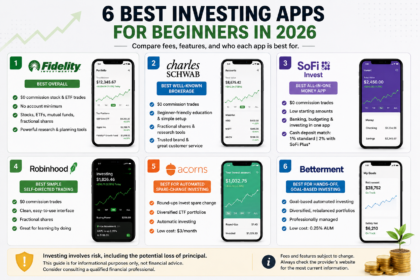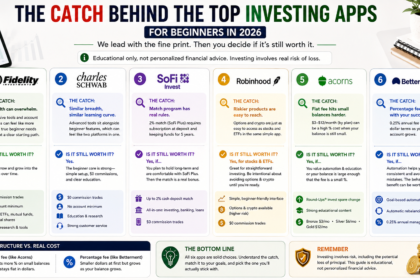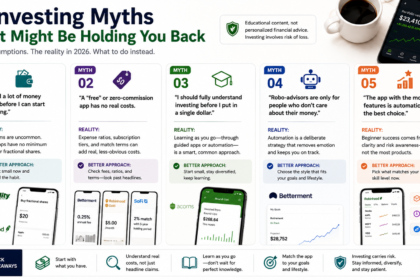


Most people don’t download an investing app because they saw an ad — they download one because something specific is standing between them and actually starting to invest. They don’t know where to begin. They don’t have time or interest to actively manage a portfolio. Their budget feels too small to bother. Most app roundups skip straight to feature comparisons without asking the more useful question first:
- Problem 1: “I genuinely don’t know where to start or what any of these terms mean”
- Problem 2: “I don’t have the time or interest to actively manage a portfolio”
- Problem 3: “My budget for investing is genuinely tiny, and it doesn’t feel worth starting”
- Problem 4: “I’m juggling too many separate finance apps already and don’t want to add another”
- Problem 5: “I’m worried I’ll get in over my head with risky investments before I understand what I’m doing”
- Matching Problems to Apps: Quick Reference
- A Word on Solving More Than One Problem at Once
- FAQ’s
- Conclusion
What’s actually stopping you from investing right now?
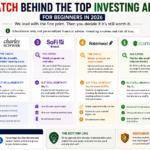
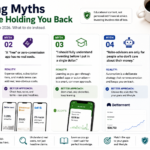
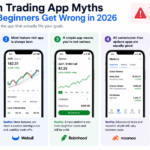
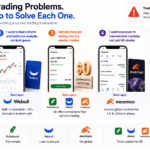
Here are five common beginner investing problems in 2026, and the specific apps built to solve each one.
Quick reminder: this is educational content, not personalized financial advice, and investing involves real risk of loss.
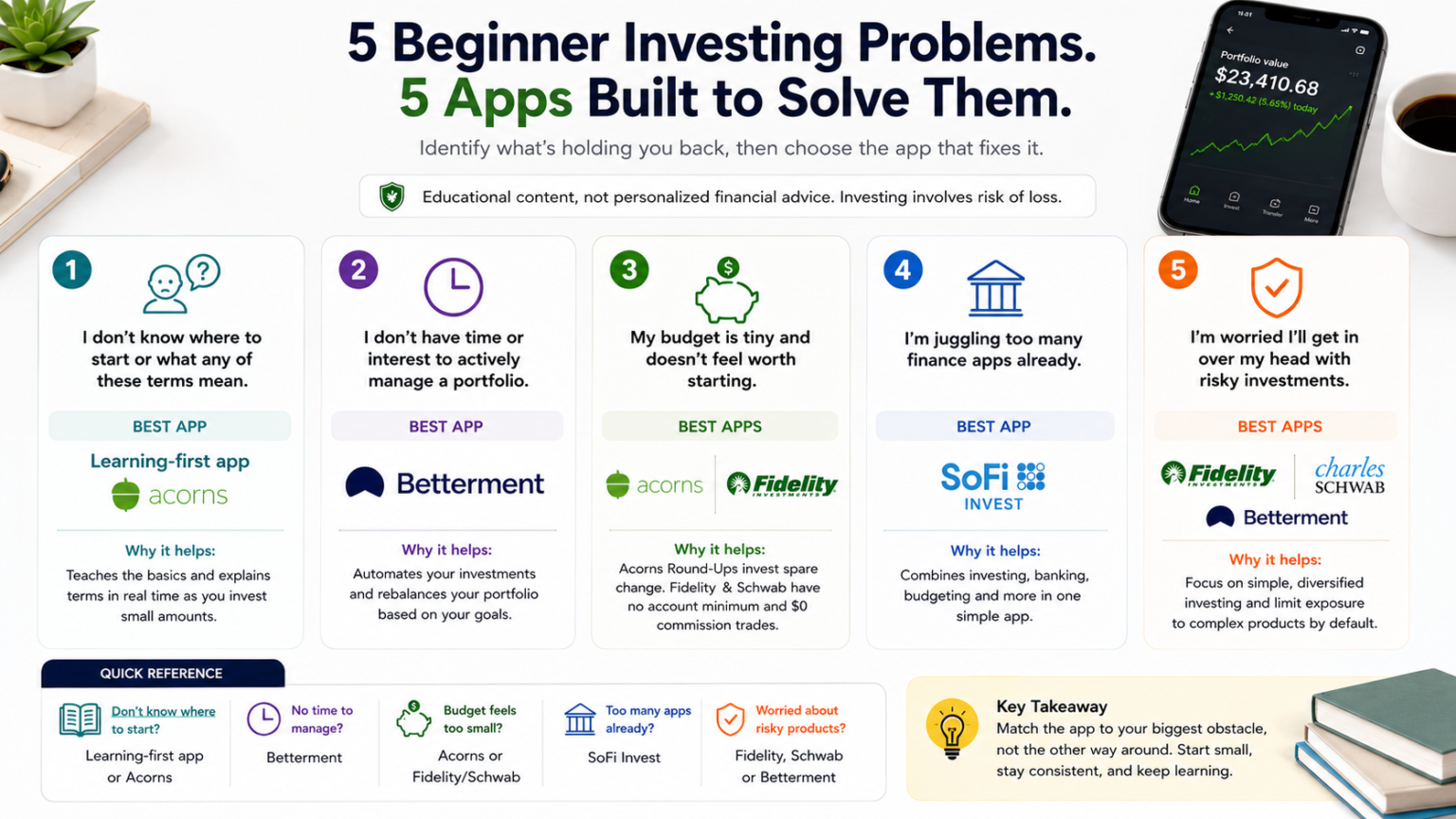
Problem 1: “I genuinely don’t know where to start or what any of these terms mean”
If stocks, ETFs, and expense ratios all sound like a foreign language, the fix is an app specifically built to teach before it asks you to make decisions with real money.
The right app: A learning-first app with daily lessons and simulator practice, or Acorns, whose educational content is specifically designed to give real-time, simple explanations of unfamiliar words as you use the app — letting the learning happen naturally alongside small, automated investing rather than in a separate, disconnected lesson.
Where it falls short: Learning-first, simulator-based apps are great for building understanding but eventually require you to transition to a real-money platform to actually start investing — the practice phase shouldn’t become indefinite if your goal is genuinely to start building wealth, not just to learn indefinitely.
Problem 2: “I don’t have the time or interest to actively manage a portfolio”
If picking individual stocks, monitoring the market, and rebalancing sounds like more effort than you want to commit to regularly, the fix is automation that handles those decisions for you.
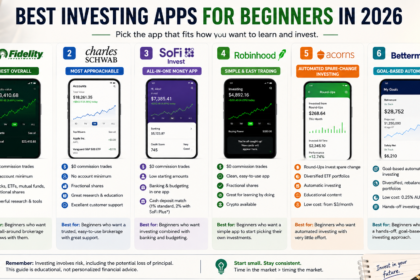
The right app: Betterment. Its robo-advisor model builds and manages a diversified portfolio automatically based on your goals and risk tolerance, including ongoing rebalancing — a genuinely hands-off approach for beginners who want their money working without needing to actively monitor it.
Where it falls short: The percentage-based management fee means costs scale up as your account grows, a real trade-off for the convenience of automation — worth weighing against the value of your own time and attention if you were considering managing it yourself instead.
Problem 3: “My budget for investing is genuinely tiny, and it doesn’t feel worth starting”
If you’re waiting until you have “enough” money to start investing, the fix is an app specifically designed to make small, painless contributions without requiring you to consciously set aside a specific dollar amount each month.
The right app: Acorns. Its Round-Ups feature automatically invests spare change from purchases you’re already making, rounding up to the nearest dollar — removing the psychological barrier of deciding how much to contribute and just building the habit passively in the background.
Where it falls short: Acorns’ flat monthly fee ($3/month for the Bronze tier) can represent a meaningfully high percentage cost on a very small account balance, so it’s worth checking whether a fee-free option like Fidelity or Schwab (both with no account minimum) might actually be more cost-effective for a genuinely tiny starting budget, even without the round-up convenience.
Problem 4: “I’m juggling too many separate finance apps already and don’t want to add another”
If your banking, budgeting, and now investing are scattered across multiple disconnected apps, the fix is consolidating rather than adding yet another standalone platform.
The right app: SoFi Invest. It’s specifically built to combine investing with broader personal finance tools — banking, budgeting — in a single app, reducing the number of separate platforms you need to check and manage.
Where it falls short: Consolidation comes with a trade-off in depth — SoFi Invest’s investment selection and advanced research tools are generally less extensive than a dedicated full-service brokerage like Fidelity or Schwab, so if you eventually want deeper research capabilities, you may need to add a second, more specialized platform anyway.
Problem 5: “I’m worried I’ll get in over my head with risky investments before I understand what I’m doing”
If part of your hesitation about investing apps is a fear of accidentally drifting into options trading, crypto, or other complex products before you’re ready, the fix is choosing a platform structured around simpler, more guided investing by default.
The right app: Fidelity or Charles Schwab, both of which center their beginner experience around straightforward stock, ETF, and fund investing with extensive educational content, rather than surfacing riskier products as prominently as some more trading-focused apps do. Betterment solves this concern even more directly, since its automated model doesn’t involve you picking individual, potentially risky investments at all.
Where it falls short: This is a matter of platform structure and default experience, not an absolute guarantee — any investing, including diversified stocks and ETFs, carries real risk of loss, and no app fully removes the need for you to understand the basics of what you’re invested in.
Matching Problems to Apps: Quick Reference
| Your Problem | Best-Fit App | Not the Right Fit For |
|---|---|---|
| Don’t know where to start | Learning-first app or Acorns | Anyone ready to skip straight to active trading |
| No time/interest to manage a portfolio | Betterment | Anyone who wants to learn to pick their own investments |
| Budget feels too small to bother | Acorns (Round-Ups) or Fidelity/Schwab (no minimum) | Anyone who’d rather pay zero fees over convenience |
| Too many separate finance apps already | SoFi Invest | Anyone wanting the deepest possible research tools |
| Worried about accidentally overreaching into risky products | Fidelity, Schwab, or Betterment | Anyone who specifically wants access to options/crypto |
A Word on Solving More Than One Problem at Once
It’s tempting to look for one app that solves every beginner obstacle simultaneously — teaches you everything, requires zero time, costs nothing, consolidates all your finances, and completely eliminates risk. In practice, the apps above are strong specifically because they’re built around a particular priority. No app eliminates the fundamental risk that comes with investing, and no single platform is simultaneously the most educational, the most automated, the cheapest, and the most consolidated. Identify which specific problem is actually keeping you from starting, and choose based on that.
FAQ’s
What if my biggest obstacle is a mix of not knowing where to start and having a small budget?
Acorns addresses both reasonably well at once — its real-time educational explanations help with the knowledge gap, while its Round-Ups mechanic accommodates a tiny budget without requiring a specific monthly contribution decision.
Is it irresponsible to start investing with an app if I still don’t fully understand investing?
Not inherently, as long as you start with straightforward, diversified options (broad index funds or automated portfolios) rather than complex or high-risk individual bets, and continue learning as you go — many of the apps here are specifically built to support that gradual approach.
Should I wait until I have more money saved before opening an investing account?
Not necessarily — several of these apps have no account minimum and support very small contributions, so waiting for a specific “enough” amount isn’t required to start; the habit of consistent investing, even in small amounts, is often more valuable than waiting to invest a larger lump sum later.
Can consolidating my finances into one app like SoFi Invest actually hurt me in the long run?
It can, if you later need research tools or investment options that a more specialized brokerage offers — consolidation trades some depth for convenience, so it’s worth reassessing periodically whether a dedicated platform would serve your growing needs better.
Conclusion
The fastest way to keep putting off investing is waiting for the “perfect” app instead of matching one to the specific thing actually holding you back — a knowledge gap, a lack of time, a tight budget, app fatigue, or fear of taking on more risk than you’re ready for. Match the app to your real obstacle, start small if needed, and remember that every app on this list still requires you to understand that investing carries genuine risk of loss — no platform, however well-designed, removes that fundamental reality.
This article is for informational and educational purposes only and does not constitute financial, investment, or tax advice. The authors are not licensed financial advisors. Investing involves risk, including the potential loss of principal, and past performance does not guarantee future results. Fees, features, and account terms change frequently and may have been updated since this article was published — always verify current details directly on each provider’s official website, and consider consulting a qualified financial professional before making investment decisions.