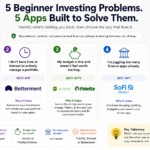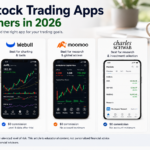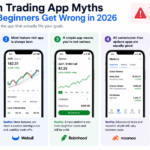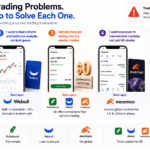


Ask ten people what stops them from investing, and a lot of the answers trace back to assumptions nobody’s actually tested — you need a lot of money to start, a “free” app has no real costs, you should wait until you fully understand everything before putting in a dollar. Some of this thinking made more sense years ago, before account minimums largely disappeared and fractional shares became standard. In 2026, several of these assumptions are quietly keeping people from starting, or steering them toward costlier choices once they do.
- Myth 1: “I need a significant amount of money saved before I can start investing”
- Myth 2: “A ‘free’ or zero-commission investing app has no real costs”
- Myth 3: “I should fully understand investing before I put in a single dollar”
- Myth 4: “Robo-advisors are only for people who don’t care about their money”
- Myth 5: “The app with the most features is automatically the best choice for a beginner”
- Myth vs. Reality: Quick Reference
- FAQ’s
- Conclusion
Here are five of the most common investing app myths, what current app landscapes actually show, and what to do instead.
As always: this is educational content, not personalized financial advice, and investing carries genuine risk of loss.
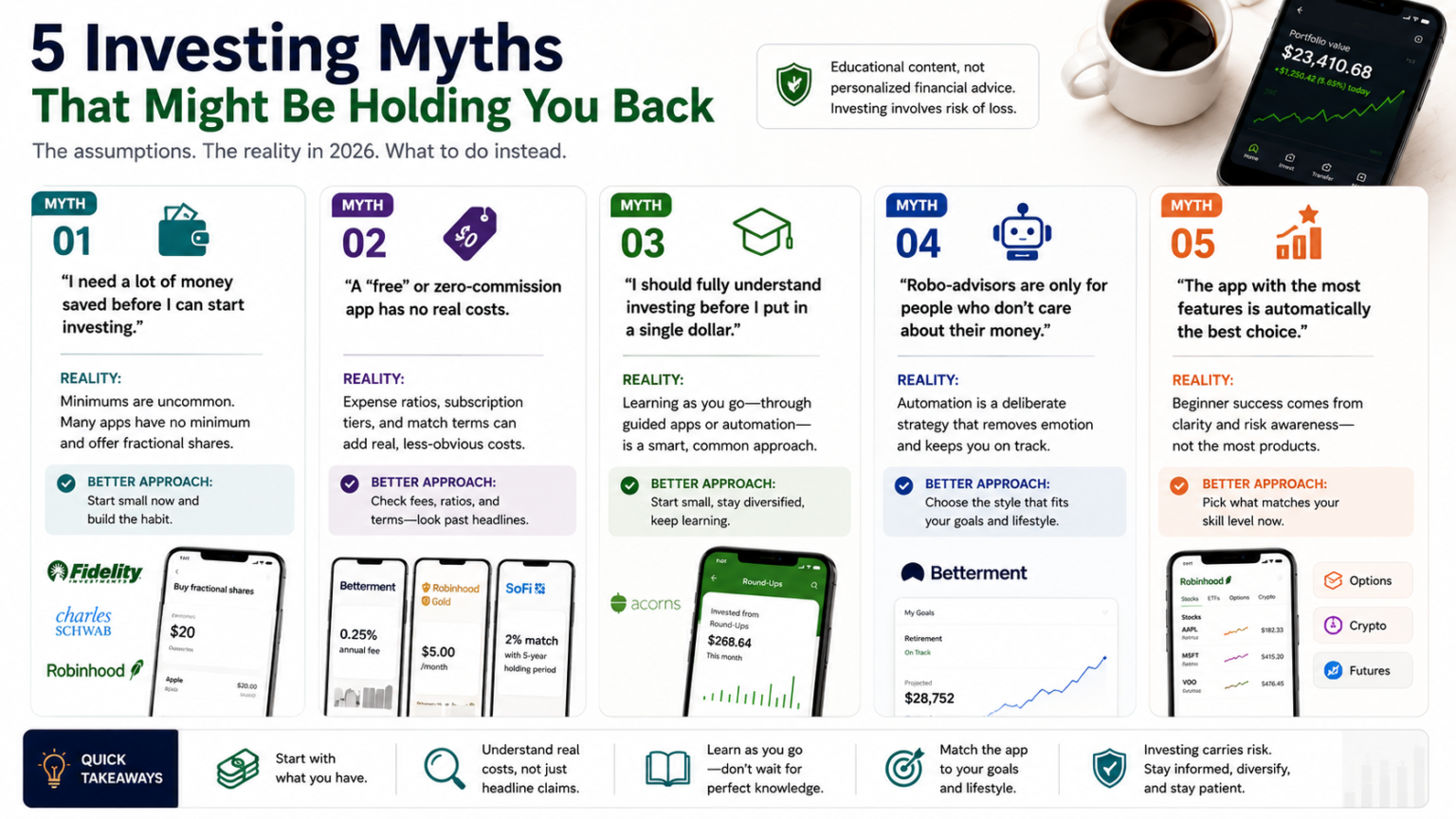
Myth 1: “I need a significant amount of money saved before I can start investing”
The assumption: Investing apps require a meaningful upfront deposit — hundreds or thousands of dollars — making it not worth exploring until you’ve saved up enough to “really” get started.
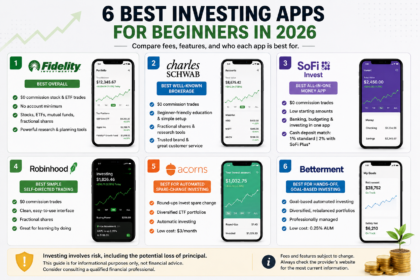
The reality: Minimums are uncommon in 2026, and several major apps — including Fidelity, Charles Schwab, and Robinhood — have no account minimum at all, with fractional share investing letting you start with just a few dollars. One direct piece of guidance specifically recommends avoiding any broker that requires upfront deposits of several hundred or thousand dollars, precisely because that’s no longer the norm among reputable apps.
What to do instead: Start with whatever small amount you’re comfortable with rather than waiting to accumulate a larger sum first — building the habit of consistent investing, even in small amounts, is generally more valuable than delaying until you have a bigger lump sum.
Myth 2: “A ‘free’ or zero-commission investing app has no real costs”
The assumption: Since apps like Fidelity, Schwab, and Robinhood advertise $0 commission trades, using them is genuinely free with no meaningful costs to account for.
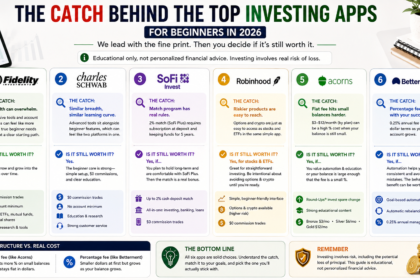
The reality: Zero-commission trading doesn’t mean zero cost in every case — fund expense ratios, optional subscription tiers (like Robinhood Gold or SoFi Plus), and match program terms with specific holding requirements can all add real cost or conditions that aren’t obvious from the “$0 commission” headline alone. Acorns’ flat monthly fee, for instance, is directly noted by reviewers as potentially expensive relative to a small account balance despite the app’s low-friction reputation.
What to do instead: Look past the headline “$0 commission” or “free” claim and check for fund-level expense ratios, optional subscription costs, and any conditions on bonus or match programs before assuming an app has no meaningful costs.
Myth 3: “I should fully understand investing before I put in a single dollar”
The assumption: Since investing carries real risk, the responsible approach is to thoroughly study and understand every concept before opening an account or making a first contribution.
The reality: The better starting point for a first-time investor is often an app that explains the basics, helps build a repeatable habit, and lets the user practice decisions before real money is on the line — not necessarily full mastery before starting at all. Apps built around gradual, guided learning (daily lessons, simulator practice) or low-effort automation (Acorns’ Round-Ups) are specifically designed to let understanding develop alongside actual, if small and cautious, participation.
What to do instead: Start small with a straightforward, diversified option while continuing to learn, rather than treating “full understanding” as a prerequisite that must be met before any money goes in — waiting indefinitely for complete confidence often just delays the compounding benefit of starting early.
Myth 4: “Robo-advisors are only for people who don’t care about their money”
The assumption: Choosing an automated, hands-off platform like Betterment signals a lack of engagement with your finances compared to actively picking your own stocks through a self-directed app.
The reality: Robo-advisors exist specifically because automated, goal-based portfolio management and rebalancing is a legitimate, deliberate strategy — not a lesser one — for people who’d rather have their money working toward a specific goal without needing to actively monitor and adjust it themselves. Removing emotional, ad-hoc decision-making from investing is, for many people, a genuine advantage rather than a sign of disengagement.
What to do instead: Choose between self-directed and automated investing based on how you actually want to engage with your money, not based on an assumption that one approach reflects more “seriousness” about investing than the other.
Myth 5: “The app with the most features is automatically the best choice for a beginner”
The assumption: Since apps like Robinhood offer stocks, ETFs, options, and crypto all in one place, that breadth of available products makes it a more complete — and therefore better — choice for a new investor than a more narrowly focused app.
The reality: Reviewers specifically evaluate beginner suitability based on whether an app reduces confusion and helps users understand risk before they chase returns — not on how many total products it offers. Easy access to a wide range of products, including considerably riskier ones like options and crypto, can work against a true beginner if it encourages exploring complexity before they’ve built a foundation in basic stock and ETF investing.
What to do instead: Prioritize apps and account structures that match your current skill level over ones that simply offer the most total features — you can always add complexity, and additional products, once you’ve built a solid foundation.
Myth vs. Reality: Quick Reference
| Myth | Reality |
|---|---|
| You need a lot of money saved to start | Minimums are uncommon; several major apps have no minimum and support fractional shares |
| “Free” or zero-commission apps have no real costs | Expense ratios, subscription tiers, and match program terms can add real, less-obvious costs |
| You must fully understand investing before starting | Starting small while learning gradually is a reasonable, commonly recommended approach |
| Robo-advisors are only for the less engaged | Automation is a legitimate, deliberate strategy, not a sign of disengagement |
| More features/products always means a better beginner app | Beginner suitability is about reducing confusion and risk, not maximizing available products |
FAQ’s
How small can I realistically start investing with in 2026?
Very small — several apps support fractional share investing with no account minimum, meaning you can genuinely start with just a few dollars rather than needing a large lump sum.
What hidden costs should I specifically check for before choosing a “free” investing app?
Look for fund-level expense ratios (a percentage charged by the underlying investment, not the app itself), any optional paid subscription tiers, and the specific terms of any deposit match or bonus program, including holding period requirements.
Is it bad to start investing before I fully understand terms like expense ratio or diversification?
Not necessarily — many beginner-friendly apps are specifically designed to teach these concepts as you go, and starting with a simple, diversified option (a broad index fund, for example) while you continue learning is a commonly recommended approach rather than waiting for full mastery first.
Should I feel like I’m “doing investing wrong” if I choose an automated app over picking my own stocks?
No — automated, goal-based investing is a legitimate strategy suited to people who’d rather not actively manage individual holdings, and it’s not a lesser or less serious approach than self-directed investing, just a different one matched to different preferences.
Conclusion
None of these five myths are unreasonable on their face — they’re mostly cautious-sounding assumptions that don’t hold up once tested against how accessible and varied the 2026 investing app landscape actually is. The pattern across all five: starting small, checking past headline claims for real costs, learning gradually rather than waiting for full mastery, and choosing based on your actual preferences rather than perceived seriousness or feature count all serve beginners better than the more hesitant, assumption-driven defaults. Test these assumptions against your own situation, and remember that whichever app you choose, investing still carries genuine risk — this article is educational, not a substitute for professional financial advice.
This article is for informational and educational purposes only and does not constitute financial, investment, or tax advice. The authors are not licensed financial advisors. Investing involves risk, including the potential loss of principal, and past performance does not guarantee future results. Fees, features, and account terms change frequently and may have been updated since this article was published — always verify current details directly on each provider’s official website, and consider consulting a qualified financial professional before making investment decisions.