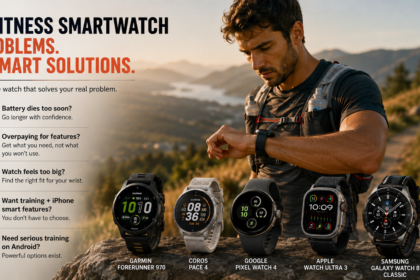


Every “best fitness smartwatch” list leads with the same headline numbers: battery life, display size, starting price. What most skip is the trade-off that shows up after you’ve already bought the watch — a battery rating that only applies in one mode, a size that only comes in one option, or a price gap that isn’t justified by the actual difference in daily use.
- Apple Watch Ultra 3: The Trade-Off Is a Massive Battery Drop in GPS Mode
- Garmin Forerunner 970: The Trade-Off Is a Steep Price for a Modest Upgrade Over a Cheaper Model
- COROS Pace 4: The Trade-Off Is Fewer Smart Features and a Smaller Ecosystem
- Garmin Venu 4: The Trade-Off Is Reduced Battery Life and Navigation Depth Versus Dedicated Running Watches
- Samsung Galaxy Watch 8 Classic: The Trade-Off Is a Single Large Size With No Smaller Option
- Google Pixel Watch 4: The Trade-Off Is a Less Traditional Watch Aesthetic and Weaker Fitness-Specific Depth
- Trade-Off Quick Reference
- FAQ’s
- Conclusion
This guide flips the format. For each smartwatch, we lead with the trade-off, then explain whether it’s still worth the purchase despite it.
Apple Watch Ultra 3: The Trade-Off Is a Massive Battery Drop in GPS Mode
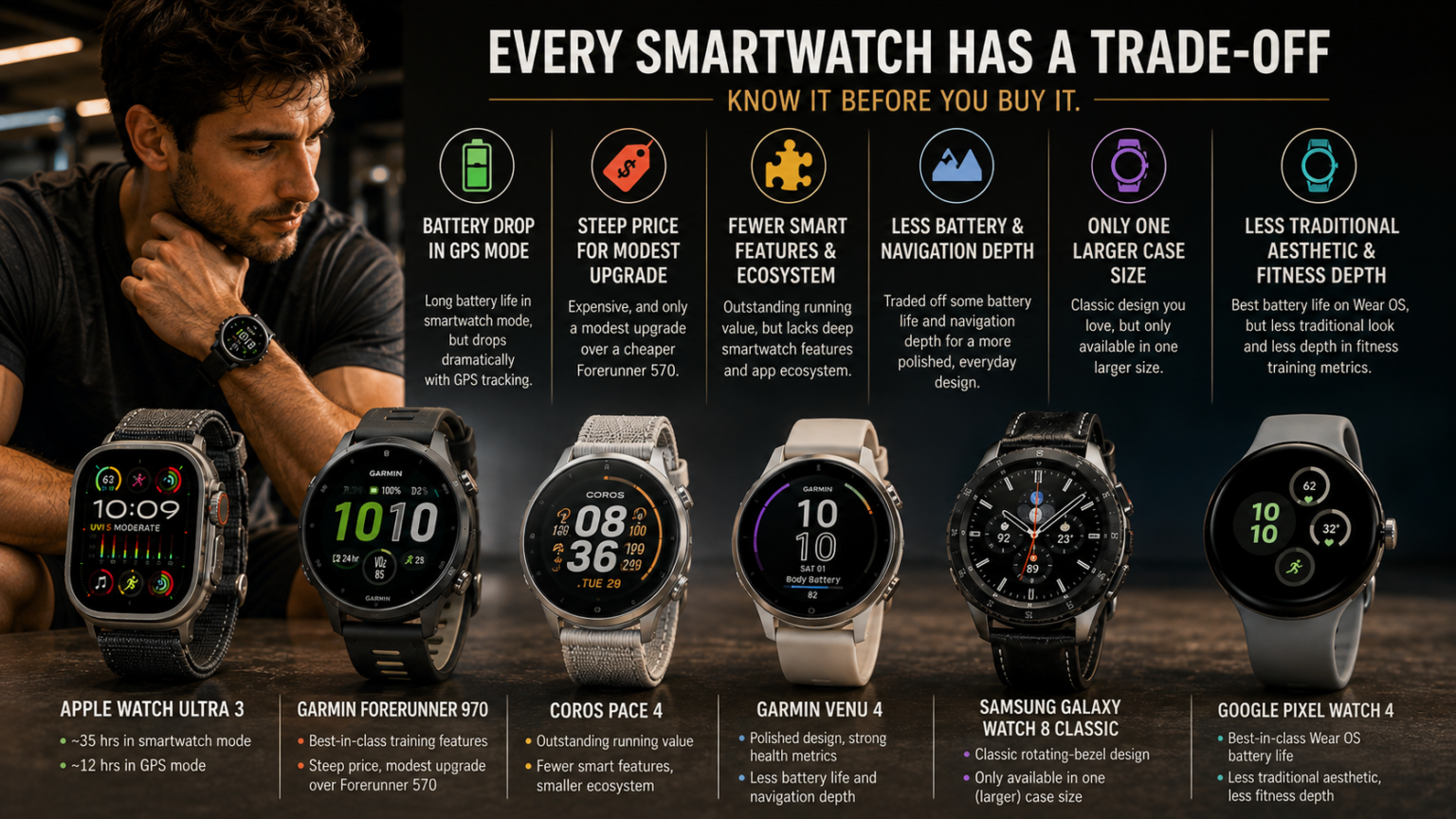
The Apple Watch Ultra 3’s roughly 35-hour battery life in normal smartwatch mode sounds genuinely competitive. The trade-off, easy to miss in headline marketing: that battery life drops to about 12 hours in GPS tracking mode — meaning the number that actually matters for a long run, hike, or endurance event is dramatically lower than the number most prominently advertised.
Is it still worth it? Yes, for most everyday fitness use and shorter workouts, where 12 hours of GPS tracking is plenty. It’s a real limitation specifically for ultra-endurance events or multi-day activities, where a dedicated sports watch like the Garmin Forerunner 970 (41–65 hours in GPS mode) will hold up meaningfully better.
Garmin Forerunner 970: The Trade-Off Is a Steep Price for a Modest Upgrade Over a Cheaper Model
At $749 (sometimes discounted to $649), the Garmin Forerunner 970 is positioned as Garmin’s A-list running watch, and its feature set is genuinely comprehensive. The trade-off, stated directly by reviewers: it’s expensive and not a huge leap over the more affordable Forerunner 570 for basic use — meaning a meaningful share of buyers may be paying a premium for mapping, battery life, and performance depth they won’t fully use.
Is it still worth it? Yes, specifically if you’ll actually use features like offline mapping, long battery life for multi-day events, and deep performance analytics. If your training is more casual, the Forerunner 570 (or the far cheaper COROS Pace 4) delivers most of the practical benefit at a fraction of the cost.
COROS Pace 4: The Trade-Off Is Fewer Smart Features and a Smaller Ecosystem
At $249, the COROS Pace 4 delivers outstanding running-specific value. The trade-off: it’s explicitly described as “not a do-it-all device” — it lacks some of the deeper smartwatch functionality, extensive third-party app support, and broader ecosystem integration that Apple, Samsung, and Google devices offer.
Is it still worth it? Yes, if running-specific accuracy and value are your priority over smartwatch breadth. If you want your watch to also handle notifications, apps, and a voice assistant as a genuine daily-use smartphone companion, a Wear OS or Apple Watch device will serve that additional need better.
Garmin Venu 4: The Trade-Off Is Reduced Battery Life and Navigation Depth Versus Dedicated Running Watches
The Garmin Venu 4 packs genuinely impressive performance capability — Training Readiness, Triathlon Mode — into a polished, lifestyle-focused design. The trade-off, noted directly in reviews: it trades off some battery life and navigation depth compared to a dedicated running watch like the Forerunner 970, and its breadcrumb navigation is limited compared to higher-end Garmin and COROS models.
Is it still worth it? Yes, for most users who value everyday wearability and approachable insights over race-day navigation precision — reviewers specifically note most people “likely won’t mind” this trade-off. It’s a real consideration specifically for backcountry or unmarked-trail runners who rely on detailed route navigation.
Samsung Galaxy Watch 8 Classic: The Trade-Off Is a Single Large Size With No Smaller Option
The Galaxy Watch 8 Classic’s rotating bezel and stainless steel case give it genuine traditional-watch appeal. The trade-off: Samsung only offers the Classic in a 46mm case size, unlike the standard Galaxy Watch 8 or the Pixel Watch 4, both of which offer multiple sizes — a real limitation for buyers with smaller wrists who specifically want the Classic’s premium design.
Is it still worth it? Yes, if the Classic’s specific rotating-bezel design is what draws you to it and a larger case size isn’t a dealbreaker. If wrist size is a real concern, the standard Galaxy Watch 8 or the Pixel Watch 4 (offered in 41mm and 45mm) provide more flexibility.
Google Pixel Watch 4: The Trade-Off Is a Less Traditional Watch Aesthetic and Weaker Fitness-Specific Depth
The Pixel Watch 4’s battery life (60+ hours in the 45mm model) genuinely leads the Wear OS smartwatch category. The trade-off: its domed, rounded design lacks the traditional watch styling (rotating bezel, stainless steel case) that draws some buyers to the Galaxy Watch 8 Classic, and its fitness-tracking depth still falls behind dedicated sports watches like the Forerunner or COROS lines.
Is it still worth it? Yes, if battery life and a more modern, minimalist smartwatch design are your priorities over traditional watch aesthetics or deep training metrics. Serious training-focused users may still prefer a dedicated sports watch alongside or instead of the Pixel Watch 4.
Trade-Off Quick Reference
| Smartwatch | The Appeal | The Trade-Off |
|---|---|---|
| Apple Watch Ultra 3 | ~35 hrs smartwatch battery life | Drops to ~12 hrs in GPS tracking mode |
| Garmin Forerunner 970 | Best-in-class training features | Steep price, modest gain over cheaper Forerunner 570 |
| COROS Pace 4 | Outstanding running-specific value | Fewer smart features, smaller app ecosystem |
| Garmin Venu 4 | Polished design, strong health metrics | Less battery life/navigation depth than dedicated running watches |
| Galaxy Watch 8 Classic | Traditional rotating-bezel design | Only available in one (larger) case size |
| Google Pixel Watch 4 | Best-in-class Wear OS battery life | Less traditional aesthetic, less fitness-specific depth |
FAQ’s
Is the Apple Watch Ultra 3’s battery life actually a problem for most people?
For everyday workouts and shorter runs, no — 12 hours of GPS tracking covers the vast majority of typical exercise sessions. It only becomes a real limitation for genuinely long endurance events like ultramarathons or multi-day hikes.
Is it worth paying $500 more for the Garmin Forerunner 970 over the COROS Pace 4?
It depends on whether you’ll use the extra features — offline mapping, longer battery life, deeper performance analytics — that justify the price gap. For runners who stick to standard routes and don’t need every advanced metric, the Pace 4 delivers most of the practical value at a much lower cost.
Should I avoid the Galaxy Watch 8 Classic if I have a small wrist?
Not necessarily avoid it, but try it on first — the single 46mm case size can look and feel large on smaller wrists, so it’s worth checking fit in person or considering the standard Galaxy Watch 8 or Pixel Watch 4 for more size flexibility.
Does the Pixel Watch 4’s longer battery life come at the cost of fitness tracking accuracy?
Not accuracy specifically, but depth — it still falls behind dedicated sports watches on advanced training metrics like VO2 max trends or detailed running dynamics, even though its core heart rate and activity tracking are solid.
Conclusion
None of these trade-offs make the smartwatches on this list bad purchases — the Apple Watch Ultra 3, Garmin Forerunner 970, COROS Pace 4, Garmin Venu 4, Samsung Galaxy Watch 8 Classic, and Google Pixel Watch 4 are all genuinely well-regarded devices. The difference between a satisfying purchase and a frustrating one usually comes down to understanding the specific trade-off behind each watch’s headline strength before buying, not discovering it mid-workout or mid-training block.
Pricing, specifications, and availability for smartwatches change frequently and may have been updated since this article was published. Always verify current pricing and specs directly on the manufacturer’s or retailer’s official website before purchasing. This article is for informational purposes and does not constitute medical advice; consult a healthcare provider for health-related concerns.