

Affiliates don’t buy software because it says “AI-powered” on the landing page — they buy it because something specific is costing them time, rankings, or money. Most affiliate tool roundups skip straight to feature comparisons without asking the more useful question first:
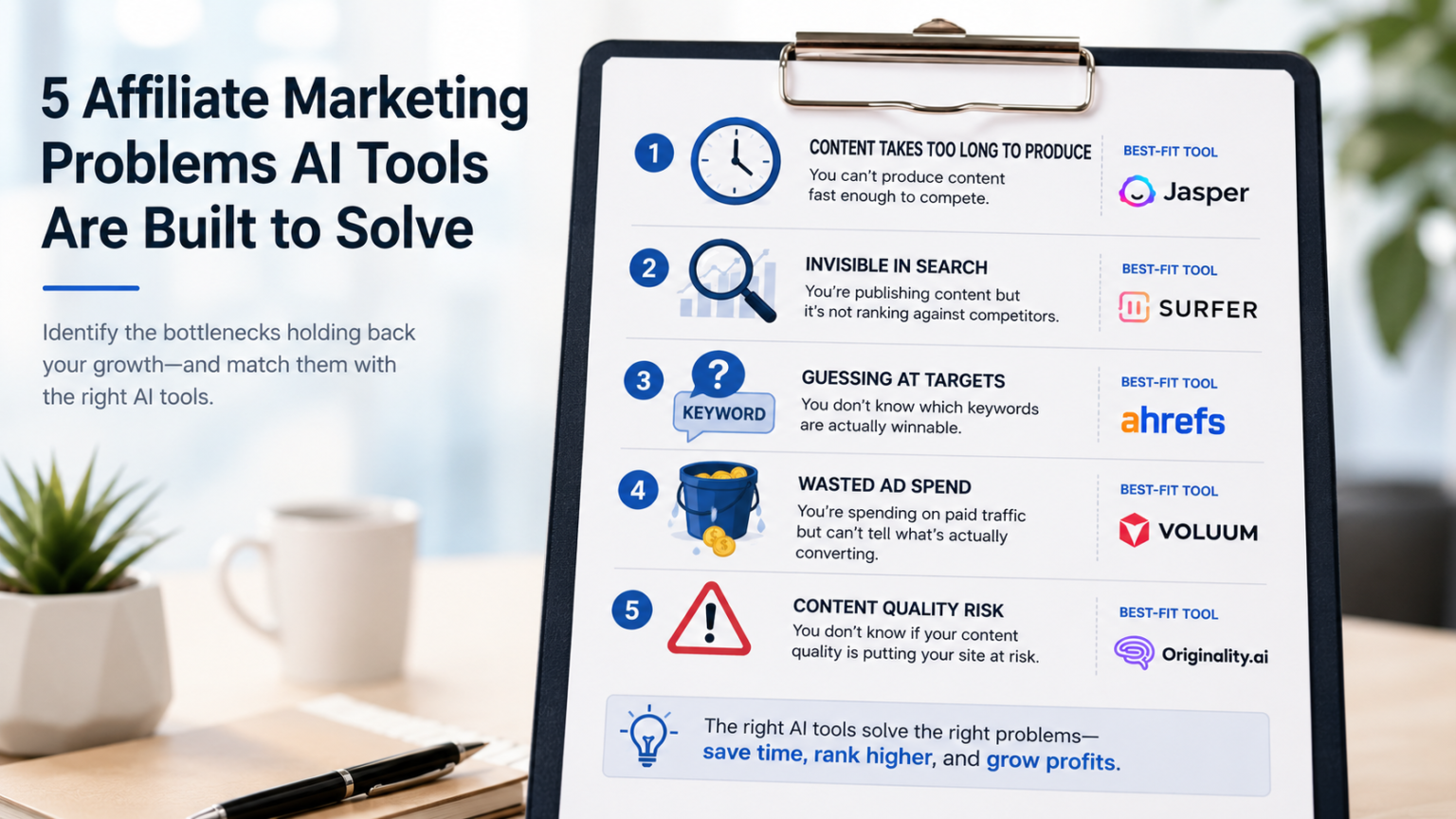
- Problem 1: “I can’t produce content fast enough to compete”
- Problem 2: “I’m publishing content but it’s not ranking against competitors”
- Problem 3: “I’m guessing at which keywords are actually winnable”
- Problem 4: “I’m spending on paid traffic but can’t tell what’s actually converting”
- Problem 5: “I don’t know if my content quality is putting my site at risk”
- Matching Problems to Tools: Quick Reference
- A Word on Solving Problems in the Right Order
- FAQ’s
- Conclusion
what’s actually broken in your operation right now?
Here are five common affiliate marketing problems in 2026, and the specific AI tools built to solve each one — along with where each tool stops being the right answer.
Problem 1: “I can’t produce content fast enough to compete”
If the bottleneck is raw output — product reviews, comparison posts, buying guides — the fix is an AI writing tool with a trained voice and built-in persuasion structure, not a general-purpose chatbot you’re prompting from scratch for every article.
The right tool: Jasper. Its Brand Voice feature keeps tone consistent once you’re producing content at real volume, and its built-in AIDA and PAS copy frameworks are specifically useful for affiliate hooks and urgency-driven calls to action — something a general AI assistant won’t apply automatically.
Where it falls short: Jasper produces drafts, not finished, fact-checked reviews. Prices, specs, and claims about the products you’re covering still need independent verification before publishing — this is true across every AI writing tool, not a Jasper-specific gap.
Problem 2: “I’m publishing content but it’s not ranking against competitors”
This is a different problem than raw output speed. If you’re already publishing consistently and still losing to established review sites, the issue is competitiveness, not volume.
The right tool: Surfer SEO. Its Content Editor scores your draft in real time against pages currently ranking for your target keyword, flagging missing subtopics and structural gaps that are hard to spot by manually studying SERPs.
Where it falls short: Surfer optimizes content you’ve already decided to write — it doesn’t tell you which keywords are actually worth targeting in the first place. That’s a research problem, not an optimization problem.
Problem 3: “I’m guessing at which keywords are actually winnable”
Publishing content for keywords with unrealistic competition wastes both writing time and Surfer SEO credits. Before drafting anything, affiliates need real data on search volume, difficulty, and what’s already ranking.
The right tool: Ahrefs, specifically its Keyword Explorer and Content Explorer features. Keyword Explorer gives search volume, difficulty, and intent data; Content Explorer surfaces what’s already performing well for a topic and where competitors have content or link gaps you could fill instead.
Where it falls short: Content Explorer — arguably the most affiliate-relevant feature — doesn’t unlock until Ahrefs’ Standard tier (roughly $249/month). Affiliates on the entry Starter or Lite plans are doing keyword research without one of the tool’s most useful capabilities for finding realistic opportunities.
Problem 4: “I’m spending on paid traffic but can’t tell what’s actually converting”
Once affiliates move beyond organic traffic into paid campaigns, manually comparing performance across offers, landing pages, and traffic sources in spreadsheets stops being realistic — and by the time you notice a problem manually, you’ve likely already wasted meaningful ad spend.
The right tool: Voluum. Its AI-powered traffic distribution automatically routes clicks toward better-performing offers and landing pages in real time, and its anti-fraud detection filters out bot traffic before it skews your conversion data — both catching problems faster than manual review would.
Where it falls short: Voluum’s value is directly tied to spend volume. Below roughly $3,000/month in ad spend, the platform’s own positioning suggests the optimization gains don’t clearly outweigh the subscription cost — a smaller affiliate is often better served by a cheaper tracker until spend increases.
Problem 5: “I don’t know if my content quality is putting my site at risk”
Once more than one person — a freelancer, a VA, or heavy reliance on AI drafting — is contributing to an affiliate site, it becomes genuinely hard to know what’s actually live, whether any of it reads as low-effort AI output, or whether something got accidentally duplicated from another source.
The right tool: Originality.ai. It combines AI-content detection with plagiarism checking in a single scan, giving site owners a screening layer before content goes live, particularly useful for teams where multiple contributors or tools touch the same content pipeline.
Where it falls short: No AI-detection tool in the industry is infallible — false positives and false negatives both happen. Treat a flagged score as a prompt to review the content more closely, not as automatic proof it needs to be rewritten or that it’s safe to publish.
Matching Problems to Tools: Quick Reference
| Your Problem | Best-Fit Tool | Not the Right Fit |
|---|---|---|
| Content production is too slow | Jasper | Ahrefs, Voluum |
| Content isn’t ranking against competitors | Surfer SEO | Jasper alone |
| Guessing at winnable keywords | Ahrefs (Standard tier+) | Surfer SEO alone |
| Wasted or unclear paid traffic spend | Voluum | Free platform-native dashboards below ~$3K/mo spend |
| Content quality/risk with multiple contributors | Originality.ai | Skipping review entirely on solo sites |
A Word on Solving Problems in the Right Order
It’s tempting to tackle all five problems by buying all five tools in a single week. Resist that. Content speed (Problem 1) and keyword targeting (Problem 3) usually need to be solved before optimization (Problem 2) even matters — there’s nothing to optimize if you’re not publishing, and nothing worth optimizing if you’re targeting the wrong keywords. Paid traffic tracking (Problem 4) only becomes relevant once you’re actually running paid campaigns. Solve problems in the order your operation is actually experiencing them, not in the order a tool roundup lists them.
FAQ’s
What if I have more than one of these problems at the same time?
Start with whichever problem is most directly costing you revenue right now. A content-speed problem (Problem 1) usually has a faster, more measurable payoff than a ranking problem (Problem 2), which can take months to show results even with the right tool.
Can one tool solve more than one of these problems?
Rarely well. Semrush touches both keyword research and AI-search visibility, and some platforms bundle content generation with basic optimization scoring, but in most cases a tool built specifically for one problem will outperform a tool that’s adequate at several.
How do I know if a tool actually fixed the problem, or just added a feature I’m not using?
Set a measurable target before buying — publishing frequency, ranking position, conversion rate, or flagged-content rate — and check it against a baseline 60–90 days later. If the number hasn’t moved, the tool likely isn’t solving the problem it was bought for.
Should I solve the cheapest problem first to build momentum?
Not necessarily — prioritize by revenue impact and how fast you can measure results. Content-speed and paid-traffic tracking problems tend to show measurable results faster than ranking or content-quality problems, which can take longer to reflect in the data.
Conclusion
The fastest way to overspend on affiliate marketing tools is buying them in the order they appear on a “best of” list instead of the order your actual problems are costing you money and rankings. Match the tool to the specific bottleneck — content speed, ranking competitiveness, keyword targeting, paid traffic waste, or content quality risk — and one well-matched tool will do more for your operation than five tools chosen because they were popular.
Pricing, features, and plan names for software products change frequently and may have been updated since this article was published. Always verify current pricing and feature availability directly on each provider’s official website before making a purchasing decision. This article is for informational purposes and does not constitute professional business or financial advice.