

Ask ten affiliates what makes a good AI tool stack, and a lot of the answers trace back to assumptions nobody’s actually tested — more research tools are always better, higher price means more reliable data, AI-detection scores are definitive. Some of this advice made sense a couple of years ago. In 2026’s market, several of these assumptions are now quietly steering affiliates toward overspending or under-protecting their content.
- Myth 1: “You need both Ahrefs and Semrush for serious research”
- Myth 2: “A higher-priced content tool always produces more reliable output”
- Myth 3: “Credit-based research plans are cheaper than unlimited plans”
- Myth 4: “AI content detection scores are a reliable pass/fail test”
- Myth 5: “Paid traffic tracking tools pay for themselves at any spend level”
- Myth vs. Reality: Quick Reference
- FAQ’s
- Conclusion
Here are five of the most common myths circulating in affiliate marketing tool advice, what the evidence actually shows, and what to do instead.
Myth 1: “You need both Ahrefs and Semrush for serious research”
The assumption: Since Ahrefs and Semrush are both considered top-tier SEO platforms, running both gives you more complete data and a competitive edge over affiliates using just one.
The reality: The two tools overlap substantially on core keyword research and competitive analysis — search volume, difficulty, keyword gap analysis, and backlink data are available on both. The meaningful difference in 2026 is less about data completeness and more about a specific bundled feature: Semrush folded AI Visibility Analytics (tracking mentions across ChatGPT, Google AI Overviews, and Perplexity) directly into its core plans, while Ahrefs’ strength remains its backlink data depth and near real-time refresh speed.
What to do instead: Pick one based on which specific gap matters more to your strategy — Ahrefs if backlink and content-gap research (via Content Explorer) is central to your approach, Semrush if AI-search visibility tracking is a priority. Running both at full price is rarely worth the overlap cost for most individual affiliates.
Myth 2: “A higher-priced content tool always produces more reliable output”
The assumption: Jasper costs more than many general AI writing tools, so its output must be more factually reliable, not just better-branded or better-structured.
The reality: Price reflects consistency, structure, and brand-voice training — not factual accuracy. Every AI writing tool, including premium ones, remains unreliable specifically on the details that carry the most risk in affiliate content: prices, product specifications, and claims attributed to a product or company. This is a known characteristic of how large language models generate text, and no amount of subscription price changes that.
What to do instead: Treat AI writing tools as a speed and consistency multiplier, not a fact-checking layer. Every price, spec, or claim in AI-drafted affiliate content needs independent verification against the actual product or source before publishing — regardless of which tool produced the draft.
Myth 3: “Credit-based research plans are cheaper than unlimited plans”
The assumption: Ahrefs’ $29/month Starter or $129/month Lite plan looks like the obviously cheaper choice compared to the $249/month Standard tier, so budget-conscious affiliates should start there and stay there.
The reality: Credit-based entry plans can end up costing more per useful insight than they appear to, in two ways. First, every report opened — Site Explorer, Keywords Explorer, Content Explorer — consumes a credit, and active research burns through monthly allotments faster than casual use suggests. Second, Content Explorer, one of the most affiliate-relevant features for finding content and link gaps, doesn’t unlock until Standard tier — meaning Lite users are paying for keyword research without one of the tool’s most useful discovery features.
What to do instead: Estimate your actual research volume (how many keyword and competitor lookups per week) before choosing between Starter/Lite and Standard. If Content Explorer would meaningfully change your content strategy, the jump to Standard is often worth more than the sticker-price gap suggests.
Myth 4: “AI content detection scores are a reliable pass/fail test”
The assumption: Running a draft through Originality.ai and getting a low AI-detection score means the content is safe to publish; a high score means it needs to be rewritten.
The reality: AI-detection tools across the entire industry — including well-regarded ones with independent accuracy rankings — aren’t infallible. False positives (human-written content flagged as AI) and false negatives (AI content that passes undetected) both happen. Treating the score as a binary pass/fail test, rather than a signal prompting closer review, risks both over-editing genuinely good human content and under-scrutinizing content that actually needs a closer look.
What to do instead: Use detection scores to prioritize which pieces get a closer human review, not as an automatic publish/reject gate. The score is a triage tool, not a verdict.
Myth 5: “Paid traffic tracking tools pay for themselves at any spend level”
The assumption: Since Voluum’s AI traffic distribution and anti-fraud detection clearly improve ROAS, it’s worth subscribing as soon as you start running any paid traffic, however small the budget.
The reality: Voluum’s own positioning is direct about this: the tool’s optimization gains and fraud-detection savings generally don’t outweigh its roughly $149+/month subscription cost until you’re spending somewhere around $3,000+/month on traffic. Below that threshold, the platform’s AI traffic routing and multi-step funnel tracking don’t have enough data volume to meaningfully outperform manual monitoring or a cheaper tracker.
What to do instead: Match the tracker to your actual spend level. Below roughly $3,000/month, a lower-cost tracker covers the core tracking need; upgrade to a platform like Voluum once your spend volume is high enough that the AI optimization has enough data to act on.
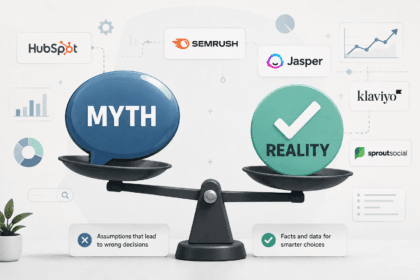
Myth vs. Reality: Quick Reference
| Myth | Reality |
|---|---|
| You need both Ahrefs and Semrush | Pick one based on your priority: backlinks/content gaps (Ahrefs) or AI visibility (Semrush) |
| Higher-priced content tools are more factually reliable | Price reflects consistency and branding, not fact accuracy — verify claims regardless of tool |
| Credit-based entry plans are always cheaper | Credit limits and locked features (like Content Explorer) can make entry tiers cost more per insight |
| AI-detection scores are pass/fail | Scores are a triage signal, not a definitive verdict — both false positives and negatives occur |
| Traffic trackers pay off at any spend level | Generally worth it above ~$3,000/month in ad spend; not before |
FAQ’s
If Ahrefs and Semrush overlap, is there ever a reason to use both?
Occasionally, for agencies managing multiple client accounts with different priorities — one client needing backlink-heavy analysis, another needing AI-visibility tracking. For a single affiliate operation, one tool is usually sufficient.
How much should I budget for fact-checking AI-generated affiliate content?
Plan for a dedicated human review pass on every piece before publishing, specifically for prices, specs, and product claims — this is an ongoing editorial cost, not a one-time setup step, regardless of which AI writing tool produced the draft.
Is it too late to upgrade to Ahrefs Standard if I’ve been on Lite for months?
No — the value of Content Explorer and deeper credit limits applies immediately once you upgrade. There’s no lost benefit from having started on a lower tier, aside from the research opportunities you may have missed along the way.
What should I do if Originality.ai flags a piece I know I wrote myself?
Treat it as expected tool behavior rather than a personal accusation — false positives happen across all AI-detection tools. Review the flagged sections for anything unusually formulaic, but don’t assume the score itself proves anything definitively.
Conclusion
None of these five myths are unreasonable on their face — they’re mostly advice that made sense at an earlier stage of the market and hasn’t been updated as tools and pricing structures shifted. The pattern across all five: the right decision comes down to your specific volume, spend, and strategy priorities, not a general rule about which tool is “better.” Test each assumption against your own numbers before you buy, not after the invoice arrives.
Pricing, features, and plan names for software products change frequently and may have been updated since this article was published. Always verify current pricing and feature availability directly on each provider’s official website before making a purchasing decision. This article is for informational purposes and does not constitute professional business or financial advice.