

Ask ten women what makes a “good” summer dress, and a lot of the answers trace back to assumptions nobody’s actually tested — a bold print is risky, an expensive designer piece is always worth it, one dress can cover every occasion. Some of this advice made more sense a few seasons ago. In 2026, several of these assumptions are quietly steering women toward overspending, or toward a dress that doesn’t actually solve the problem they bought it for.
- Myth 1: “A bold printed dress is risky, so a solid color is always the safer choice”
- Myth 2: “Spending more on a designer dress always guarantees better value”
- Myth 3: “One really versatile dress can realistically cover every summer occasion”
- Myth 4: “If a dress looks slightly wrinkled or textured in a store, something’s wrong with it”
- Myth 5: “A dress that photographs beautifully on an influencer will work the same way for me”
- Myth vs. Reality: Quick Reference
- FAQ’s
- Conclusion
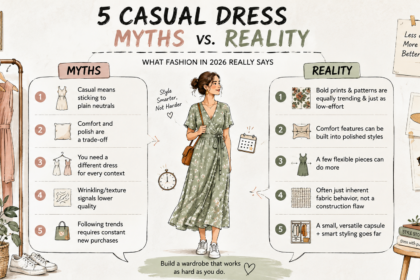
Here are five of the most common summer dress myths, what current fashion coverage actually shows, and what to do instead.
Myth 1: “A bold printed dress is risky, so a solid color is always the safer choice”
The assumption: Bold florals, abstract patterns, or graphic prints are a statement that might not age well or could feel like a passing trend, making a solid, neutral dress the lower-risk purchase.
The reality: Bold prints are having a genuinely major moment this season, specifically because a strong printed midi dress makes an entire outfit on its own without requiring additional styling effort — pairing well with something as simple as white sneakers. The real risk isn’t the print itself; it’s over-wearing a highly recognizable print to overlapping social circles, which is a wardrobe-repetition consideration, not a fashion-risk one.
What to do instead: Choose a bold print with confidence if it genuinely suits the occasions you have coming up, and reserve concerns about “risk” specifically for how often you’ll wear it to the same people, not whether prints themselves are a safe category.
Myth 2: “Spending more on a designer dress always guarantees better value”
The assumption: A dress from a recognized designer label is inherently a smarter purchase than a more affordable alternative, since higher price should reflect proportionally higher quality and longevity.
The reality: This season’s coverage specifically highlights affordable options — including budget-friendly retailers with linen maxi and wrap silhouette pieces starting under $30–$40 — as a legitimate way to try multiple trending styles without overspending, precisely because trying several trends at accessible prices lets you learn what actually works for your body and lifestyle before committing to a pricier version of a style you’re unsure about.
What to do instead: Reserve higher spending for pieces you’re already confident you’ll wear repeatedly and across multiple occasions (a versatile slip dress, a well-fitting shirt dress), and use more affordable options to test newer or bolder trends you haven’t tried before.
Myth 3: “One really versatile dress can realistically cover every summer occasion”
The assumption: If you find a genuinely flexible dress — one that layers, transitions from day to night, or works dressed up and down — it’s reasonable to rely on that single piece for the whole season’s range of events.
The reality: Even the most versatile pieces this season, like the slip dress and linen shirt dress, have real limits. The slip dress works alone in heat and layered when cooler, and the linen shirt dress moves between beach and city — but neither is built for, say, a beaded-mini-appropriate night out or a floor-length backless-maxi evening event. Versatility within a lane isn’t the same as covering every lane.
What to do instead: Identify the two or three genuinely distinct occasion types you expect this summer (casual daytime, one dressier event, one going-out night) and choose a versatile piece for each lane rather than expecting a single dress to flex across all of them.
Myth 4: “If a dress looks slightly wrinkled or textured in a store, something’s wrong with it”
The assumption: A dress that isn’t perfectly smooth and crisp on the hanger or in a fitting room reflects a lower-quality garment or a flaw specific to that piece.
The reality: Fabric behavior is often simply inherent to the material, not a defect. Linen wrinkles visibly and easily as a basic characteristic of the fiber, and shirred dresses are gathered and textured by design — neither is a sign of poor construction. Judging these fabrics against a “crisp is better” standard misunderstands what they’re actually built to do.
What to do instead: Judge linen and shirred dresses by their intended texture and drape rather than expecting them to look like a structured cotton poplin. If a genuinely crisp, unwrinkled look matters most to you, choose a fabric blend suited to that goal rather than assuming any wrinkling means a flaw.
Myth 5: “A dress that photographs beautifully on an influencer will work the same way for me”
The assumption: Seeing a specific dress styled well in a social media post or editorial photo is a reliable indicator of how it will look and feel in your own everyday context.
The reality: Several of this season’s trending styles — the slip dress, the shirred dress, the tiered maxi — specifically depend on fit, fabric drape, and sometimes an underlayer choice that doesn’t come through in a single styled photo. A slip dress’s fit precision, a shirred dress’s shape unpredictability across different bodies, or a backless dress’s undergarment requirements are all practical realities that a beautifully lit editorial shot doesn’t capture.
What to do instead: Treat trend photos as style inspiration rather than a literal preview of fit and function on your own body. Check size guides, reviews, and fabric details specifically, rather than assuming a photographed result will translate directly.
Myth vs. Reality: Quick Reference
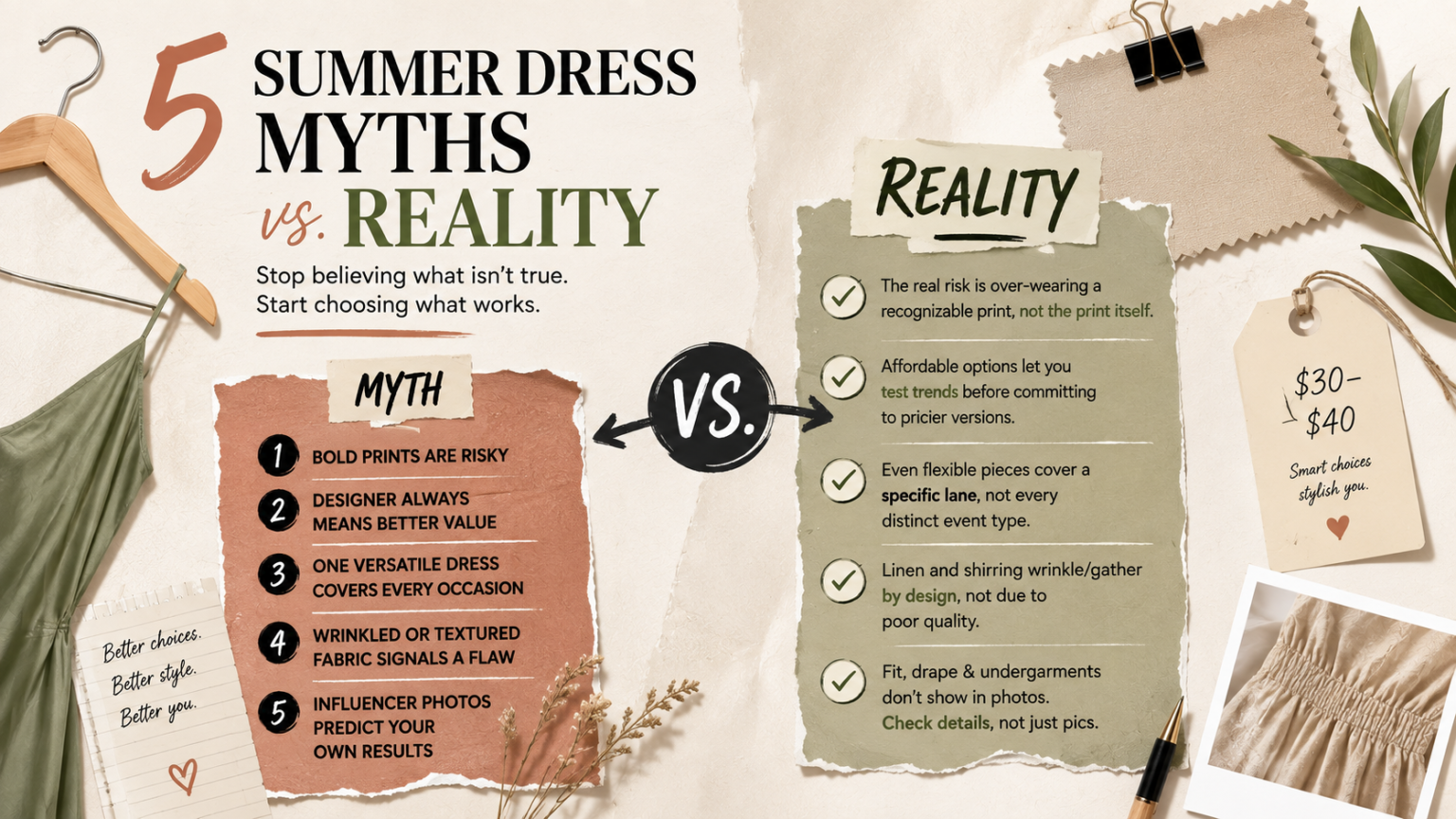
| Myth | Reality |
|---|---|
| Bold prints are the riskier choice | The real risk is over-wearing a recognizable print, not the print itself |
| Designer always means better value | Affordable options let you test trends before committing to pricier versions |
| One versatile dress covers every occasion | Even flexible pieces cover a specific lane, not every distinct event type |
| Wrinkled/textured fabric signals a flaw | Linen and shirring wrinkle/gather by design, not due to poor quality |
| Influencer photos predict your own results | Fit, drape, and undergarment needs don’t show up in a single styled photo |
FAQ’s
Is it ever worth paying more for a bold print I’m unsure about?
Generally not for a first try — testing a bold print at a more affordable price point lets you confirm it genuinely suits you and your occasions before investing in a pricier version from a specific label.
How many “occasion lanes” should I realistically plan for in a summer wardrobe?
Most women’s summer calendars break down into a small number of distinct categories — casual daytime, one or two dressier events, and possibly a night-out setting — planning one versatile piece per lane, rather than one dress for everything, tends to cover the season more reliably.
Should I avoid linen entirely if I don’t like the wrinkled look?
Not necessarily — a cotton-linen blend wrinkles less than pure linen while keeping much of the breathability, which is a reasonable middle ground if a crisper appearance matters to you.
How can I tell if a trending dress will actually fit and drape well on me before ordering?
Check the retailer’s specific size guide and any customer reviews or photos (rather than relying solely on the brand’s own styled imagery), since fit and drape can vary meaningfully by body shape in styles like slip and shirred dresses.
Conclusion
None of these five myths are unreasonable on their face — they’re mostly intuitive-sounding fashion beliefs that don’t hold up once tested against how 2026’s dress trends actually work in practice. The pattern across all five: bold choices, accessible price points, occasion-specific planning, and checking real fit details consistently serve women better than the more cautious, assumption-driven defaults. Test these assumptions against your own summer calendar and body before defaulting to what seems obviously “safe.”
Fashion trends, product availability, and pricing change frequently and may have been updated since this article was published. Always check current pricing, sizing, fabric care instructions, and availability directly with the retailer before purchasing. This article reflects general style guidance and is not personalized styling advice.