

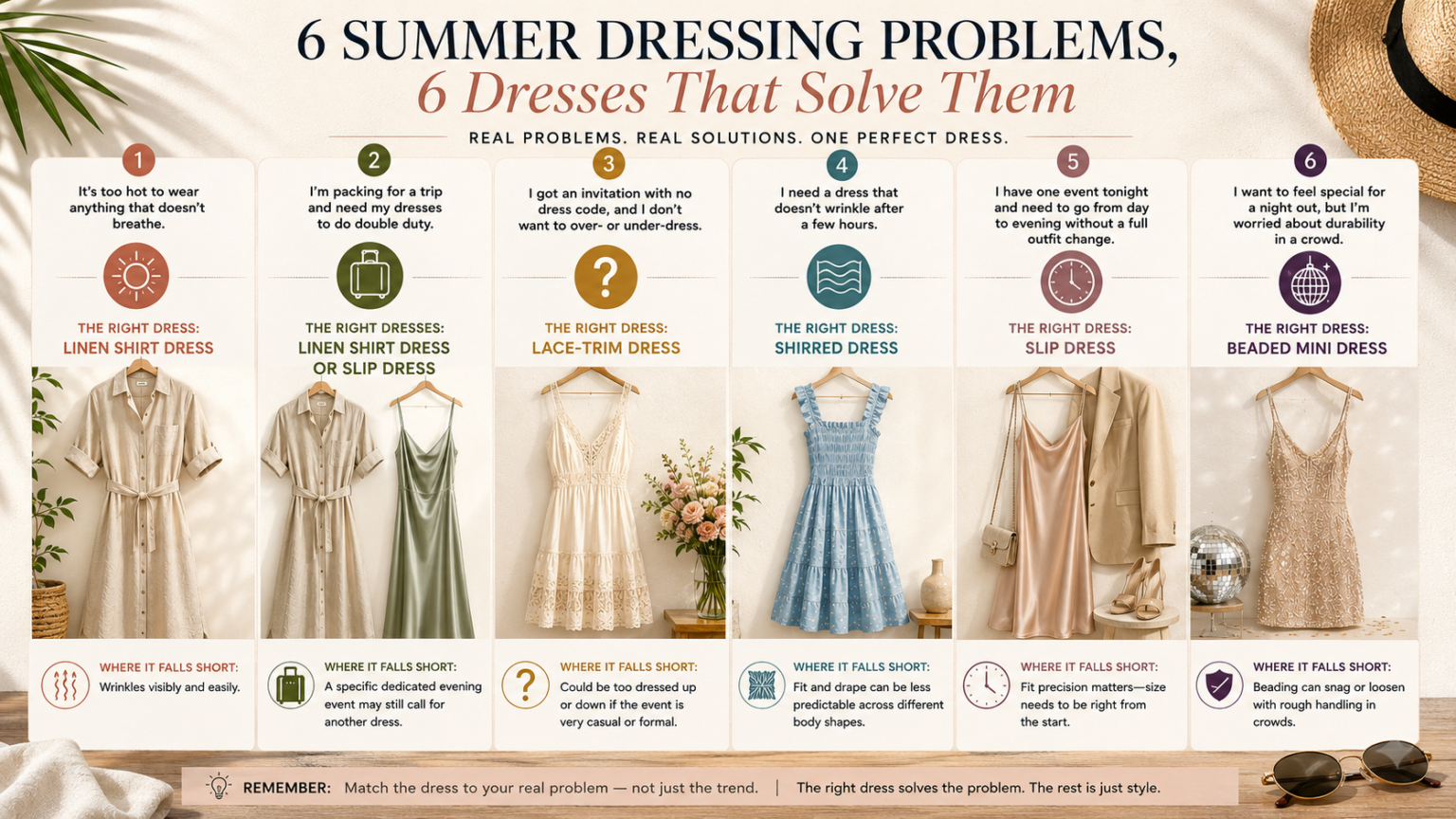
Most women don’t buy a new summer dress because they saw it trending — they buy it because something specific about summer dressing has become a genuine hassle. It’s too hot to think about layering. The suitcase is already too full. There’s a wedding invitation with no dress code listed. Most dress roundups skip straight to trend photos without asking the more useful question first:
- Problem 1: “It’s too hot to wear anything that doesn’t breathe”
- Problem 2: “I’m packing for a trip and need my dresses to do double duty”
- Problem 3: “I got an invitation with no dress code, and I don’t want to over- or under-dress”
- Problem 4: “I need a dress that doesn’t wrinkle after a few hours”
- Problem 5: “I have one event tonight and need to go from day to evening without a full outfit change”
- Problem 6: “I want to feel special for a night out, but I’m worried about durability in a crowd”
- Matching Problems to Dresses: Quick Reference
- A Word on Solving More Than One Problem With a Single Dress
- FAQ’s
- Conclusion
what’s actually the problem you’re trying to solve?
Here are six common summer dressing problems in 2026, and the specific dress styles built to solve each one.
Problem 1: “It’s too hot to wear anything that doesn’t breathe”
If you’re avoiding anything with structure or layers because the heat makes it genuinely uncomfortable, the fix is a dress built around breathability first, not a style chosen for its look alone.
The right dress: The linen shirt dress. Linen is specifically favored this season for its breathability, making it a genuinely practical choice in hot, humid conditions compared to synthetic fabrics that tend to cling and trap heat.
Where it falls short: Linen wrinkles visibly and easily — a trade-off worth accepting for the comfort payoff, but not one that disappears with a “wrinkle-free” claim on the label. Expect a relaxed, slightly rumpled look by midday as simply how the fabric behaves.
Problem 2: “I’m packing for a trip and need my dresses to do double duty”
If your suitcase can’t accommodate a separate outfit for every activity, the fix is a dress designed specifically to transition between contexts without a full outfit change.
The right dress: The linen shirt dress, again, specifically because it can function as a swim cover-up during the day and a standalone dinner outfit once buttoned up properly — genuinely reducing how many separate pieces a trip requires. The slip dress is the second-strongest packing pick, since it works alone in heat and layered under a tee once temperatures cool, covering two distinct use cases in one garment.
Where it falls short: Neither piece solves every packing scenario — a specific evening event may still call for a dedicated piece like the beaded mini or backless maxi, which don’t double as casual daytime options.
Problem 3: “I got an invitation with no dress code, and I don’t want to over- or under-dress”
Dress code ambiguity is a genuinely common summer problem, particularly for daytime or garden-style events where the range of “appropriate” is wide.
The right dress: The lace-trim dress. Its delicate detailing reads as appropriately dressed-up for most daytime and garden event settings without tipping into either overly casual or overly formal territory, making it a safer middle-ground choice when the dress code is genuinely unclear.
Where it falls short: For an event that turns out to be either much more casual (a backyard barbecue) or much more formal (black-tie) than expected, even a safe middle-ground choice can miss the mark — when possible, it’s worth asking the host directly rather than relying entirely on a dress choice to hedge the uncertainty.
Problem 4: “I need a dress that doesn’t wrinkle after a few hours”
If a crisp, unwrinkled appearance matters more to you than the coziest, most breathable fabric option, the fix is choosing a dress specifically for its resistance to wrinkling, not just its look in a single photo.
The right dress: The shirred dress. Its gathered, elasticized construction is inherently less prone to visible wrinkling than a flat linen or cotton fabric, since the texture itself already incorporates gathers and folds by design rather than developing them unpredictably through wear.
Where it falls short: Shirred dresses can fit and drape somewhat unpredictably across different body shapes compared to a flat-fabric style, so it’s worth checking reviews or a size guide closely rather than assuming the fit shown in a product photo will look identical on you.
Problem 5: “I have one event tonight and need to go from day to evening without a full outfit change”
If your schedule runs straight from daytime obligations into an evening event with no time to go home and change, the fix is a dress genuinely capable of transitioning in place, with minimal adjustment.
The right dress: The slip dress, worn under a simple layer (a blazer, a light cardigan, or a tee) during the day, then removed or swapped for evening. Its bias-cut, minimal-structure design reads as casual when layered and elegant when worn alone, making the day-to-evening transition genuinely achievable without a full change.
Where it falls short: The slip dress’s fit precision matters more than with a structured dress — sizing needs to be right from the start, since there’s little room to adjust or compensate with layering the way a looser silhouette might allow.
Problem 6: “I want to feel special for a night out, but I’m worried about durability in a crowd”
A big night out calls for a dress with impact, but crowded venues, tight seating, and dance floors all pose real risks to delicate fabric and embellishment.
The right dress: The beaded mini, chosen specifically for its shorter length and easier movement compared to a floor-length embellished gown, reduces some of the practical risk while still delivering the sparkle and celebratory feel the occasion calls for.
Where it falls short: Beading is still inherently more delicate than plain fabric and can snag or loosen with rough handling — for an event you know will involve close, crowded conditions or a lot of physical activity, a sturdier fabric choice (even without beading) may hold up better over the course of the night.
Matching Problems to Dresses: Quick Reference
| Your Problem | Best-Fit Dress | Not the Right Fit For |
|---|---|---|
| Too hot for structured clothing | Linen shirt dress | Anyone prioritizing a crisp, wrinkle-free look |
| Packing light for a trip | Linen shirt dress or slip dress | A specific dedicated evening event |
| Unclear dress code | Lace-trim dress | Confirmed very casual or very formal events |
| Wants to avoid visible wrinkling | Shirred dress | Anyone needing a very predictable, uniform fit |
| Day-to-evening transition, no time to change | Slip dress (layered, then worn alone) | Anyone unsure of their size (fit precision matters) |
| Night out, worried about durability | Beaded mini (shorter length) | Very crowded, high-contact events |
A Word on Solving More Than One Problem With a Single Dress
It’s tempting to look for one dress that checks every box — breathable, wrinkle-resistant, packable, dressy enough for an unclear invitation, and durable enough for a crowded party. In practice, the dresses above are strong specifically because they’re built around a particular priority. Trying to find a single piece that does all six well usually means settling for a dress that’s merely adequate at each, rather than genuinely excellent at the one thing you actually need most from it right now.
FAQ’s
What if I have more than one of these problems on the same trip or day?
Prioritize the most pressing constraint. If packing space is genuinely limited, that usually outweighs a secondary concern like wrinkle resistance — choose the most space-efficient, multi-use piece first and treat the rest as secondary considerations.
Is there a single dress that works for both hot weather and a formal event?
Rarely well — hot-weather comfort and formal polish tend to pull in different directions (breathable, relaxed fabrics versus structured, elevated ones). It’s usually better to have one dress for each need rather than compromising on both.
How do I know if a dress is genuinely wrinkle-resistant or just marketed that way?
Check the fabric composition specifically — a cotton-linen blend or a fabric with some synthetic content will generally wrinkle less than pure linen, regardless of marketing language, so read the material details rather than relying on descriptive claims alone.
Should I buy a dress specifically for one uncertain-dress-code event, or wear something I already own?
If you don’t already own a reasonably dressed-up, adaptable piece like a lace-trim or similar dress, it may be worth the investment since dress-code uncertainty is a recurring summer problem, not a one-time issue.
Conclusion
The fastest way to end up frustrated with a summer dress purchase is choosing based on trend appeal alone, rather than the specific problem you’re actually trying to solve. Match the dress to what’s genuinely bothering you — heat, packing constraints, dress-code uncertainty, wrinkling, day-to-evening transitions, or durability concerns for a big night out — and you’ll get more real value from the purchase than picking whatever’s most photographed on social media this season.
Fashion trends, product availability, and pricing change frequently and may have been updated since this article was published. Always check current pricing, sizing, fabric care instructions, and availability directly with the retailer before purchasing. This article reflects general style guidance and is not personalized styling advice.